
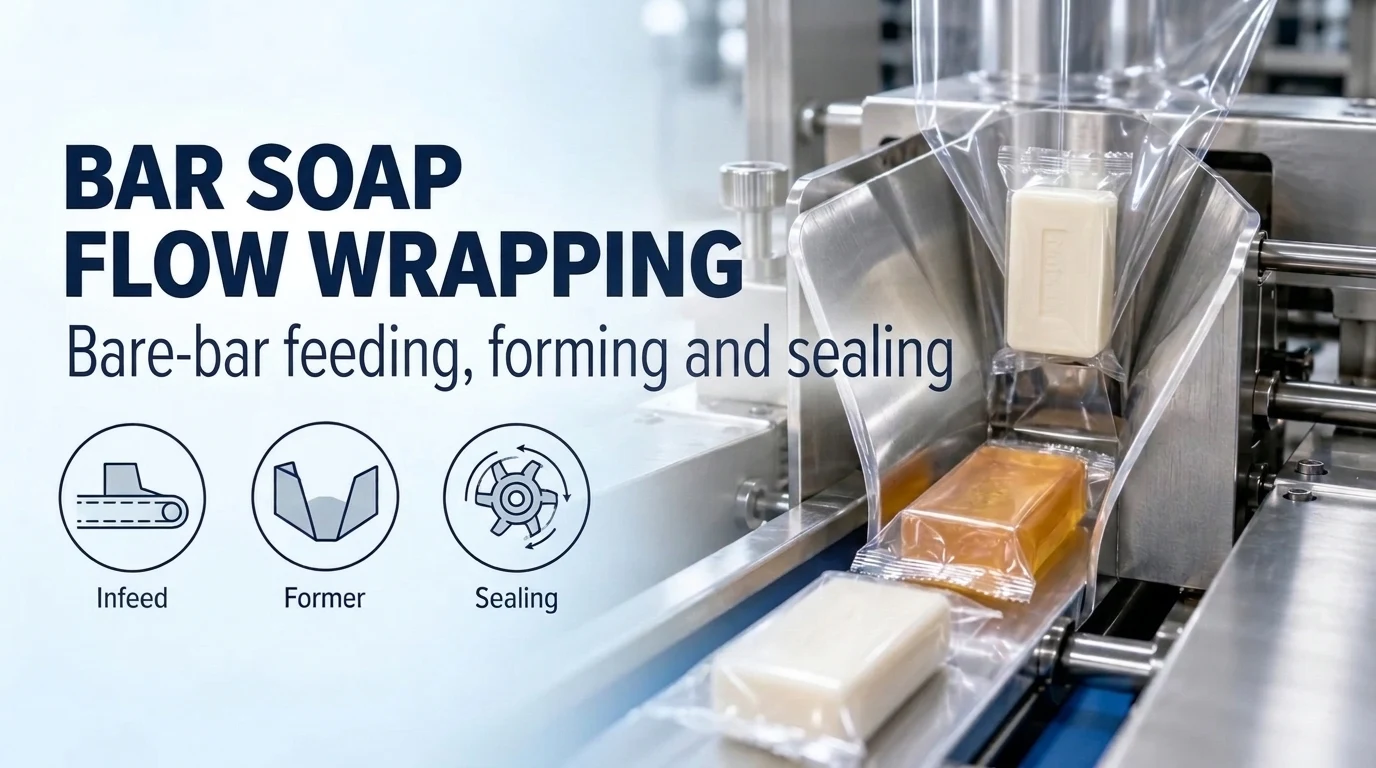
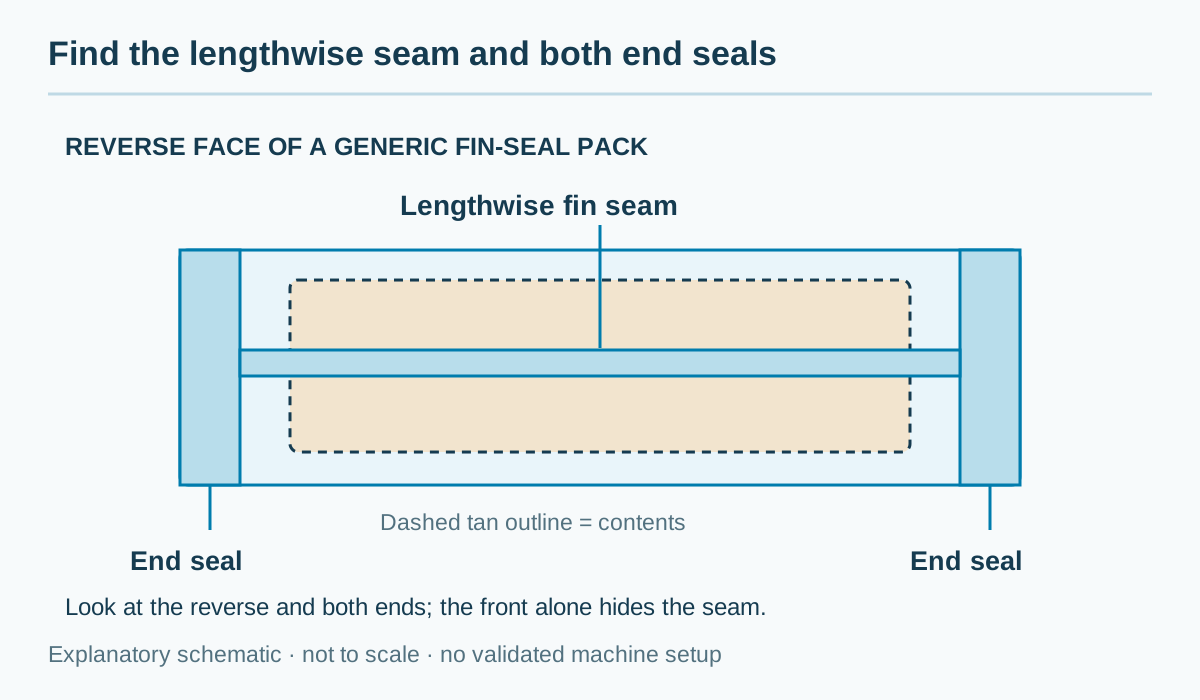
This engineering guide explains how to evaluate horizontal flow wrapping machines within our non-food flow wrapping application hub before you send bar samples or request a quotation via LINEVO WhatsApp. Our horizontal flow pack (HFFS) machines form a tight pillow package from a single film reel using three welds—two transverse end seals and one longitudinal back seal—for personal care and household products. In our non-food flow wrapping engineering reviews, we check bar orientation, rub marks, and corner contact for rigid single bars on guided belt or lug-pusher infeeds, and we test residue buildup, former release, and seal-zone contamination for moisturized, oily, or waxy bar surfaces.
How does horizontal flow wrapping work for bar soap and hotel soap?
When selecting soap packaging machinery, we first separate horizontal pillow-pack flow wrapping from cartoning, shrink-tunnel bundling, thermoforming, and vertical liquid/powder bagging:
- Horizontal Flow Wrapper (HFFS) — Single Bar: Wraps rectangular, oval, or contoured toilet and hotel soap bars in clear or metallized film from a single reel at high speed.
- Horizontal Flow Wrapper (HFFS) — Multipack & Gusseted: Wraps collated 2-bar to 6-bar soap multipacks (bare or pre-wrapped) on a cantilevered frame featuring optional end-seal gusseting and straight-line or zigzag cutoff knives.
- Box Cartoning & Pleated/Stretch Overwrap: Folds paperboard cartons around premium hotel or gift soaps, or applies pleated/stretch-film overwrap around round and oval specialty bars.
- Shrink-Sleeve & Polyolefin Shrink Tunnel: Bundles multi-carton retail packs or detergent boxes in tight polyolefin shrink film through a heat tunnel.
- Rigid Thermoforming & Vertical (VFFS) Sachet: Forms rigid blister trays for gel blocks or doses liquid/powder soaps into LDPE or laminated sachets on a vertical form-fill-seal machine.
On our single-lane horizontal bar soap flow wrappers, feeding, longitudinal fin sealing, and transverse end sealing are built on a cantilevered frame for rapid soap-dust cleanup, delivering single-lane capacities of 60–200 bags/min on a 220 V, 50/60 Hz power supply. To compare horizontal pillow wrapping against heat-tunnel shrink lines, vertical baggers, and grouped pack layouts, review our guides on flow wrap packaging fundamentals, how flow wrapping works, flow wrap vs shrink wrap, horizontal vs vertical form-fill-seal, and individual wrap vs multipack flow wrapping.
| Soap Packaging Format | Primary Mechanism & Pack Structure | Typical Soap & Personal Care Scope |
|---|---|---|
| Flow Pack (HFFS) — single bar | Single-reel pillow pack with 1 longitudinal fin seal + 2 transverse end seals (60–200 bags/min) | Individual rectangular, oval, and hotel toilet soap bars in BOPP, metallized BOPP, or paper laminate |
| Flow Pack (HFFS) — multipack | Cantilevered wide-jaw wrapper with inline collation, optional gusseting, and straight/zigzag knife | Grouped 2-bar to 6-bar banded or family multipacks of wrapped or bare soap bars |
| Shrink wrap & heat tunnel | L-bar or sleeve wrapper paired with a recirculating hot-air polyolefin shrink tunnel | Tight transparent overwrap on bundled soap cartons or multi-box detergent packs |
| Box cartoner / stretch-pleat | Tuck/glue paperboard cartoner or pleated stretch-film die-fold wrapper | Boxed luxury bath soaps, hotel amenity cartons, and round pleated specialty bars |
| Vertical (VFFS) / thermoform | Vertical tube bagger with liquid/auger filler or rigid-web thermoformer | Liquid/gel soap sachets in LDPE/laminate film and rigid-cavity detergent pods |
True soap vs synthetic detergent and medicated cleanser bars: FDA 21 CFR 701.20 and MoCRA boundaries
According to the U.S. FDA, ordinary soap is made by combining fats or oils and an alkali, such as lye, whereas most solid and liquid body cleansers on the market are synthetic detergent products because they suds easily in water and do not form gummy deposits. Under U.S. FDA 21 CFR 701.20, three conditions must all be met for a bar to be regulated as true soap: (1) it must be composed mainly of the alkali salts of fatty acids, (2) those alkali salts must be the only material producing the cleaning action (adding synthetic detergents classifies the bar as a cosmetic), and (3) it must be labeled and marketed solely as soap without cosmetic claims (such as moisturizing, perfuming, or deodorizing the skin, which trigger FDA cosmetic regulation) or drug claims (such as antibacterial germ-killing or treating acne/eczema, which trigger FDA drug regulation).
While true soap bars fall under Consumer Product Safety Commission (CPSC) jurisdiction, solid syndet and moisturizing cleanser bars regulated as cosmetics must comply with the Modernization of Cosmetics Regulation Act of 2022 (MoCRA), including facility registration, product listing, and batch trace coding on the flow-wrapped package.
Bare-bar infeed pushers, forming-shoulder geometry and surface protection
Product shape, packaging film stiffness, infeed pitch, and pack dimensions govern how we engineer the flowpack forming shoulder for bar soap. Designing the forming collar requires exact bar length, width, height, and cross-section (rectangular, oval, or curved) alongside the web specification (clear BOPP, metallized BOPP, or paper laminate, including micron thickness and unfolded reel width). On our soap flow wrappers, the lug-chain infeed pusher carries the bar far enough into the forming throat that the soap remains supported and stable until the fin wheels take over, while maintaining positive mechanical clearance so the pusher never strikes the forming shoulder.
We specify a custom-machined forming shoulder whenever the bar is oval or asymmetric, uses stiff paper-based packaging (which folds with lower tolerance for sharp transitions than BOPP), has a soft or glossy stamped logo sensitive to scuffing, or requires a non-standard width-to-height ratio. Because increasing web tension cannot cure a mismatched former geometry, our adjustable and custom forming boxes are set with a 3–10 mm product-to-former clearance window, and lightweight composite-and-stainless former assemblies reduce lift weight by up to 40% during format changeovers.
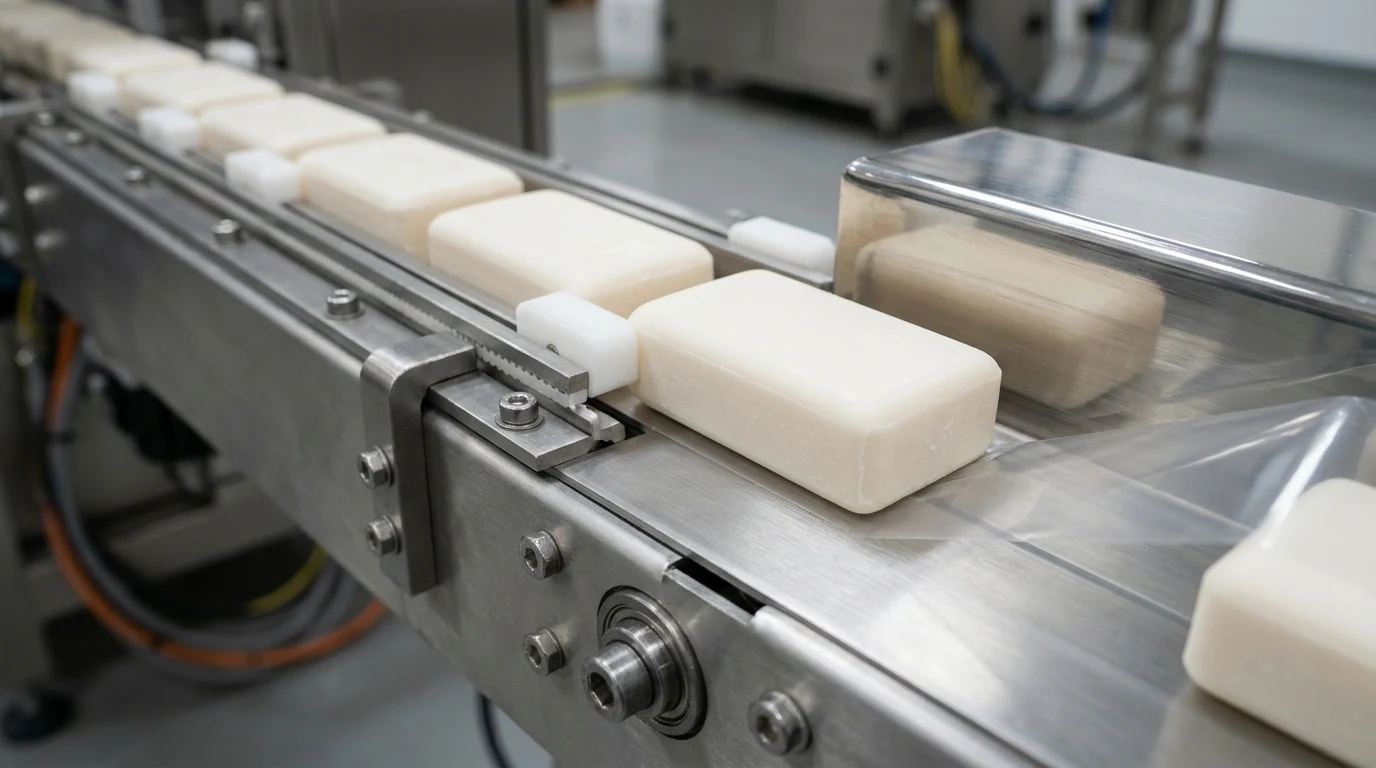
As our forming shoulder folds the flat web into a tube around the soap bar, it maintains uniform contact and tension so the longitudinal fin wheels pull the tube straight without slippage. Eliminating score marks, creases, and pleats at the forming collar preserves the moisture-barrier coating and prevents multi-layer wrinkles at the fin-to-end-seal intersection that otherwise cause channel leakers or crushed seams. Proper cooling and curing of freshly extruded or stamped soap bars before wrapping prevents waxy residue buildup on the infeed bed and stops out-of-registration bars from being clipped by the rotary jaws. To match bar surface friction, former clearance, and line transfer to the right machine frame, see our guides on flow wrap forming box product clearance, horizontal flow wrapper types, flow wrapper sizing, and manual feeding vs automatic feeding.
Clear BOPP vs metallized BOPP soap films: COF, seal initiation and moisture barrier
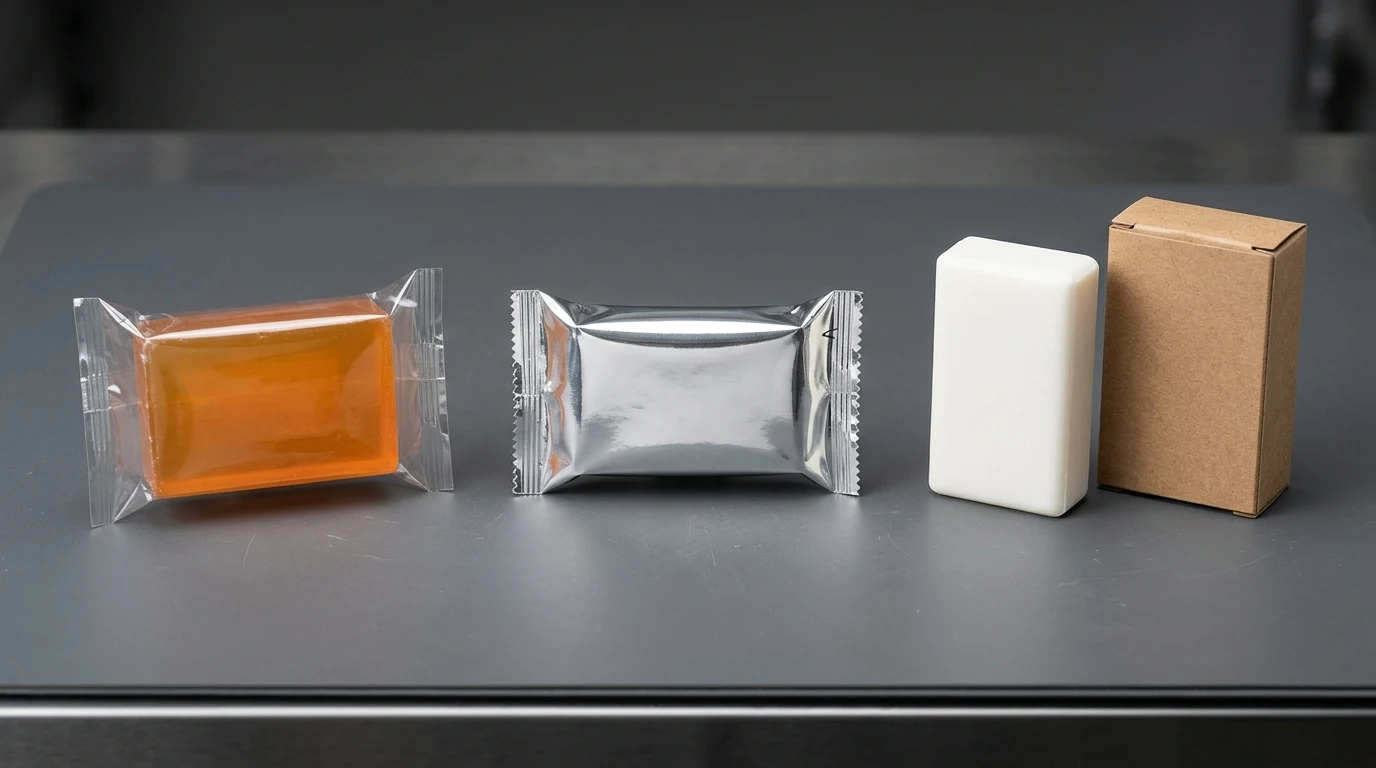
Flex Films specifies that FLEXOPP B-THL transparent both-side heat-sealable BOPP film is produced in 15, 18, 20, 23, 25, 30, 35, 40, 48, and 50 micron thicknesses (60 to 200 gauge), featuring an untreated-to-untreated (UTR/UTR) dynamic coefficient of friction (COF) of 0.30±0.05 under ASTM D1894, a wetting tension of 38 dyne/cm under ASTM D2578, a heat seal initiation temperature of 105 °C, a minimum heat seal strength of 300 to 450 gm/25mm, and a water vapour transmission rate (WVTR) of 7.0 to 4.5 gm/m²/day at 38 °C and 90% RH under ASTM F1249.
Toray Plastics (America) specifies that Torayfan PMX2 one-side heat-sealable, one-side metallized BOPP film is produced in 15, 17.5, 20, and 25 micron thicknesses with nominal yields of 73.3, 62.6, 54.5, and 43.4 m²/kg. Torayfan PMX2 provides a sealant-side static COF (μs) of 0.66 and dynamic COF (μd) of 0.45 under ASTM D1894, a seal initiation temperature (>200 g/25 mm) of 91 °C, a heat seal strength at 121 °C of 430 g/25 mm, hot tack at 250 °F of 210 g/25 mm, and an MVTR at 38 °C, 90% RH of 0.39 g/m²/day under ASTM F1249—over 10× tighter moisture protection than clear BOPP to prevent bar weight loss and fragrance evaporation. For web-width calculation and film roll specification across different bar cross-sections, consult our guides on flow wrap film selection and flow wrap film width and bag length calculation.
| Film Property | FLEXOPP B-THL (Clear BOPP) | Torayfan PMX2 (Metallized BOPP) |
|---|---|---|
| Thickness & yield range | 15–50 μm (60–200 ga) across 10 standard gauges | 15, 17.5, 20, 25 μm (yield: 73.3–43.4 m²/kg) |
| COF (ASTM D1894) & surface energy | μd = 0.30 ± 0.05 (UTR/UTR); 38 dyne/cm (ASTM D2578) | Sealant side: μs = 0.66, μd = 0.45 |
| Seal initiation temperature (SIT) | 105 °C | 91 °C (>200 g/25 mm threshold) |
| Heat seal & hot tack strength | 300–450 g/25 mm minimum across gauge range | 430 g/25 mm @ 121 °C; hot tack 210 g/25 mm @ 250 °F |
| Moisture barrier (38 °C, 90% RH) | WVTR: 7.0–4.5 g/m²/day (ASTM F1249) | MVTR: 0.39 g/m²/day (ASTM F1249; >10× moisture barrier) |
Non-stick endseal coatings, rotary crimper hygiene and ASTM F88/F88M-15 seal verification
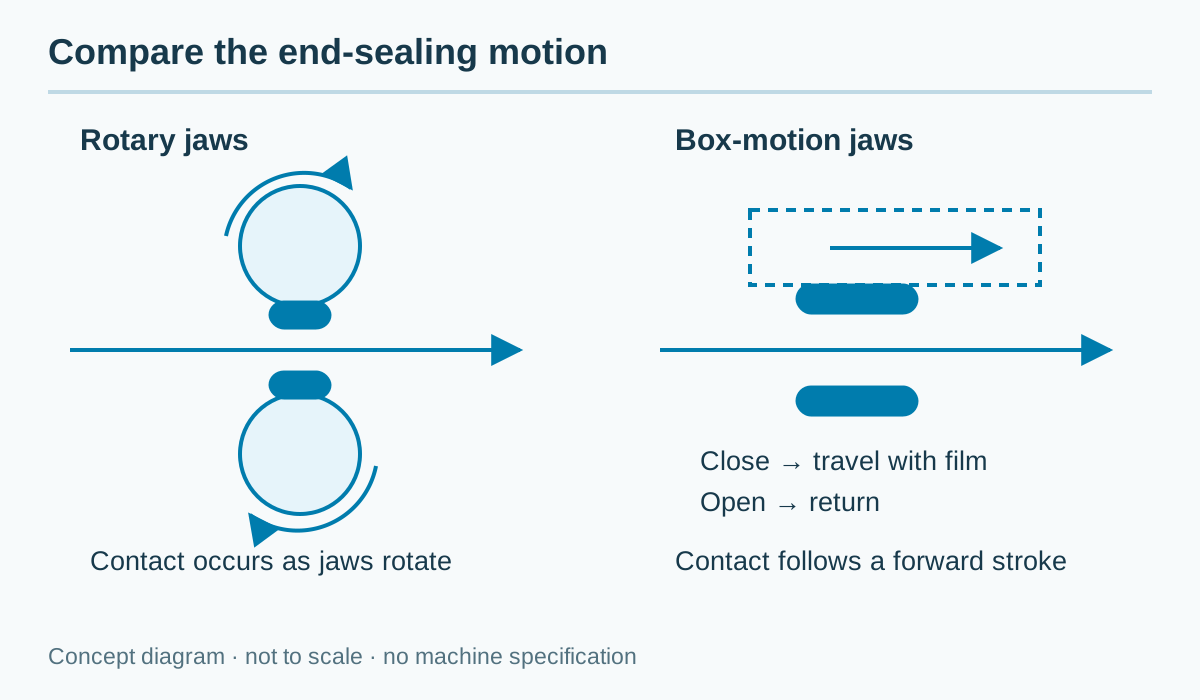
To prevent soap dust and melted BOPP sealant from fouling the transverse crimpers, we supply rotary end-seal jaws treated with self-lubricating Nickel Teflon Coating (NTC) that resists corrosion, flaking, chipping, and film sticking while maintaining uniform temperature and nip pressure across the jaw face. Depending on your retail pack design, we machine end-seal serrations in fine, coarse, sinusoidal, horizontal, vertical, diagonal, or cross-hatched patterns and integrate a precision tear notch directly into the end seal.
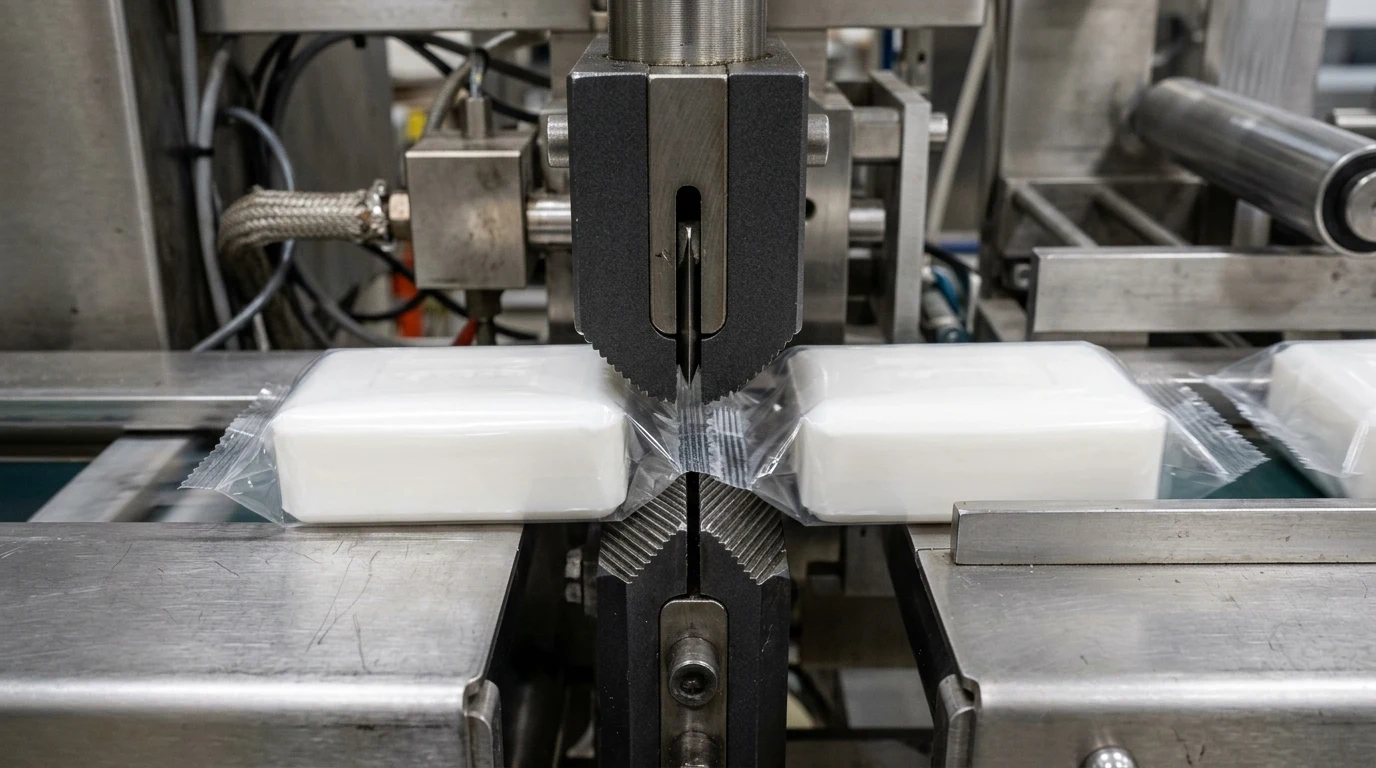
During rotary jaw maintenance, if leading end-seal leakers appear, check whether an over-adjusted cutoff knife is striking the anvil hard enough to bounce the upper and lower crimpers apart; whenever the knife is removed, strip out old shims and clean soap residue from the knife slot so compacted buildup does not create a sponge effect. We verify finished soap-pack seal strength under ASTM F88/F88M-15 (Sections 1.1, 1.4, 4.2.1–4.2.3, 6.2, and 9.6) by cutting 25 mm (0.984 in.), 15 mm (0.591 in.), or 25.4 mm (1.00 in.) strips and pulling them at 200–300 mm/min (8–12 in./min) using consistent tail support (Technique A unsupported, Technique B 90° hand-supported, or Technique C 180° supported). For detailed jaw dwell and seal peel calibration steps, consult our guide on flow wrap crimp dwell and seal strength.
Prepare your bar soap flow wrapping trial and quotation brief
To configure a horizontal soap flow wrapper without guesswork, prepare the following intake parameters from our flow wrapper requirements checklist and flow wrapper price guide before contacting our engineering team:
- Bar dimensions and product type: Provide bar length, width, and height, cross-section shape (rectangular or oval), and whether the product is true alkali-fatty-acid soap or a synthetic detergent cleanser bar.
- Pack format: Specify whether the machine will wrap individual bars (60–200 bags/min single-lane) or collated multipacks with gusseting.
- Film structure: Share your target film specification (clear heat-sealable BOPP, metallized BOPP, or paper laminate, including micron thickness and reel width).
- End-seal and easy-open preferences: Indicate whether your package requires horizontal, vertical, diagonal, or cross-hatched crimper serrations, a tear notch, and Nickel Teflon Coated (NTC) non-stick sealing jaws.
Send your bar photos, dimensional range, and film details directly via LINEVO WhatsApp to review forming-shoulder clearance, lug-chain pusher geometry, and sample trial options with our engineering team.
Can a horizontal flow wrapper pack both single soap bars and multipack soap formats?
Yes. We configure cantilevered horizontal soap flow wrappers for individual hotel and bath bars at 60–200 bags/min as well as collated 2-bar to 6-bar multipacks using wider cross jaws, optional end-seal gusseting, and straight or zigzag cutoff knives.
What sealing and moisture barrier ratings are published for Torayfan PMX2 metallized BOPP film?
Published converter data for Torayfan PMX2 (15–25 μm) specifies a 91 °C seal initiation threshold (>200 g/25 mm), 430 g/25 mm seal strength at 121 °C, 210 g/25 mm hot tack at 250 °F, and an ASTM F1249 MVTR of 0.39 g/m²/day at 38 °C and 90% RH—over ten times lower moisture transmission than standard clear BOPP (4.5–7.0 g/m²/day).
Why do soap bars get scratched or clipped during horizontal flow wrapping?
Surface scuffing and jaw clipping occur when the forming box lacks the required 3–10 mm side clearance, when the infeed lug pusher fails to support the bar into the former throat without rubbing the shoulder, or when uncured waxy bars drag on the bed and arrive out of pitch at the rotary crimpers.
How does U.S. FDA regulatory classification distinguish true soap from cosmetic cleanser bars?
Under 21 CFR 701.20, a bar is regulated as true soap (under CPSC) only if alkali salts of fatty acids provide 100% of its cleaning action and no moisturizing, deodorizing, or medicated claims are made. Adding synthetic detergents or cosmetic claims places the bar under FDA cosmetic rules and MoCRA facility registration and listing.
Sources
- LINEVO Non-Food Horizontal Flow Wrapper Engineering Specifications — Single-Bar and Multipack Cantilever Soap Wrapping Systems
- U.S. Food and Drug Administration (FDA) — 21 CFR 701.20 Regulatory Definition of Soap and Modernization of Cosmetics Regulation Act (MoCRA) Guidance
- Flex Films — FLEXOPP B-THL Transparent Both-Side Heat-Sealable BOPP Film Technical Data Sheet (ASTM D1894, D2578, F1249)
- Toray Plastics (America), Inc. — Torayfan PMX2 Metallized BOPP Film Technical Data Sheet (ASTM D1894, F1249)
- ASTM International — ASTM F88/F88M-15 Standard Test Method for Seal Strength of Flexible Barrier Materials
Before you request a quote
Flow Wrap Packaging: How It Works and When to Use It
Flow wrapping uses reel-fed film to make a pack with a lengthwise seal and two end seals. Check the pack format, product handling and film before choosing a machine.
Compare Flow Wrapper Types and Configurations
Rotary or box motion? Top film or bottom film? Compare the feeding, film path and end-seal choices in a flow wrapper proposal.
Choosing Flow Wrap Film for Your Product and Machine
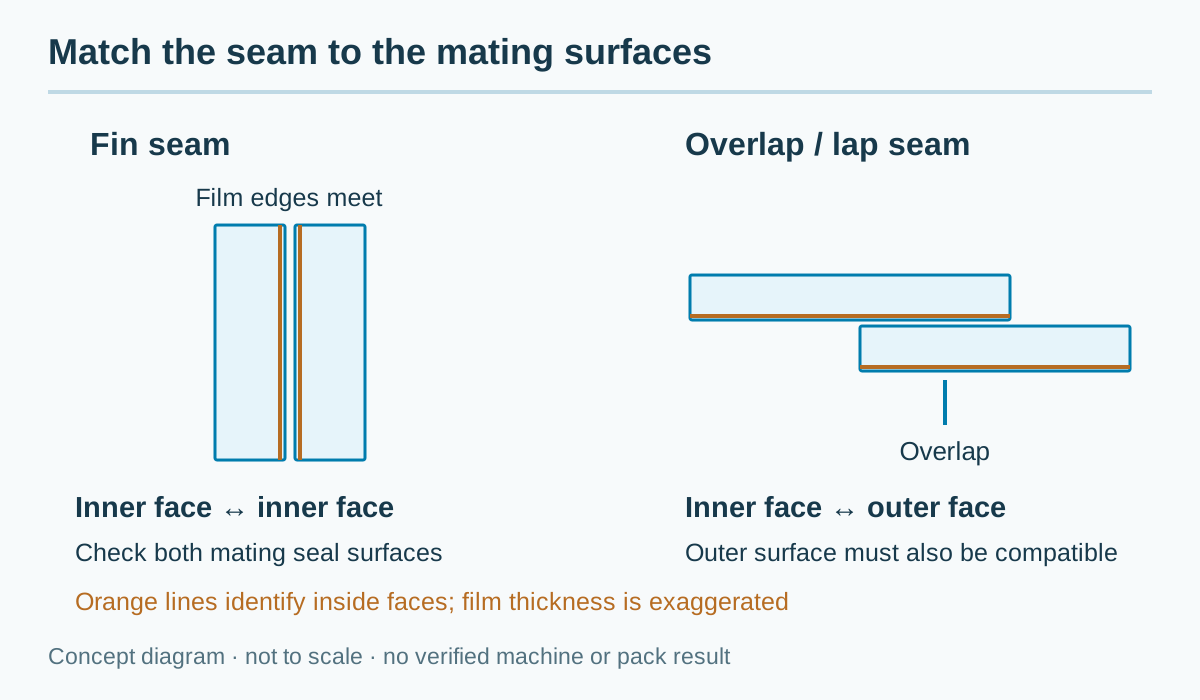
Choosing flow wrap film starts with the product and required seal. Gather the film specification, reel dimensions and samples for compatibility testing.