
Updated 2026-10-17
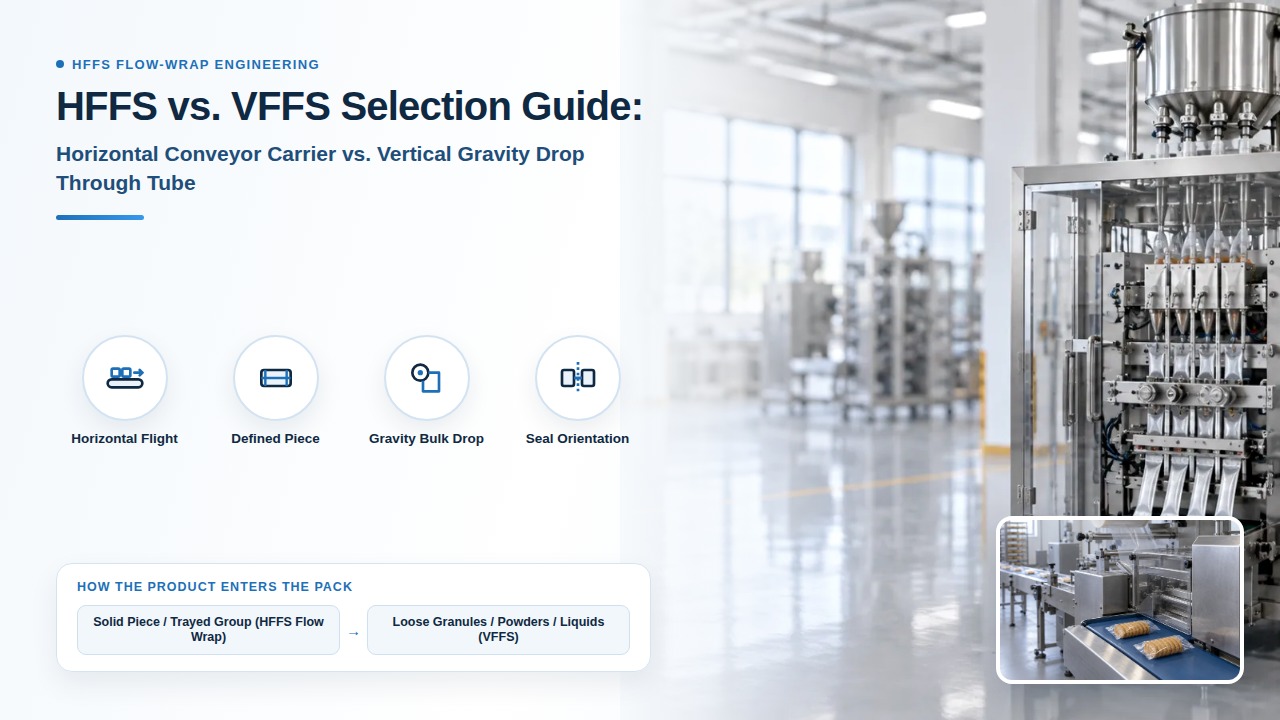
Dropping fragile coated biscuits, wafer stacks, or orientation-critical medical trays down a 1.2 to 1.8 m vertical forming tube causes 5% to 18% impact damage, package rejects, and cross-jaw downtime, whereas feeding loose granules, dusty powders, or liquid doses onto an open horizontal wrapper conveyor results in wasted product and seal leaks. Evaluating HFFS vs VFFS requires comparing three distinct rollstock machine architectures across four physical boundaries: product entry vector and drop height (0 mm supported horizontal transport vs 800 to 1,800 mm gravity free-fall through a vertical forming tube vs 250 to 600 mm top-down dosing into horizontally indexed pouches), molten bottom-seal impact loading under ASTM F1921, bag format and width-changeover mechanics (adjustable horizontal forming box vs fixed-diameter vertical forming collar/tube), and plant ceiling height versus linear floor length. Crucially, the acronym HFFS (Horizontal Form-Fill-Seal) covers two mechanically separate machine families—a horizontal flow wrapper (which forms a continuous three-seal pillow tube around solid items) and a horizontal rollstock pouch machine (which forms upright flat or stand-up gusseted pouches horizontally and fills them from above)—while VFFS (Vertical Form-Fill-Seal) denotes a vertical bagger that pulls film down a vertical tube around a gravity-dropped dose.
Engineering summary: Specify a horizontal flow wrapper (tubular HFFS) when packaging discrete solid items, bars, or trayed multipacks at 50 to 600+ packs/min that require 0 mm vertical drop height, preserved product orientation, and rapid 5 to 15 minute bag-width adjustments under standard 2.2 to 2.5 m ceilings; specify a vertical form-fill-seal (VFFS) bagger when dosing loose granules, snack chips, powders, or pumpable liquids at 30 to 300 bags/min inside a compact 3.5 to 5.0 m² floor footprint with 3.5 to 5.5 m overhead weigher clearance and high ASTM F1921 hot-tack sealant webs; or specify a horizontal rollstock pouch machine (pouch HFFS) when producing stand-up Doypack, zipper, or spouted pouches at 40 to 240+ pouches/min with top-down dosing and 50% to 65% lower film cost than premade pouches.
| Engineering parameter | Horizontal Flow Wrapper (Tubular HFFS Baseline) | Horizontal Rollstock Pouch (Pouch HFFS Baseline) | Vertical Bagger (VFFS Baseline) |
|---|---|---|---|
| Product entry vector & gravity drop height (h_drop) | Horizontal lugged chain or belt conveyor support; 0 mm vertical drop during tube forming and sealing | Horizontal pouch transport (walking beam or continuous turret) + vertical top-down dosing (250–600 mm drop) | Vertical gravity free-fall from overhead weigher/auger through forming tube (800–1,800 mm drop; or 45° inclined option) |
| Primary product & dosing compatibility | Discrete solid pieces, bars, bakery items, soap, hardware, or collated stacks/trays requiring fixed orientation | Liquids, pastes, fine powders, granules, or multi-component doses requiring upright stand-up or zipper pouches | Loose free-flowing granules (coffee, snacks, frozen IQF, nuts), auger-dosed powders, or pump-dosed liquid sachets |
| Finished bag formats & seam geometry | 3-seal pillow pack (1 longitudinal fin/lap seam + 2 transverse end crimps, 12–18 mm) or gusseted pillow pack | 3-side or 4-side flat pouch, stand-up Doypack bottom gusset, reclosable zipper, shaped contour, or corner spout | Vertical pillow bag, side-gusseted bag, flat-bottom / block-bottom bag, or 4-corner quad-seal bag |
| Seal stress regime & governing ASTM test | Unloaded end crimps (conveyor supports product weight); verified by ASTM F88 cooled peel strength (1.5–4.0 N/15 mm) | Bottom/side seams cured before filling station; top seal verified by ASTM F88 peel & ASTM F1140 burst pressure | Falling dose impacts freshly welded bottom cross-seal within 50–250 ms; demands high ASTM F1921 hot-tack strength (3.5–8.0 N/15 mm) |
| Bag-width changeover mechanics & duration | Adjustable forming box handwheels (or fixed former swap); 5 to 15 min width & pitch recipe changeover | Adjustable plow folder, side-seal bars, and pouch gripper pitch; 30 to 60 min format changeover | Requires unbolting and swapping a dedicated stainless forming collar + tube per bag width; 30 to 60 min changeover |
| Baseline speed, utilities & facility envelope | 50–300+ packs/min (up to 600–1,000+ ppm high-speed); 3.0–6.5 kVA; 4.5–7.6 m length x 2.2–2.5 m ceiling height | 40–120 pouches/min simplex (up to 240–360 ppm duplex/continuous); 8.0–18.0 kVA + 6 bar air; 5.0–9.0 m length | 30–100 bags/min intermittent (120–300 bpm continuous); 6.5–13.0 kVA total; 3.5–5.0 m² floor x 3.5–5.5 m ceiling height |
How Do the Three Form-Fill-Seal Architectures Differ in Product Entry and Film Forming?
Comparing proposals labeled simply HFFS or VFFS without specifying the product-entry vector and bag-forming hardware causes severe scope mismatches. Even when two machines produce a three-seal pillow bag from the same flat laminate rollstock, a horizontal flow wrapper wraps film around a conveyor-supported solid unit, whereas a vertical bagger drops a metered bulk charge down a rigid metal tube. Before issuing supplier RFQs, review our HFFS machine category selector and verify which of the three form-fill-seal architectures matches your product physics.
1. Horizontal Flow Wrapping (Tubular Reel-Fed HFFS)
In a horizontal flow wrapper—documented in ULMA Packaging's Flow Pack HFFS reference and Syntegon's horizontal flow wrapper overview—individual solid items, stacked groups, or loaded paperboard/plastic trays travel horizontally at a fixed pitch along a lugged infeed chain or servo timing belt. A single flat film web (20 to 65 um BOPP, BOPP/CPP, PET/PE, paper/PE, or cold-seal film) folds over an adjustable forming shoulder into a continuous horizontal tube around the product. Counter-rotating fin wheels pull and seal the longitudinal seam (12 to 15 mm wide), while rotary (1 to 4 jaws per shaft) or box-motion cross-sealing jaws weld and sever the two transverse end seals (12 to 18 mm wide) in the clear gaps between products. For a stage-by-stage mechanical breakdown, see how a flow wrapper works and our flow wrap packaging guide.
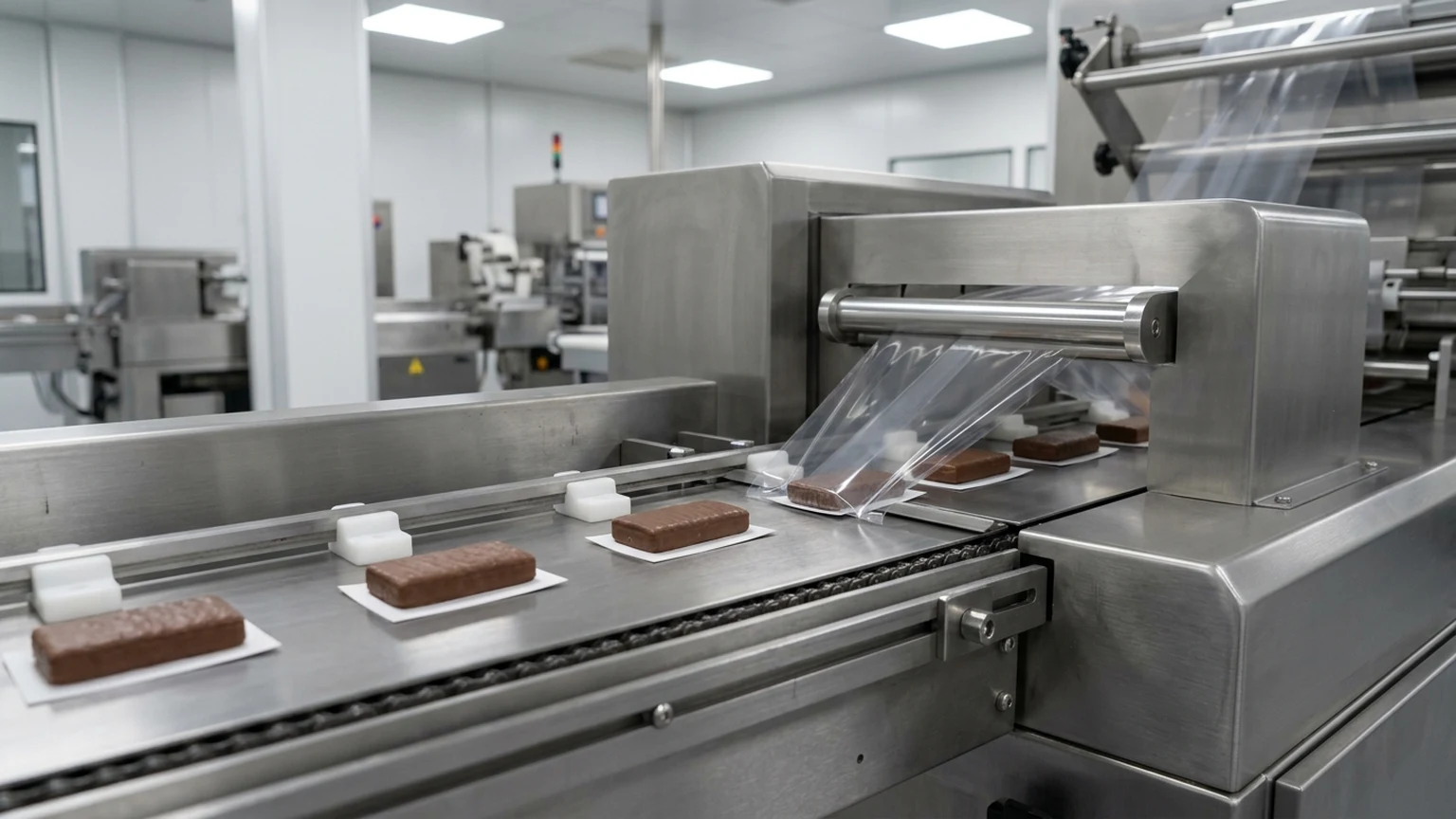
Because the product never falls through a chute or tube (h_drop = 0 mm), horizontal flow wrapping is the primary baseline for fragile baked goods (see bakery packaging machines), enrobed bars (see chocolate bar packaging machines), and medical or hardware components (see non-food flow wrapping). However, a horizontal flow wrapper does not meter loose bulk material: if a product consists of multiple pieces, those pieces must either be collated on a tray/U-card (see cookie and biscuit flow wrapping) or supported from underneath on a bottom-reel belt wrapper (see flow wrapper types).
2. Horizontal Rollstock Pouch Form-Fill-Seal (Pouch HFFS) vs Premade-Pouch Fillers
When equipment builders such as Volpak, Bartelt, or WeighPack refer to an HFFS pouch machine—as detailed in Volpak's intermittent and continuous HFFS pouching overview—the word horizontal describes the travel path of the pouch, not the direction of product entry. Flat barrier rollstock (typically 60 to 130 um PET/AL/PE or PET/MET-PET/PE) unwinds over a triangular plow folder that forms a bottom fold or W-gusset (for stand-up Doypack pouches). Vertical heated bars seal the side seams, a vertical knife cuts individual pouches (or advances a continuous strip), and mechanical grippers transport the upright pouches horizontally across successive stations. At the filling station, vacuum suction cups and an air-jet blast pull the top mouth open while an overhead auger, liquid piston pump, or multihead weigher doses product vertically downward (h_drop = 250 to 600 mm) into the supported pouch before top-sealing jaws close the package.
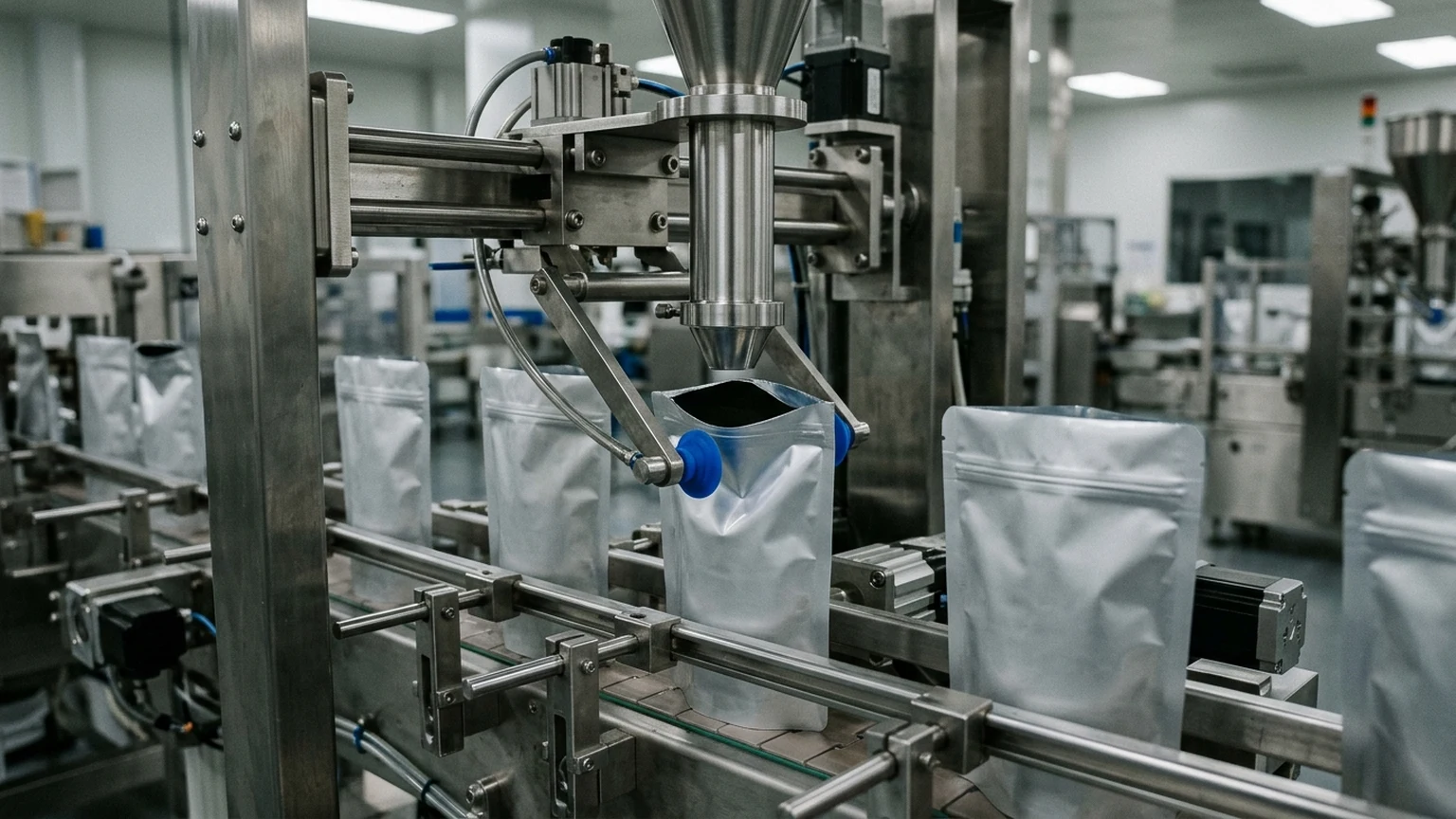
Engineers must distinguish Rollstock Pouch HFFS (which forms pouches from a flat film reel at 40 to 120 pouches/min on intermittent simplex machines and up to 240 to 360 pouches/min on duplex/continuous platforms) from Premade-Pouch Fill-and-Seal Machines (rotary turret or inline machines that pick pre-converted pouches from a magazine at 15 to 60 pouches/min). While premade-pouch machines switch bag widths in 10 to 20 minutes by adjusting gripper width, buying pre-converted pouches adds 100% to 250% (2.0x to 3.5x) to packaging material cost per 1,000 units compared with forming pouches inline from rollstock.
3. Vertical Form-Fill-Seal (VFFS Vertical Bagger)
In a vertical form-fill-seal system (such as the intermittent ULMA VTI 400 up to 100 cycles/min, the continuous ULMA VTC 800, or the continuous 4-servo Syntegon SVX series up to 300 bags/min on a single lane), flat rollstock feeds over a curved vertical forming collar (shoulder) and wraps around a cylindrical or rectangular stainless-steel forming tube. Side-mounted friction or vacuum pull belts draw the film downward while a vertical heater bar (or continuous band sealer) welds the longitudinal back seam (fin or lap). Directly below the bottom lip of the forming tube, horizontal cross-sealing jaws clamp across the film tube.
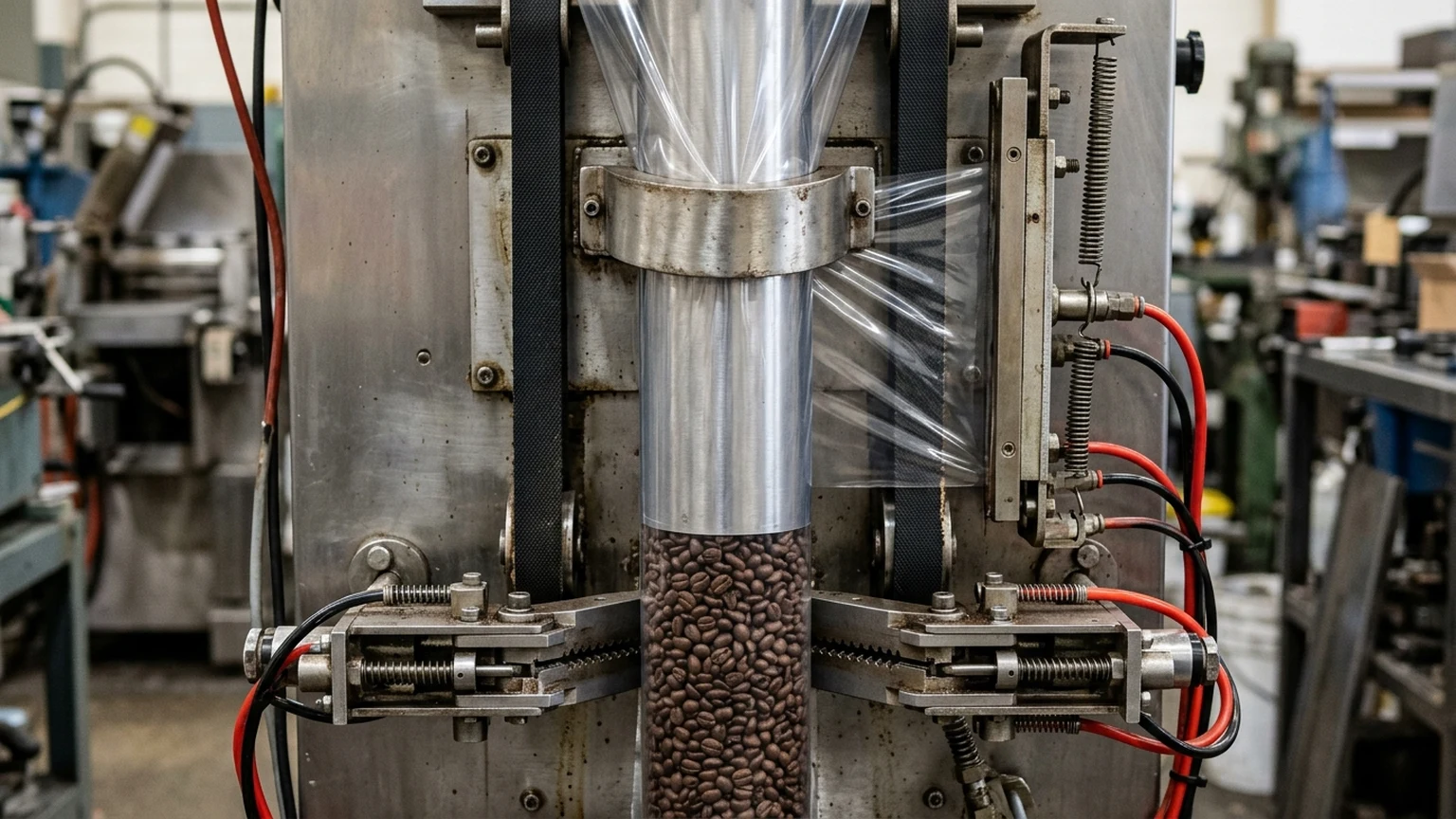
When the overhead filler (a 10- to 24-head combination weigher, servo auger filler, volumetric cup turret, or liquid pump) releases a portion, the charge falls by gravity straight through the hollow center of the forming tube (typically h_drop = 800 to 1,800 mm) into the bag waiting below. For fragile discrete products (such as frozen dumplings, shortbread cookies, or delicate produce), OEMs offer 45° inclined VFFS frames (such as the ULMA VTI 400 45° inclined configuration), which slide the dose down an angled tube rather than dropping it in vertical free-fall.
| Packaging architecture | Forming & dosing kinematics | Baseline speed & utilities | Dominant Failure Mode & Mechanical Prevention |
|---|---|---|---|
| Rotary Horizontal Flow Wrapper (Tubular HFFS) | Horizontal lug/belt infeed (0 mm drop) + adjustable forming box + rotary fin wheels + 1–4-jaw rotary cross head (e.g., ULMA FR 100 / Syntegon Pack 202) | 50–300+ packs/min (up to 600+ ppm high-speed); 3.0–5.0 kVA electrical draw | Misaligned product clipped by rotary cross jaws or center-fin channel leak -> Enable optical Misplaced Product Detection (MPD) and machine a center relief step in jaw serrations |
| Box-Motion Horizontal Flow Wrapper (MAP HFFS) | Horizontal infeed + gas-flush lance inside film tube + orbital D-cam cross jaws providing 150–350 ms parallel seal dwell (e.g., ULMA FM 300) | 40–150 packs/min (up to 30 m/min web); 4.5–6.5 kVA + 6 bar gas/air supply | Headspace oxygen drift (>1–2% residual O2) on thick barrier films (>50 um) -> Balance stainless lance flow rate with 180+ ms box-motion jaw dwell and high-hot-tack sealant |
| Rollstock Horizontal Pouch Machine (Pouch HFFS) | Plow bottom fold + vertical side sealers + horizontal walking-beam or continuous gripper transport + vacuum top opening + top-down dosing (e.g., Volpak SI / SC+) | 40–120 pouches/min simplex (up to 240–360 ppm duplex/continuous); 8–18 kVA + 6–8 bar air | Incomplete top-mouth opening or liquid/powder splash in top seal flange -> Pair vacuum suction cups with positive air-blast openers and dive-in dosing nozzles with suck-back valves |
| Intermittent Vertical Bagger (Intermittent VFFS) | Vertical forming collar/tube + step-index draw belts + stationary-film pneumatic/servo cross jaws; supports pillow, gusset, and block-bottom bags (e.g., ULMA VTI 400) | 30–100 bags/min; 4.5–7.5 kVA bagger + 2–3 kVA weigher + 6 bar air; 3.5–5.5 m ceiling height | Bottom cross-seal blowout when heavy dose hits warm seal -> Specify high ASTM F1921 hot-tack metallocene PE sealant, jaw cooling air bars, or staggered dump timing |
| Continuous Vertical Bagger (Continuous VFFS) | Vertical forming collar/tube + continuous vacuum draw belts + reciprocating/orbital flying cross jaws closing on moving film (e.g., ULMA VTC 800 / Syntegon SVX) | 120–300 bags/min single lane (up to 600 bpm duplex); 7.0–12.0 kVA + 6–8 bar air | Tail-end granules or fine dust trapped in closing cross jaws -> Synchronize multihead weigher dump phase angle, add servo jaw obstruction sensing, and install dust extraction hoods |
Why Does VFFS Demand Higher ASTM F1921 Hot-Tack Strength Than Horizontal Flow Wrapping?
A pillow pack produced on a horizontal flow wrapper and a pillow bag produced on a vertical bagger share the exact same three-seal geometry (one longitudinal back seam and two transverse end crimps), yet a film roll that seals cleanly at 200 packs/min on an HFFS flow wrapper will frequently split open at the bottom seam on a VFFS bagger.
As explained in Syntegon's engineering guide to horizontal flow wrapper sealing and cutting and PFM's comparative horizontal-versus-vertical sealing engineering documentation, the difference lies in whether the freshly welded transverse seal must support falling product mass before the polymer cools:
- VFFS Simultaneous Double-Seal Loading (
ASTM F1921Hot-Tack Regime): On a vertical bagger, the horizontal cross-sealing jaws perform two jobs in one stroke: clamping across the film tube seals the top of the lower filled bag while simultaneously forming the bottom weld of the next bag above it. Within50 to 250 millisecondsafter the heated jaws open—while the inner sealant resin (at 75 to 110 °C) is still in a semi-molten state—the next product dose (50 g to 5,000 g) drops800 to 1,800 mmdown the forming tube and impacts that bottom seam directly. UnderASTM F1921(Standard Test Methods for Hot Tack of Thermoplastic Polymers and Blends), a VFFS sealant layer (typically 30 to 65 um metallocene LLDPE or high-hot-tack CPP) must deliver3.5 to 8.0 N/15 mmof immediate molten hot-tack resistance (plus optional air-jet jaw cooling) so the falling charge does not peel or blow through the warm weld. - HFFS Unloaded Horizontal Sealing (
ASTM F88Cooled Peel Regime): On a horizontal flow wrapper, the conveyor bed and bottom film web carry100%of the product's weight horizontally. Zero gravitational impact force acts against the transverse end crimps as the rotary or box-motion jaws open. While HFFS barrier films still require adequate hot-tack to prevent spring-back on thick gussets, seal validation is governed primarily byASTM F88cooled peel strength (1.5 to 4.0 N/15 mm), allowing thinner20 to 35 umcoextrudedBOPPor ambient cold-seal webs to run at150 to 600+ packs/min. Compare film structures in our flow wrap film guide and thermal shrink behavior in flow wrap vs shrink wrap. - Seal-Zone Contamination Vectors: On a horizontal flow wrapper, contamination occurs if a solid item slides out of lug pitch (
or if sticky syrup smears the forming plate, see sticky bar flow wrapping). On a VFFS bagger, fine powder plumes (flour, protein powder, spices), static-charged flakes, or elongated pieces (pretzel sticks, French fries, shredded cheese) stay suspended in the vertical air column inside the forming tube and get clamped directly between the closing cross jaws. All polyolefin food-contact sealant layers (BOPP, CPP, LDPE, LLDPE) across both platforms must comply withFDA 21 CFR 177.1520extractable limits.
| Process & product category | Recommended film structure & gauge | Critical seal metric (ASTM F1921 vs F88) | Dominant Failure Mode & Mechanical Prevention |
|---|---|---|---|
| HFFS Flow Wrap — Ambient / Dry Solids (Biscuits, Bars, Soap) | 20–40 um coextruded BOPP, BOPP/BOPP, or pattern cold-seal BOPP (FDA 21 CFR 177.1520 compliant) | ASTM F88 cooled peel strength 1.5–3.5 N/15 mm; low hot-tack load (zero drop impact) | Center-fin 4-layer intersection channel leak -> Profile cross-jaw serrations with a 0.15–0.30 mm center relief step |
| HFFS Flow Wrap — Gas-Flushed MAP (Fresh Bakery, Cheese, Meat Trays) | 45–75 um PET/PE-EVOH-PE or BOPP/CPP barrier laminate | ASTM F88 peel >= 3.0 N/15 mm + ASTM F1921 hot-tack >= 2.5 N/15 mm; 150–350 ms box-motion dwell | Leakers from gas-flush billowing during jaw opening -> Use orbital box-motion cross jaws with mechanically synchronized product stripper plates |
| VFFS Bagger — Light / Medium Dry Granules (Snacks, Coffee, Nuts, 50–500 g) | 40–70 um BOPP/VMCPP or PET/VMPET/metallocene-LLDPE | ASTM F1921 hot-tack 3.5–5.5 N/15 mm at 105–125 °C to hold falling dose immediately after jaw open | Static cling or elongated pieces bridging in cross-seal zone -> Install ionized static eliminator bars, staggered weigher dump chutes, and rotary stripping jaws |
| VFFS Bagger — Heavy Bulk / Frozen IQF (1.0–5.0 kg Pet Food, Ice, Produce) | 65–120 um heavy coextruded LDPE/LLDPE or PET/LDPE laminate | ASTM F1921 hot-tack 5.5–8.5 N/15 mm + ASTM F88 tensile seal > 12 N/15 mm to absorb 10–60 J drop energy | Bottom cross-seal split under high kinetic impact -> Specify metallocene PE sealant, pneumatic bag-support shaker/vibrator shelf under jaws, or 45° inclined VFFS frame |
| VFFS or Pouch HFFS — Fine Powders & Liquids (Flour, Spices, Sauces) | 60–110 um PET/AL/LLDPE or Nylon/PE barrier laminate (seal-through-contamination resin) | Ionomer (Surlyn) or metallocene LLDPE sealant capable of sealing through dust/oil droplets under ASTM F88 | Airborne powder plume or liquid drip fouling seal flange -> Extend auger tube to within 35 mm of VFFS bottom jaws with vacuum dust ring, or use diving nozzle on Pouch HFFS |
Physical-Threshold Engineering Rules: When to Specify HFFS Flow Wrap, Pouch HFFS, or VFFS
Use these four physical-threshold rules during capital project scoping to lock down the correct machine family before comparing vendor quotes:
- Product Impact Fragility & Drop-Height Threshold (
h_drop > 250 mmorE_impact > 2.0 J): If discrete items, coated confections, stacked biscuits, or assembled kits crack, chip, scuff, or lose mandatory orientation when dropped more than200 to 250 mm(corresponding to free-fall impact energy > 2.0 J for a 200 to 500 g pack) -> prioritize horizontal flow wrapping (Tubular HFFSwith0 mmvertical drop) over a standard90°verticalVFFSbagger (800 to 1,800 mmgravity drop) because the horizontal conveyor bed supports the product completely through forming and sealing. (If bulk-weighed fragile pieces must be bagged vertically, specify a 45° inclined VFFS frame or bucket-elevator horizontal pouch line.) - Loose Bulk Flowability & Dosing Method Threshold (
Un-Trayed Granules, Powders, or Liquids): If the product is a loose granular solid, powder, paste, or liquid metered by a multihead weigher, auger, volumetric cup, or piston pump without a rigid carrier tray -> prioritize vertical form-fill-seal (VFFS,30 to 300 bags/min) for pillow, side-gusset, or block-bottom bags—or horizontal rollstock pouch HFFS (40 to 240+ pouches/min) for stand-up Doypack/zipper/spouted pouches—because a tubular horizontal flow wrapper cannot contain loose bulk material on an open horizontal forming apron unless the dose is pre-filled into a rigid tray or cup. - Plant Ceiling Clearance vs Linear Floor Space Threshold (
Ceiling < 3.2 mvsFloor Length < 4.0 m): If packing-room ceiling height is below3.0 to 3.2 m(preventing installation of an overhead combination weigher and support mezzanine above a vertical bagger, which requires 3.5 to 5.5 m of vertical stack height) -> prioritize horizontal flow wrapping (2.2 to 2.5 mceiling height,4.5 to 7.6 mlinear length) or a floor-level auger/piston horizontal pouch HFFS machine; conversely, if linear floor length is restricted below4.0 mand overhead clearance exceeds4.0 mon bulk products -> prioritize VFFS (3.5 to 5.0 m²floor footprint). - Bag-Width Changeover Frequency & Rollstock Economics Threshold (
> 2 Width Changes/Shiftor> 50,000 Pouches/Day): If a solid-product line executes more than2 bag-width changeovers per shift-> prioritize servo horizontal flow wrapping with an adjustable forming box (5 to 15 minhandwheel/servo adjustment) over VFFS (which requires unbolting and swapping a dedicated stainless forming collar and tube assembly for every bag width in 30 to 60 min); if a stand-up zipper pouch line exceeds50,000 pouches/dayacross stable formats -> prioritize rollstock horizontal pouch HFFS over premade-pouch machines to eliminate the2.0x to 3.5xpre-converted bag price premium.
Quantitative Engineering Equations: Drop-Impact Energy, Dust-Clearance Window, and Flat Web Width
To prevent product breakage, cross-seal contamination, and film-sizing errors during Factory Acceptance Testing (FAT), engineers model four physical equations across HFFS and VFFS candidates. For complete HFFS dimensional allowances, consult flow wrapper sizing and flow wrap film width and bag length calculation.
1. Gravity Free-Fall Impact Velocity (v_impact) and Kinetic Energy (E_impact) in VFFS vs HFFS
v_impact (m/s) = sqrt(2 * g * h_drop)
E_impact_90 (J) = m_dose * g * h_drop
E_impact_inclined (J) = m_dose * g * L_tube * (sin(theta) - mu_k * cos(theta))
- Variables:
m_dose= portion mass (kg);g = 9.81 m/s²;h_drop= vertical drop distance from weigher/filler discharge gate through the forming tube to the closed bottom cross-seal jaw (m);L_tube= inclined tube slide length (m);theta= incline angle from horizontal (45°on inclined VFFS);mu_k= kinetic friction coefficient against stainless steel (~0.25). - Worked example: Dropping a
m_dose = 0.50 kg(500 g) portion of cookies or frozen pieces through a standard90°vertical VFFS forming tube of heighth_drop = 1.35 maccelerates the charge tov_impact = sqrt(2 * 9.81 * 1.35) = 5.15 m/s(18.5 km/h), striking the freshly welded bottom cross seal withE_impact_90 = 0.50 * 9.81 * 1.35 = 6.62 Jof impact energy. Sliding the same0.50 kgcharge down a45°inclined VFFS tube (L_tube = 1.35 m,mu_k = 0.25) reduces impact energy toE_impact_inclined = 0.50 * 9.81 * 1.35 * (0.707 - 0.25 * 0.707) = 3.51 J(a 47% reduction), whereas conveying the0.50 kgportion on a horizontal flow wrapper (h_drop = 0 m) imparts0.00 Jof vertical drop impact.
2. VFFS Cross-Jaw Product-Clearance Window (t_clear) vs Bagging Speed (N_bpm)
t_clear (s) = (60 / N_bpm) - t_jaw_dwell - (sqrt((2 * h_drop) / g) * k_spread)
- Variables:
N_bpm= vertical bagger speed (bags/min);t_jaw_dwell= cross-jaw mechanical close-and-seal time (s);h_drop= vertical drop height (m);k_spread= charge elongation/tailing factor (0.75 to 1.10depending on weigher gate timing and particle size variation). - Worked example: Running an intermittent VFFS bagger at
N_bpm = 80 bags/min(total cycle = 60 / 80 = 0.750 s) witht_jaw_dwell = 0.220 sand a granular charge tailing factork_spread = 0.85overh_drop = 1.20 m(free-fall time = sqrt(2.40 / 9.81) = 0.495 s;charge transit spread = 0.495 * 0.85 = 0.421 s) leaves onlyt_clear = 0.750 - 0.220 - 0.421 = 0.109 s(109 ms) of clear-tube window before the cross jaws clamp shut—explaining why high-speed VFFS lines require staggered dump chutes, servo jaw obstruction detection (as used on the ULMA VTI 400 and Syntegon SVX), or extended auger tubes that discharge35 mmabove the bottom seal.
3. Flat Film Web Width: Pillow/Gusset Tube (W_tube) vs Horizontal Stand-Up Pouch (W_doypack)
W_tube = 2 * (W_bag + D_gusset) + 2 * W_fin
W_doypack = (2 * H_pouch) + D_bottom_gusset + (2 * W_trim_allowance)
- Variables:
W_bag= finished flat bag face width (for HFFS: W_prod + H_prod + C_forming/2, mm);D_gusset= side-gusset tuck depth (mm,0 mmfor simple pillow bag);W_fin= longitudinal fin-seal flange width (12 to 15 mm);H_pouch= upright stand-up pouch height (mm);D_bottom_gusset= unfolded W-bottom gusset web allowance (mm);W_trim_allowance= top lip / zipper registration allowance (8 to 12 mm). - Worked example: Producing a side-gusseted pillow bag of face width
W_bag = 150 mmand side tuckD_gusset = 40 mmwithW_fin = 15 mmrequires a flat reel width ofW_tube = 2 * (150 + 40) + (2 * 15) = 380 + 30 = 410 mm(whether run horizontally on an HFFS wrapper with gusset tuckers or vertically on a VFFS forming collar). Forming aH_pouch = 200 mmtall by140 mmwide stand-up Doypack withD_bottom_gusset = 70 mmandW_trim_allowance = 10 mmon a horizontal rollstock pouch HFFS machine requiresW_doypack = (2 * 200) + 70 + 20 = 490 mmflat web (0.0686 m² film per pouch).
4. Net Shift Output (Q_net) Including Forming-Collar vs Adjustable-Box Changeover Loss
Q_net = N_rate * (T_shift_min - (N_chg * t_chg)) * OEE_run * (1 - R_scrap)
- Variables:
N_rate= running speed (packs or bags/min);T_shift_min= shift length (480 min);N_chg= number of bag-width changeovers per shift;t_chg= downtime per width changeover (min);OEE_run= running availability;R_scrap= reject rate. - Worked example: Across a
480 minshift withN_chg = 3bag-width changeovers atN_rate = 100 packs/min(OEE_run = 0.88,R_scrap = 0.01), a servo horizontal flow wrapper with an adjustable forming box (t_chg = 10 min) runs for450 minand deliversQ_net = 100 * 450 * 0.88 * 0.99 = 39,204 good packs/shift, whereas a VFFS bagger requiring3physical forming-collar and tube swaps (t_chg = 45 min, losing135 min) runs for345 minand deliversQ_net = 100 * 345 * 0.88 * 0.99 = 30,056 good packs/shift(23.3% lower net shift output at the exact same 100 ppm nameplate speed).
3-Year Total Cost of Ownership (TCO) Ledger, Mixed Primary/Secondary Lines, and Line Integration
In many commercial plants, HFFS and VFFS are not mutually exclusive—they operate in series on the same line:
- Primary HFFS + Secondary VFFS / Pouch HFFS (
Multipack Bag-in-Bag): Individual confectionery pieces (seecandy packaging machines), nutrition bars (seecereal and protein bar flow wrappers), or single-serve biscuits (seeindividual vs multipack cookie packaging) are wrapped hermetically on a high-speed horizontal flow wrapper (300 to 600+ packs/min) and then elevated into a multihead weigher feeding a VFFS bagger or horizontal pouch machine to create a10- to 30-countretail variety bag. Once primary items are flow-wrapped, the inner film cushions them against the1.2 mVFFS gravity drop. - Alternative Bakery & Tray Routes: For sliced loaves and buns where buyers compare horizontal flow wrapping against wicketed premade polyethylene baggers + clip closures, review bread packaging machines and bread flow wrap vs bagging. For capital budget planning and feeding automation, see flow wrapper price guide, manual vs automatic feeding, and our downloadable flow wrapper requirements checklist.
| TCO cost category | Horizontal Flow Wrapper (Tubular HFFS) | Horizontal Rollstock Pouch (Pouch HFFS) | Vertical Form-Fill-Seal (VFFS Bagger) |
|---|---|---|---|
| Format changeover tooling & spare parts inventory | 1 adjustable forming box covers the full width/height window ($0 extra tooling per SKU width; 5–15 min recipe recall) | Plow folder + gripper pitch adjustments included; custom shaped die-cut punches cost $4,000–$12,000 per contour | Requires 1 dedicated stainless forming collar + tube set ($2,500–$6,500 each) per bag width + 30–60 min swap downtime |
| Packaging material cost (Rollstock vs Premade / Tray) | Lowest film cost per unit (20–45 um flat rollstock, 0% trim waste); requires U-card/tray ($0.015–$0.04/unit) only if loose items need support | Saves 50%–65% ($0.03–$0.08/pouch) vs premade magazine pouches by forming stand-up/zipper bags directly from flat rollstock | Low rollstock cost per bag (0% trim waste), but requires heavier 45–100 um metallocene PE hot-tack laminates (+10%–18% film weight vs HFFS) |
| Facility structural, ceiling mezzanine & utility cost | Installs on standard flat factory floor (2.2–2.5 m ceiling height); 3.0–6.5 kVA electrical draw; minimal or zero compressed air on full-servo models | Floor-level linear installation (2.4–3.0 m ceiling height); requires 8–18 kVA power + 300–600 NL/min dry compressed air (6 bar) | Requires 3.5–5.5 m ceiling height + stainless structural mezzanine ($15,000–$45,000) + inclined bucket/Z-elevator to feed overhead weigher |
| Product breakage, dust leakers & OSHA/ISO guarding | Near-zero impact breakage (<0.2%); requires OSHA 29 CFR 1910.212 / ISO 12100 interlocked guarding over rotary cross jaws | Low drop breakage (<0.5%); requires top-seal zone monitoring so zipper crush points and liquid nozzles do not cause leakers | 2%–12% breakage risk on brittle unprotected items + dust-in-seal leakers unless equipped with 45° incline, dust extraction, and stripping jaws |
What to Send Us for an HFFS vs VFFS Process & Line Evaluation
| Item | Why we need it | Example format |
|---|---|---|
| Product physical state, fragility & orientation rules | Determines whether the product requires 0 mm horizontal conveyor support (Tubular HFFS) or tolerates 250–1,800 mm vertical dosing | Single chocolate-coated wafer bar (110 x 35 x 18 mm, 42 g, breaks if dropped >150 mm) vs 500 g loose roasted coffee beans |
| Portioning method (single piece, trayed count, or weighed dose) | Defines whether upstream scope needs a lugged horizontal feeder, tray loader, multihead weigher, auger, or piston filler | 6 biscuits stacked in a 160 x 65 x 42 mm U-board tray, or 250 g granular dose weighed to ±1.5 g accuracy |
| Finished bag drawing & closure features | Separates 3-seal pillow packs (Tubular HFFS or VFFS) from stand-up Doypack, press-to-close zipper, or corner-spout pouches (Pouch HFFS) | Dimensioned bag drawing showing 150 mm face width x 220 mm pitch, 15 mm fin seal, or 200 x 140 x 70 mm bottom-gusset zipper pouch |
| Shelf-life, MAP gas flush & ASTM seal strength targets | Sets barrier laminate gauge, box-motion vs rotary jaw dwell (150–350 ms vs 30–60 ms), and ASTM F1921 hot-tack requirements | <1.0% residual O2 nitrogen flush with >3.5 N/15 mm ASTM F88 peel strength, or 5.0 N/15 mm ASTM F1921 hot-tack for 1 kg vertical drop |
| Target speed (packs/min), SKU widths & room ceiling height | Checks changeover time (adjustable forming box vs VFFS forming-collar swaps) and verifies whether a 3.5–5.5 m weigher gantry fits | 140 packs/min across 3 pack widths (2 changeovers/shift), max 2.8 m ceiling height available, 400 V 3-phase supply |
Send Product Photos, Bag Drawing & Ceiling Limits on WhatsApp for an HFFS vs VFFS Engineering Review
Does HFFS always mean a horizontal flow wrapper?
No. In packaging machinery engineering, HFFS (Horizontal Form-Fill-Seal) refers to two distinct machine families: (1) a horizontal flow wrapper that folds a continuous film tube horizontally around solid items or trays (0 mm drop height), and (2) a horizontal rollstock pouch machine (such as Volpak or Bartelt architectures) that forms upright flat or stand-up Doypack pouches from flat film and doses liquids, powders, or granules downward from above. Always confirm the forming and product-entry sequence in writing.
Why can a pillow bag be produced on both HFFS and VFFS machines?
A pillow bag simply describes a three-seal package with one longitudinal back seam (fin or lap) and two transverse end crimps. Both a horizontal flow wrapper and a vertical VFFS bagger fold a single flat film reel into a tube and seal all three seams, but an HFFS wrapper conveys solid products horizontally into the tube while a VFFS bagger drops loose bulk doses vertically down a hollow metal forming tube.
Why do VFFS bags split at the bottom seam more easily than HFFS flow packs?
On a VFFS vertical bagger, the falling product dose (50 g to 5 kg dropping 0.8 to 1.8 m) slams directly onto the bottom cross seal within 50 to 250 milliseconds after the heated jaws open, while the sealant layer is still semi-molten. That requires film with high ASTM F1921 hot-tack strength (3.5 to 8.0 N/15 mm) and jaw cooling air. On an HFFS flow wrapper, the horizontal conveyor supports 100% of the product weight, placing zero gravitational impact on the end crimps.
When should a plant choose a 45-degree inclined VFFS over a horizontal flow wrapper?
Specify a 45-degree inclined VFFS bagger (such as the ULMA VTI 400 inclined option) when packaging multi-piece weighed doses of fragile items—like loose mini-cookies, frozen dumplings, or breaded nuggets—that cannot be fed one-by-one into a horizontal flow wrapper without a tray, yet would shatter during a 90-degree vertical free-fall drop. If the product is a single solid piece or a pre-collated tray stack, a horizontal flow wrapper remains faster and eliminates drop impact completely (0.0 J).
Related guides
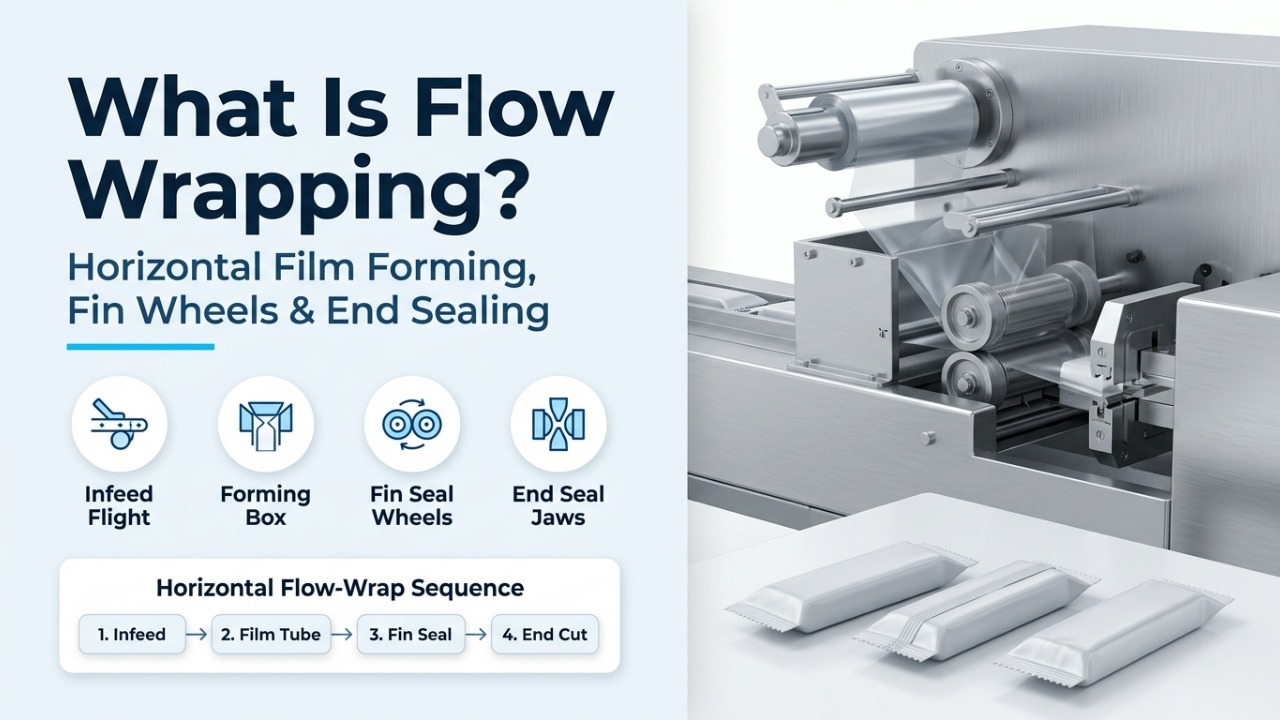
Flow Wrap Packaging: How It Works and When to Use It
Flow wrapping uses reel-fed film to make a pack with a lengthwise seal and two end seals. Check the pack format, product handling and film before choosing a machine.
Read more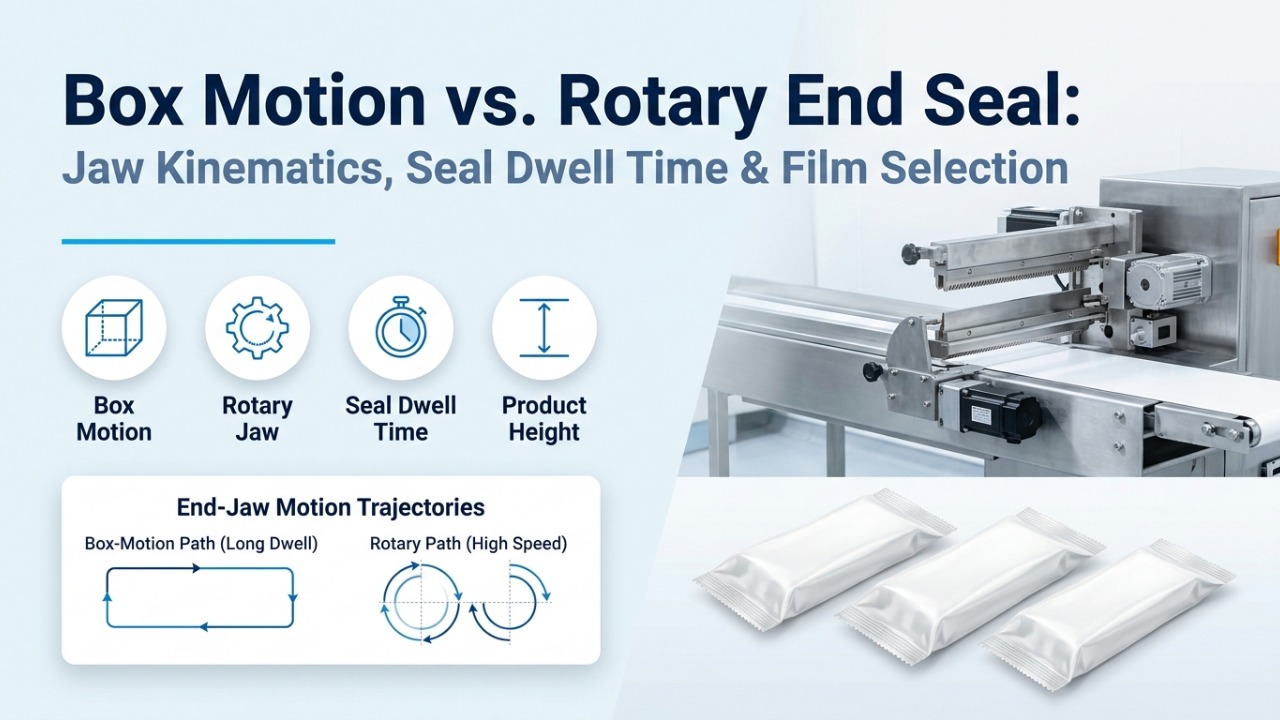
Compare Flow Wrapper Types and Configurations
Rotary or box motion? Top film or bottom film? Compare the feeding, film path and end-seal choices in a flow wrapper proposal.
Read more
Flow Wrapper Price: What Determines Your Project Cost?
What is included in a flow wrapper quote? Check feeding equipment, options, freight and installation before comparing prices.
Read more