
Updated 2026-10-17
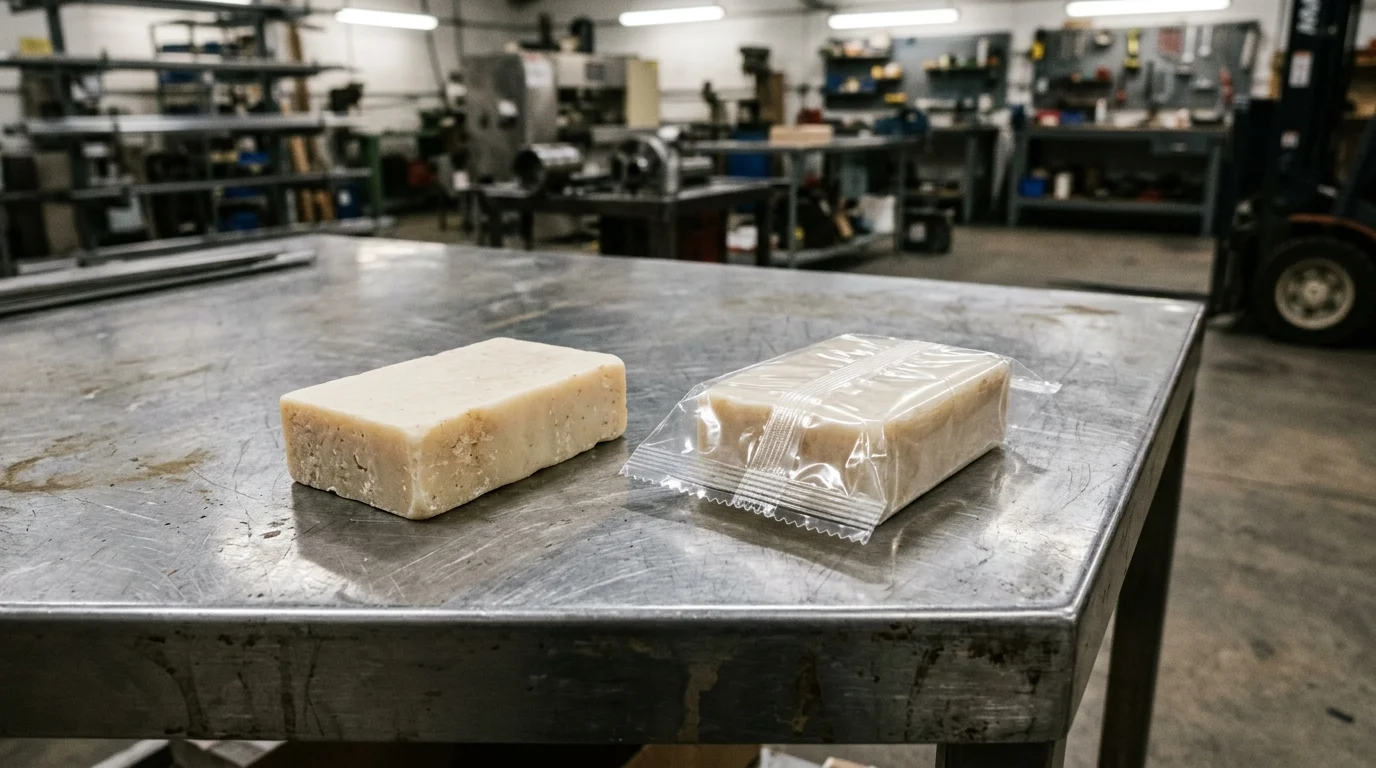
Non-food flow wrapping encloses solid household, personal-care, hospitality, and industrial products inside a horizontal pillow pack sealed along the back or bottom and crimped at both ends. Items such as toilet soap bars, cellulose sponges, pre-saturated wet wipes, hotel cutlery sets, and molded plastic or hardware parts can run on a horizontal flow wrapper when each pack unit holds a defined footprint from the infeed conveyor into the film tube without causing seal failure, film damage, or transfer downtime.
Unlike bakery or confectionery lines—where crumb breakage, chocolate melting, and food-contact hygiene drive machine setup—a flow wrap for non food items is governed by surface friction, part rigidity, sharp or abrasive edges, chemical or moisture retention, and whether loose components need a carrier tray or bottom-fed film web before the forming box. Start by checking whether your product fits a continuous pillow pack in flow wrap packaging or requires a premade bag, vertical drop-fill system, or folded carton overwrap.
Which non-food products fit horizontal flow wrapping
A product fits horizontal flow wrapping when it can move along a horizontal infeed as a repeatable unit, pass through a fixed or adjustable forming box without jamming, and leave enough open film at both ends for the cross-sealing jaws to close. That rule applies whether you are planning household product flow wrapping for retail shelves or industrial part flow wrapping for dust protection and kit verification.
Before comparing machine frames or speed ratings, check four physical properties of the non-food item at the packing station:
- Base stability and slide friction: Molded plastic housings, boxed refills, and solid soap bars slide predictably on stainless steel or low-friction polymer beds. High-friction rubber gaskets, tacky detergent blocks, or ultra-light tissue stacks can drag against guide rails unless carried on a belt or bottom film web.
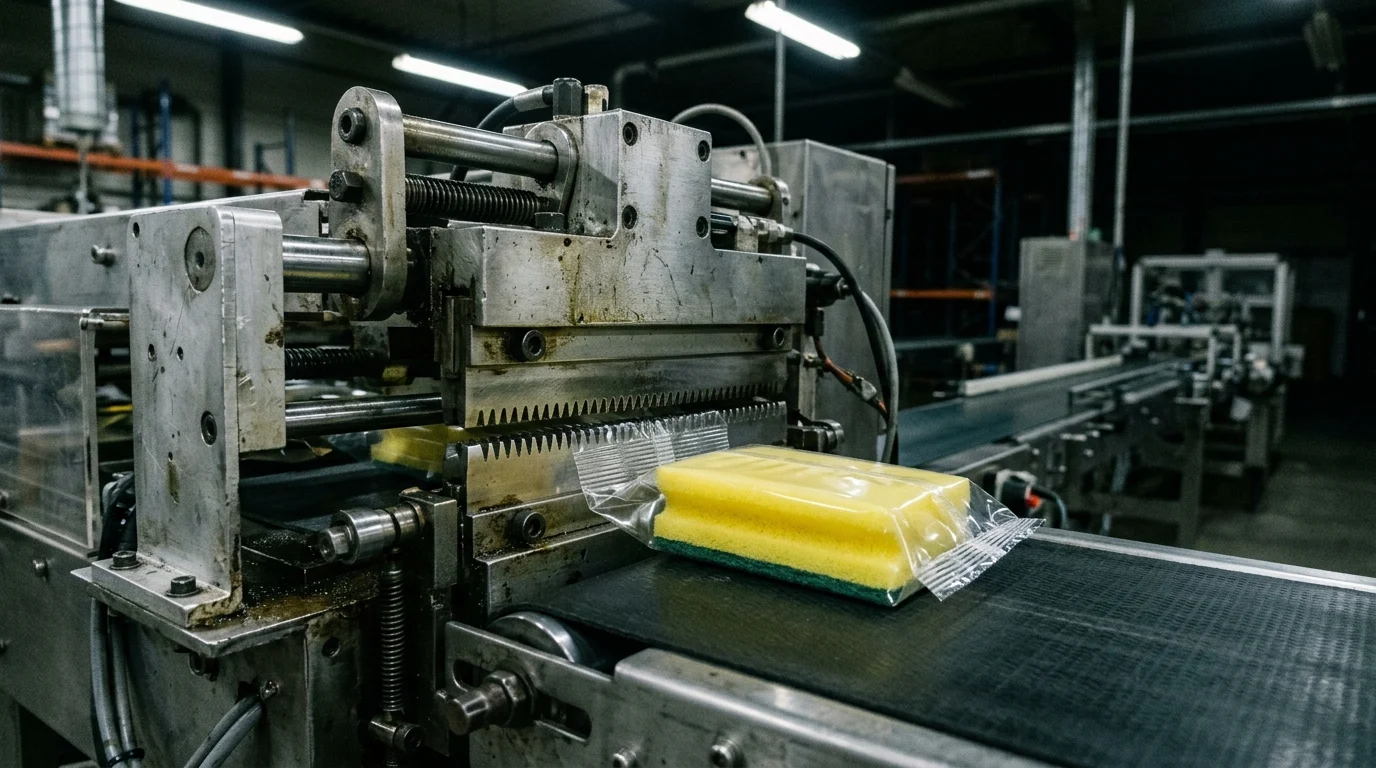
- Compressibility and height recovery: Cellular sponges, scouring pads, and stacked nonwoven wipes compress when guided into the film tube and expand again before the end-sealing jaws. You need to measure product dimensions for flow wrapping in both the relaxed and guided state so the forming collar and jaw opening do not pinch the trailing edge.
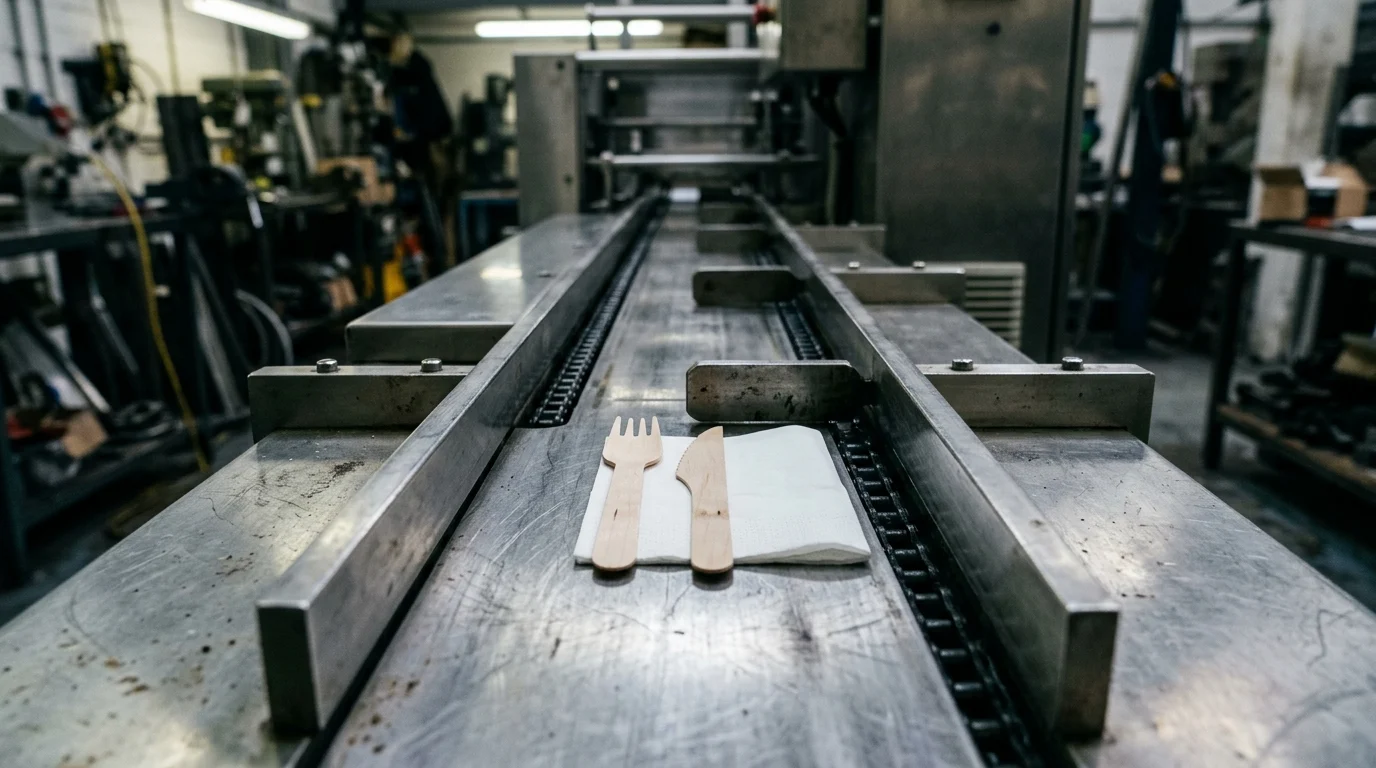
- Component cohesion: A single soap bar or plastic bracket moves as one piece. A hotel amenity kit (toothbrush + toothpaste tube) or a hospitality cutlery pack (wooden fork + knife + salt sachet + napkin) has no shared base unless the napkin, a paperboard U-card, or an inverted bottom film web carries the group into the tube.
- Edge geometry and surface residue: Stamped metal brackets, threaded fasteners, and rigid blister cards can puncture thin film webs if corners hit the forming shoulder at an angle. Waxy soap dust, surfactant residue, or liquid lotion squeezed from wet wipes can contaminate the longitudinal fin wheels and transverse crimp jaws.
| Non-food product group | Primary handling or sealing risk | Typical pack and feed arrangement | What to verify before quoting |
|---|---|---|---|
| Rigid single items (bar soap, taped rolls, boxed refills, plastic housings) | Surface scuffing, waxy residue on guide rails, or corner drag at the forming shoulder | Single pillow pack or banded multipack on a lugged chain or flat belt infeed | Minimum and maximum L × W × H, surface finish at packing temperature, and fin vs lap seam location |
| Compressible household pads (cellulose sponges, abrasive scourers, microfiber cloths) | Springback height catching on the forming box or encroaching into the end-seal zone | Single pack or 2-to-6 piece flat/vertical stack with extended pitch clearance | Relaxed height vs compressed height, abrasive grit shedding, and jaw opening clearance |
| Unattached multi-piece sets (cutlery + napkin, hotel amenity kits, assembly hardware kits) | Individual pieces shifting, overlapping, or skewing between infeed pusher lugs | Napkin-underlaid set, paperboard tray carrier, or bottom-reel (inverted) film transport | Complete bill of items per pack, which item forms the base, and manual vs automatic collating |
| Pre-saturated wet-wipe stacks and moist cleaning towels | Liquid squeeze-out contaminating seal jaws; moisture loss after first opening | Gusseted pillow pack with laminated barrier web and integrated peel-and-reseal label or rigid lid | Lotion/liquid composition, stack height tolerance, label applicator sync, and box-motion dwell time |
| Heavy, sharp-edged, or irregular industrial parts (metal brackets, bearings, plumbing fittings) | Film puncture at the forming collar or jaw cut-off; part sliding on stop-start cycles | Bottom-fed film carrier or trayed pack using thicker puncture-resistant film structures | Part weight, sharpest corner radius, oil/rust-inhibitor residue, and film thickness range |
| Fragrance-sensitive or moisture-reactive blocks (syndet bars, dishwasher tablets, laundry blocks) | Moisture ingress caking the block or perfume loss through permeable films and pinholes | Tight pillow pack with full hermetic fin and crimp seals in barrier laminate or coated BOPP | Required moisture/aroma barrier specification, seal integrity check method, and dust extraction need |
Choosing the pack format across non-food categories
The same non-food item often ships in different retail and institutional formats. Defining the exact pack unit early prevents you from sizing a wrapper around a single item when your retail buyer actually requires a collated 3-pack or a trayed kit. You can compare the layout trade-offs in single vs multipack vs tray flow wrapping.
Single-unit pillow packs
Single wrapping is standard for hotel guest soaps, individual household sponges, single rolls of tape or gauze, replacement air or water filter cartridges, and single service-part kits. A single-unit pack uses the narrowest film web and shortest pitch length for that item, with a fin seal vs lap seal chosen according to whether the back seam can sit folded against the rear face or must lie flat for barcode and label reading. On rigid rectangular blocks such as boxed refills or bar soap cartons, a tight tube wrap around the four sides keeps corner ears short so the finished pillow pack loads cleanly into display shelf trays.
Collated multipacks without trays
Household sponges, bar soaps, scouring pads, and toilet tissue rolls are frequently sold in 2-pack, 3-pack, 4-pack, or 2×2 banded multipacks. When items are firm and flat-sided—such as rectangular soap cartons or compressed sponge blocks—an upstream stacker or side-by-side collator can group them directly ahead of the flighted infeed without a cardboard tray. The film web must be wide enough to wrap the combined perimeter and hold the group tight after the longitudinal fin wheels so the end pieces do not tip into the cross-seal jaws. When switching between a single bar and a 3-bar or 4-sponge multipack on the same machine, check whether your operator will adjust a variable forming box by handwheel scales or swap a dedicated fixed forming collar for each pack width.
Trayed, U-board, and napkin-supported packs
When a non-food kit contains rounded, flexible, or mixed-size items—such as a hospitality cutlery set (fork, knife, spoon, toothpick, salt sachet, and napkin), a hotel vanity kit, or a hardware fastener assortment with small plastic anchors and a hex key—something must unify the footprint. A folded paper napkin can act as a friction sled under lightweight cutlery, while heavier hardware or cosmetic sets use a paperboard U-board, thermoformed blister tray, or corrugated flat pad. Using a tray or U-board also shields thin film from sharp hardware corners during transit and gives retail buyers a flat billboard panel for shelf display.
Gusseted and reclosable pillow packs
Thick wet-wipe stacks, dry facial tissues, and bulky household cleaning pads often use side-gusseted pillow packs so the end seals close neatly across a tall vertical profile without long dog-ears. Side gusseting blades tuck the left and right film flanks inward just before the cross-sealing jaws meet, squaring off the pack ends around a tall stack. For multi-count wet wipes (typically 15 to 120 wipes per pack), the flow wrapper integrates an inline die-cut unit and labeler upstream of the forming box to apply a flexible peel-and-reseal sticker—or works with a downstream lid applicator for rigid flip-top closures—so the pack stays moist between uses.
How non-food items enter the infeed and forming tube
On a non-food packaging line, most stoppages happen between the infeed conveyor and the forming box rather than inside the sealing jaws. Because non-food products vary from slick injection-molded polypropylene to tacky detergent bars and loose 5-piece cutlery sets, the transport architecture determines whether the product arrives square at the film tube.
- Flighted lug chain infeed (top-reel wrapper): Standard for rigid, self-supporting items such as bar soap, carton-packed household refills, taped rolls, and stable sponge blocks. Metal or polymer snap-on pusher lugs advance each item along a stainless-steel bed plate into a film tube formed from above. If the item has painted, polished, or soft wax surfaces, polymer lug faces and low-friction bed liners reduce contact marks.
- Bottom-reel (inverted) belt infeed: Used when products cannot be pushed by a rear flight lug without buckling, separating, or jamming. The film unwinds from below the product level, and the non-food item—such as a multi-piece hardware kit, flexible rubber hose coil, soft microfiber cloth, or un-trayed group—rides directly on the moving film web into the forming folder, where the longitudinal fin seal is formed on top of the pack.
- Photo-electric length sensing and no-product/no-bag control: Industrial moulding, hardware kitting, and contract non-food lines often feed parts with variable lengths or intermittent gaps. A bottom-reel wrapper equipped with photocell product-length detection can adjust bag length to the sensed item length or hold the film web and cross-sealing jaws in standby until the next part arrives, avoiding empty film bags when upstream assembly stations pause.
- Manual placement vs automatic indexing: Lower-volume contract lines and multi-component kit assembly cells often place items onto the infeed by hand or via semi-automatic belt stations. Higher-speed soap presses, sponge slitters, and wet-wipe folders discharge continuously and need automatic buffering, phase-belt indexing, or multi-axis pick-and-place transfer. Compare the line boundary in manual vs automatic feeding for flow wrappers before fixing the quote scope.
Film selection, barrier requirements, and jaw setup
Film choice on a non-food flow wrapper follows the protection job of the pack rather than food shelf-life rules. A dry industrial bracket only needs dust exclusion and part-number visibility, whereas a scented toilet soap bar or pre-saturated disinfectant wipe needs barrier control and continuous hermetic seams. Review flow wrap film and how to calculate flow wrap film width alongside your film supplier's technical data sheet.
As machine builders explain in the ULMA Flow Pack HFFS overview and the Syntegon sealing and cutting overview, matching the film structure to the longitudinal fin wheels and transverse cross-sealing jaws requires checking both material thickness and jaw motion:
- Mono-web BOPP, CPP, and PE films: Clear or white coextruded BOPP (commonly 20 to 40 microns) is widely used for dry cutlery sets, household sponges, paper napkins, and carton-trayed amenities because it runs cleanly over forming shoulders and cuts sharply in rotary jaws. Cast polypropylene (CPP) or polyethylene (PE) webs offer higher tear and puncture resistance for hardware and sharp-cornered plastic parts, though PE requires dedicated temperature control and non-stick jaw coatings.
- Barrier laminates and paper-based structures: Wet wipes, chemical detergent tablets, and scented soap bars typically run on multi-layer laminates (such as PET/PE or BOPP/metallized-film/PE) or heat-sealable coated paper webs to block moisture transfer, retain volatile fragrances, or resist surfactant migration into the seal layer.
- Rotary vs box-motion cross-sealing jaws: Standard rotary cross-sealers suit low-to-medium profile non-food packs running thin BOPP or coated paper at steady speeds. When wrapping tall cellulose sponges, thick multi-count wet-wipe bricks, or heavy barrier laminates that need longer heat-and-pressure dwell time, a box-motion (long-dwell) cross-sealing head keeps the jaws parallel to the web during sealing and gives wider vertical clearance.
- Inline coding, hole punching, and tear notches: Industrial and hardware packs frequently require an inline thermal-transfer overprinter (TTO) mounted on the film unwind frame to print batch codes, SKU numbers, and 2D barcodes directly onto clear or white film before forming. Retail non-food packs sold on pegboards add a heated or pneumatic Euro-slot punch in the cross-sealing station, which requires extra end-seal width so the hanging slot does not breach the sealed cavity.
| Item | Status | Notes |
|---|---|---|
Five non-food application groups and their process checks
When scoping a line, grouping your products by how they behave on the wrapper helps you prepare one clear flow wrapper sample testing plan. Each of the five non-food application groups below connects to a dedicated application page on this site as those guides are published:
1. Soap and detergent bars (soap and detergent bar flow wrapping)
Pressed toilet soap, hotel guest soap, laundry soap bars, and solid syndet blocks are dense, rectangular or oval pieces with a consistent footprint. On horizontal flow wrappers, they run in single packs or multi-bar retail bundles at speeds governed by upstream stamper/press output and accumulation. Key checks include keeping soap powder and glycerin residue off the infeed lugs and longitudinal fin rollers, supporting soft freshly pressed bars without edge dents, and distinguishing a sealed pillow pack from a classical 6-sided pleated/tuck-folded soap wrapper with a paper stiffener liner.
2. Household sponges and cleaning pads (sponge and cleaning pad flow wrapping)
Cellulose sponges, polyurethane foam blocks, laminated green-scourer pads, and steel-wool soaps combine tall profiles with elastic springback and abrasive surfaces. Whether packed singly or in stacks of 2 to 6 pads, the forming box and upper hold-down belts must keep the stack compressed until the longitudinal fin seam closes. Abrasive aluminum-oxide or silicon-carbide coatings on scouring pads also wear down bare metal chutes if the product slides directly against the forming shoulder, making hardened or replaceable wear strips worth specifying early.
3. Wet wipes and dry tissue packs (wipes and tissue flow wrapping)
Converted stacks of pocket tissues, dry paper napkins, and pre-saturated personal-care or household disinfecting wipes move from a folding/stacking machine into the flow wrapper in soft, brick-shaped stacks. Dry tissue packs focus on neat gusset folding and tight film tension without crushing the folded edges. Pre-saturated wet-wipe lines add stainless-steel corrosion resistance in the wetting zone, inline die-cutting for the dispensing opening, synchronized adhesive-label application, and cross-sealing jaws capable of closing through occasional lotion droplets.
4. Hotel amenities and disposable cutlery kits (hotel amenity and disposable kit flow wrapping)
Hospitality and airline service kits bundle multiple lightweight items—such as a fork, knife, spoon, napkin, toothpick, and condiment sachet, or a hotel comb, razor, and vanity set—into one hygienic outer wrap. Because the components have different lengths, weights, and thicknesses, they are either collated onto the folded napkin/tray upstream or carried on a bottom-fed film web so small items cannot slip beneath the pusher lugs. If automatic bowl or magazine feeders are requested for forks, knives, straws, and sachets, confirm each feeder module's refill height, jam sensor position, and changeover time between kit recipes.
5. Hardware, electrical, and molded plastic parts (hardware and plastic part flow wrapping)
Injection-molded plastic fittings, electrical switches, bearings, furniture hardware kits, and automotive spares use horizontal flow wrapping for unitization, dust protection, and visual count inspection. Heavy or sharp-edged parts frequently run on bottom-reel wrappers with heavier-gauge films, optional inline thermal-transfer print-and-apply coding for part numbers and barcodes, and photo-electric length registration (no-product/no-bag or variable bag-length control) when part lengths vary across batches.
When horizontal flow wrapping is the wrong process
Horizontal flow wrapping is built around discrete solid units or collated stacks that can travel horizontally into a continuous film tube. Several common non-food packaging requests look similar on a retail shelf but require a different machine class:
- Loose bulk hardware, granules, or uncollated small fasteners: Bulk screws, nails, plastic pellets, washers, and loose O-rings poured by weight or piece-count belong on a vertical form-fill-seal (
VFFS) bagger or a dedicated hardware counting-and-bagging system, where gravity drops the dose into a vertically formed tube. Compare the mechanical routes in HFFS vs VFFS vs HFS. - Liquids, gels, pastes, and stand-up refill pouches: Liquid hand soap refills, detergent pods in heavy zipper stand-up pouches (
Doypack), and spouted chemical pouches run on horizontal pouch form-fill-seal (HFS) or rotary premade pouch machines—as detailed in the Volpak intermittent pouching technology overview and our pillow pack vs pouch guide—not on a pillow-pack flow wrapper. - 6-sided tuck-folded soap wrappers and luxury cellophane carton overwraps: A traditional hotel or retail soap bar wrapped in pleated paper over an inner stiffener card, or a perfume carton with folded envelope end-flaps (
cigarette-styleoverwrap), requires a dedicated die-fold soap wrapper or carton overwrapper rather than a 3-seal pillow pack. See flow wrap vs overwrap. - Heavy transit multipacks and rigid tray-and-lid blisters: When heavy industrial assemblies need tight load containment for pallet shipping, or when medical/hardware items require a rigid thermoformed cavity sealed to a flat Tyvek or foil lidding web, compare shrink bundling, cartoning, or tray sealing in flow wrap vs shrink wrap vs carton.
Preparing a non-food flow wrapping RFQ brief
Suppliers quote faster and more accurately when your first message separates known product facts from items that still need a workshop trial. Use the checklist below alongside our full flow wrapper RFQ checklist and flow wrapper price guide so every supplier prices the same scope.
If you want to review whether your non-food item fits a standard top-reel wrapper, a bottom-reel carrier setup, or another packaging process entirely, share your product photos, dimensions, pack arrangement, film preference, and target output with the LINEVO team: Send your non-food product photos and pack brief on WhatsApp. Mark any open items as unknown so they can be checked in discussion or sample testing.
Common Questions
Can one horizontal flow wrapper run both single non-food items and multipacks?
Often yes, provided the minimum and maximum pack widths, heights, and pitch lengths fall within the forming box, lug pitch, and cross-jaw clearance of the machine. Changing from a single sponge or soap bar to a 3-pack stack usually requires adjusting or swapping the forming box, setting the bag length and eye-mark recipe, and confirming how the multipack is stacked or collated ahead of the infeed.
When does a non-food product need a bottom-reel (inverted) flow wrapper instead of a standard top-reel machine?
A bottom-reel flow wrapper is chosen when the product cannot slide smoothly along a steel bed plate pushed from behind by a flight lug. Common examples include un-trayed multi-piece cutlery or hardware kits that would separate between lugs, flexible rubber or cable coils, soft microfiber cloths, and heavy or tacky parts that drag on stationary guides. Carrying the product on the moving bottom film web keeps the group intact into the forming tube.
What is the difference between flow wrapping bar soap and traditional pleated soap wrapping?
Flow wrapping encloses the soap bar in a continuous film tube closed with one lengthwise fin or lap seal and two crimped end seals, producing a pillow pack that can be hermetic and moisture-resistant. Traditional pleated or band-wrapped soap packaging folds cut wrapper sheets and an inner stiffener card tightly against all six faces of the bar and seals the folded flaps by hot melt or wax adhesive.
How do wet-wipe flow wrappers apply the resealable top sticker or plastic flip lid?
On a wet-wipe flow wrapper, the flat film web passes through an inline rotary die-cutter that punches or scores the dispensing window and an integrated label applicator that places the pressure-sensitive peel-and-reseal sticker over the window before the web enters the forming box. If the pack uses a rigid plastic flip-top lid, a downstream wet-glue or hot-melt lid applicator attaches the lid over the die-cut window after the pillow pack is sealed.