
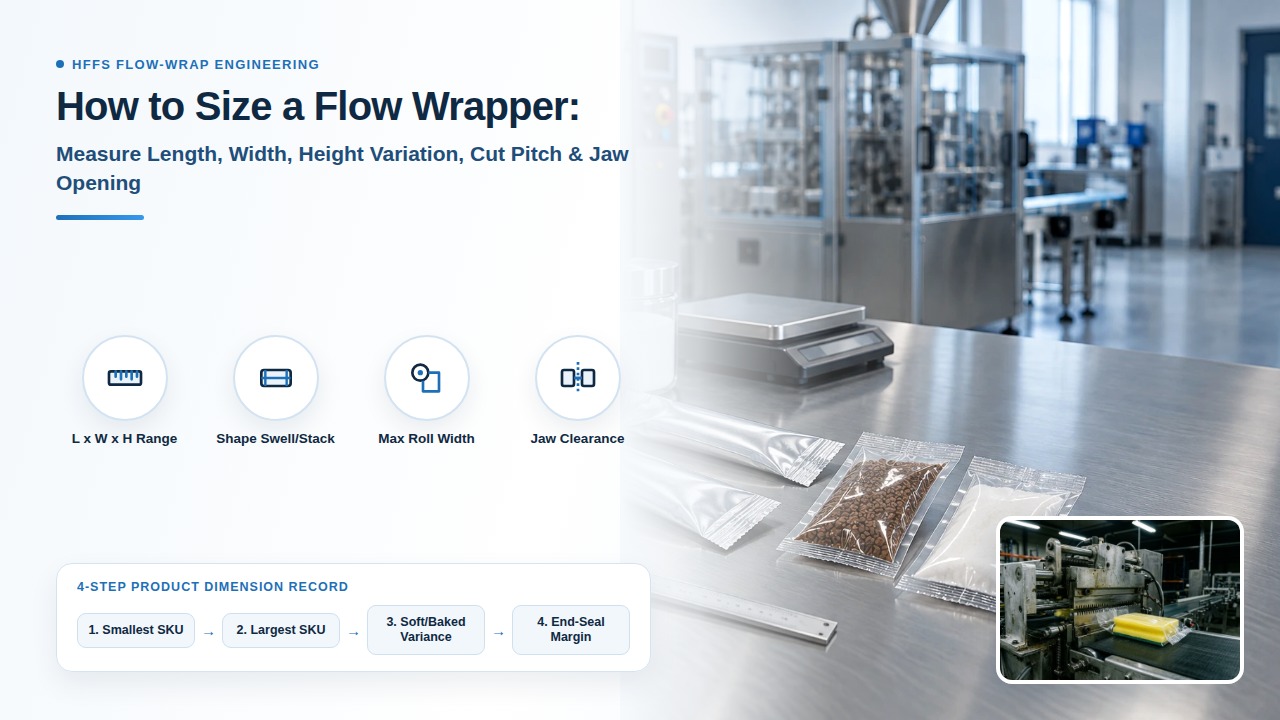
Updated 2026-10-17
Selecting a horizontal flow wrapper solely from a catalog's maximum film width or a single nominal product dimension causes forming-shoulder corner tears, crushed product tails inside rotating cross-jaws, and 12% to 22% excess rollstock waste across multi-SKU lines. Accurate flow wrapper size selection requires translating the complete physical envelope of your smallest, average, and largest real pack formats—including tray rims, paperboard U-cards, and baking or cooling swell—into four coupled mechanical constraints: flat film web width (W_web), cut-to-cut bag pitch and infeed lug spacing (L_cut and P_lug), forming-box throat geometry, and cross-sealing jaw chordal clearance. Because product width and product height both consume flat web circumference while product height and cut length jointly govern rotary jaw sweep clearance, a machine's catalog maximum width, maximum height, and minimum cut pitch cannot be achieved simultaneously on the same format.
Engineering summary: Size a horizontal flow wrapper by measuring actual production samples across all three axes—length along travel (L_prod), width across the machine (W_prod), and total height above the conveyor bed (H_prod)—and verifying that every SKU combination satisfies W_web = 2(W_prod + H_prod) + 2F_fin + C_forming within a 450 to 700 mm reel backstand, L_cut = L_prod + H_prod + 2W_crimp + C_jaw within a 25 to 625 mm cut-pitch window, and radial or box-motion jaw clearance without clipping tall product shoulders at 50 to 600+ packs/min.
| Sizing input or subsystem | Standard engineering baseline or source | Why it governs machine frame & tooling selection |
|---|---|---|
| Three-axis product envelope (L_prod x W_prod x H_prod) | Measured across min, nominal, and max samples including trays/U-cards (ULMA & Syntegon HFFS sizing protocol) | Establishes simultaneous combinations rather than isolated maxima; orientation swap trades infeed pitch against reel width |
| Flat film web width capacity (W_web) | 450 mm standard / 650 mm optional backstand (Syntegon Pack 103/202); up to 700 mm web / 300 mm OD on 76 mm core (ULMA FR 100/200) | Must satisfy W_web = 2(W_prod + H_prod) + 2F_fin + C_forming; exceeding backstand width forces a wider frame tier |
| Bag cut-off pitch (L_cut) & lug spacing (P_lug) | 25–457 mm w/ Ø100 mm short-cut head (Pack 103); 40–565 mm (Pack 202/403); 90–625 mm or 100 mm–infinity photo-sensor mode (ULMA FR 100/200) | Sets linear film speed V_film = (N_ppm * L_cut) / 1000, chain flight pitch, and eye-mark repeat window |
| Product height (H_prod) & jaw clearance | 6–90 mm narrow rotary (Pack 403); 6–110 mm (Pack 103/202); 5–150 mm (FR 100/200); up to 150–225 mm high-profile / FM 300 box-motion | Tall products (>75–90 mm) intersect the circular sweep arc of multi-jaw rotary shafts and require D-cam or box-motion jaws |
| Forming-box throat clearance | +2 to +5 mm over max width/height on fixed formers; +4 to +8 mm on handwheel-adjustable forming boxes | Tight clearance causes product jamming and smears; excessive clearance causes longitudinal fin wander and corner dog-ears |
| Seal, polymer & safety standards | ASTM F88 (cooled peel), ASTM F1921 (molten hot-tack), FDA 21 CFR 177.1520 (polyolefins), OSHA 29 CFR 1910.212 / ISO 12100 | Prevents steep wrap angles from splitting molten fin seams and mandates interlocked guards over cross-sealing knives |
Step 1 — How Do You Measure Product Length, Width, and Height Across Real Production Variations?
Sizing a horizontal flow wrapper starts with measuring conditioned production samples—never nominal CAD targets or bare piece dimensions when the pack includes a carrier. On a horizontal Form-Fill-Seal (HFFS) line, product length (L_prod) is the dimension parallel to conveyor travel, product width (W_prod) is the horizontal dimension perpendicular to conveyor travel across the forming throat, and product height (H_prod) is the vertical profile from the conveyor bed or tray bottom to the highest peak of the product. Rotating an item by 90 degrees on the infeed bed swaps L_prod and W_prod, trading linear film speed and jaw RPM against flat reel width and forming-box span. See our flow wrapper types guide and how a flow wrapper works for how these axes interact across all five machine zones.
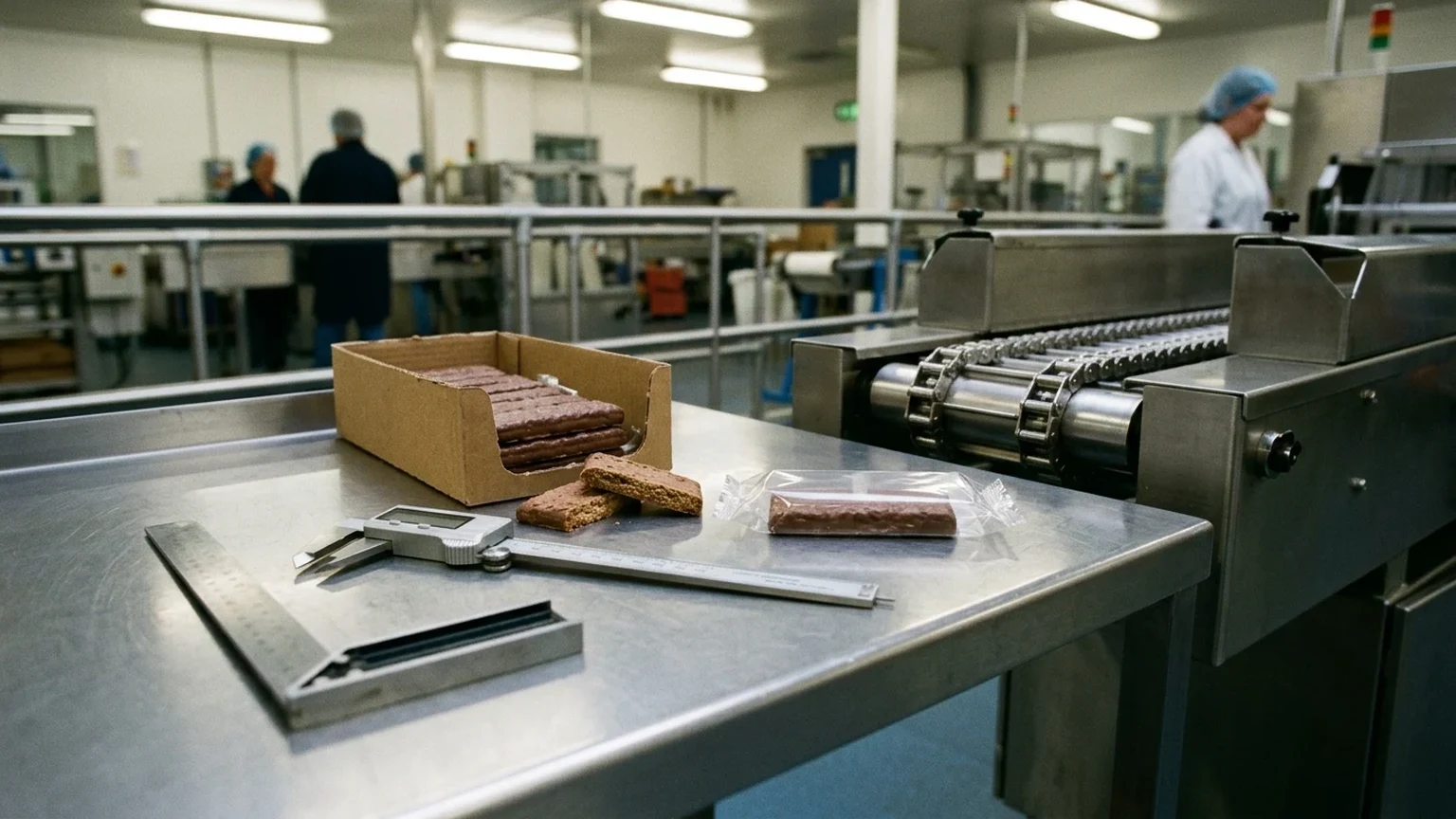
When auditing multi-SKU lines for bakery packaging machines, cereal and protein bar lines, or non-food flow wrapping, engineers record the minimum, nominal, and maximum values for every real format as a locked (L_prod, W_prod, H_prod) triplet rather than three unrelated overall extremes:
- Thermal and mechanical shape swell: Baked loaves, soft cakes, and enrobed bars expand, dome, or develop chocolate bottom tails during cooling. Measure products at the exact temperature (
e.g., 24 to 30 °C exit from a cooling tunnel) and humidity at which they enter the infeed lugs. For tacky or deformable items, review sticky bar flow wrapping and chocolate bar packaging machines. - Grouped, stacked, and shingled multipacks: When wrapping two-high biscuit stacks, edge-stacked crackers, or multipack trays (
seecookie packaging machines and individual vs multipack cookie packaging), record piece-to-piece shingle slippage (typically +3 to +6 mm on length) and cumulative stack height tolerance (n_layers * tolerance_piece). - Carrier trays, U-cards, and flared rims: If the product rides inside a thermoformed punnet, paperboard tray, or corrugated U-card, the upper lip or corner flare of the tray—not the food item inside—frequently defines
W_prod_maxand controls passage through the forming box.
| Measurement record | Physical parameter & tolerance to capture | Governed machine subsystem | Dominant Failure Mode & Mechanical Prevention |
|---|---|---|---|
| Length along travel (L_prod min / nom / max) | Leading-to-trailing edge distance (mm) in travel direction, including chocolate tails, tray lips, or stack shingle drift | Infeed chain lug pitch (P_lug), bag cut length (L_cut), and cross-jaw dwell timing | Oversized product tail lags into the cross-jaw cut path -> Add +8 to +15 mm length tolerance into L_cut and enable optical Misplaced Product Detection (MPD) |
| Width across travel (W_prod min / nom / max) | Cross-machine width (mm) perpendicular to travel at the widest base or upper tray flange | Infeed side-guide rail span, forming-box throat width, and flat film reel width (W_web) | Flared tray rim or wide biscuit edge binds inside forming shoulder -> Size fixed forming throat +2 to +5 mm (+4 to +8 mm adjustable) wider than W_prod_max |
| Total height above bed (H_prod min / nom / max) | Vertical distance (mm) from bed plate to highest dome, topping, or stacked piece plus tray base thickness | Forming-box vertical throat, fin-wheel elevation, and rotary cross-jaw chordal clearance | Rotating upper cross-jaw clips tall product shoulder or pulls molten fin seam open -> Set jaw center height to H_prod / 2 and switch to box-motion head above 75–90 mm height |
| Smallest vs largest SKU combination matrix | Complete (L_prod x W_prod x H_prod) table for every SKU assigned to the line, plus target speed (packs/min) | Backstand reel width range, number of forming boxes, and servo cam speed envelope | Smallest SKU skews sideways inside an oversized forming box -> Specify drop-in dedicated forming boxes whenever SKU cross-perimeter 2(W+H) differs by >25–35 mm |
| Travel orientation & support rigidity | Narrow-end leading vs wide-edge leading; flexural stiffness across deadplate transfer gaps and surface tackiness | Top-reel lug chain vs bottom-reel belt infeed and linear web speed vs reel width trade-off | Wide-edge leading exceeds reel backstand width; limp product sags in lug gap -> Orient narrow-end leading for long bars or specify bottom-reel carrier belt feed |
Step 2 — How Do Product Dimensions Map to Flow Wrapper Machine Frame Tiers and Forming Boxes?
Once the (L_prod, W_prod, H_prod) matrix is locked, engineers map those combinations against standard horizontal flow wrapper frame tiers. Published OEM specifications—such as those in ULMA Packaging's Flow Pack HFFS catalog (covering the FR 100, FR 200, FR 305, and FM 300 Box Motion series) and Syntegon's horizontal flow wrapper portfolio (covering the Pack 103, Pack 202, and Pack 403 series)—separate product dimension limits, bag cut-length ranges, and film reel width capacities because each parameter is constrained by a different mechanical assembly:
- Reel backstand and frame width (
450 mmvs650–700 mm+): Compact and high-speed bar frames (such as the Syntegon Pack 403 and standard Pack 202) carry450 mmmaximum film reels (with optional 650 mm backstands on multi-format models), whereas bakery, produce, and tray wrappers (such as the ULMA FR 100 and FR 200) carry700 mmwide film mandrels (up to 300 mm roll outer diameter on a 76 mm core). - Forming box (
forming shoulder) architecture: The forming box bends the flat web around the product profile. A fixed forming box is precision-machined toW_prod_max + 2 to 5 mmin width andH_prod_max + 2 to 5 mmin height for a single SKU, delivering wrinkle-free tracking at high speed. An adjustable forming box uses handwheel lead-screws (or motorized actuators) to vary throat width and height across multiple formats in3 to 8 minutes, requiring+4 to +8 mmclearance and12 to 18 mmof forming allowance (C_forming).
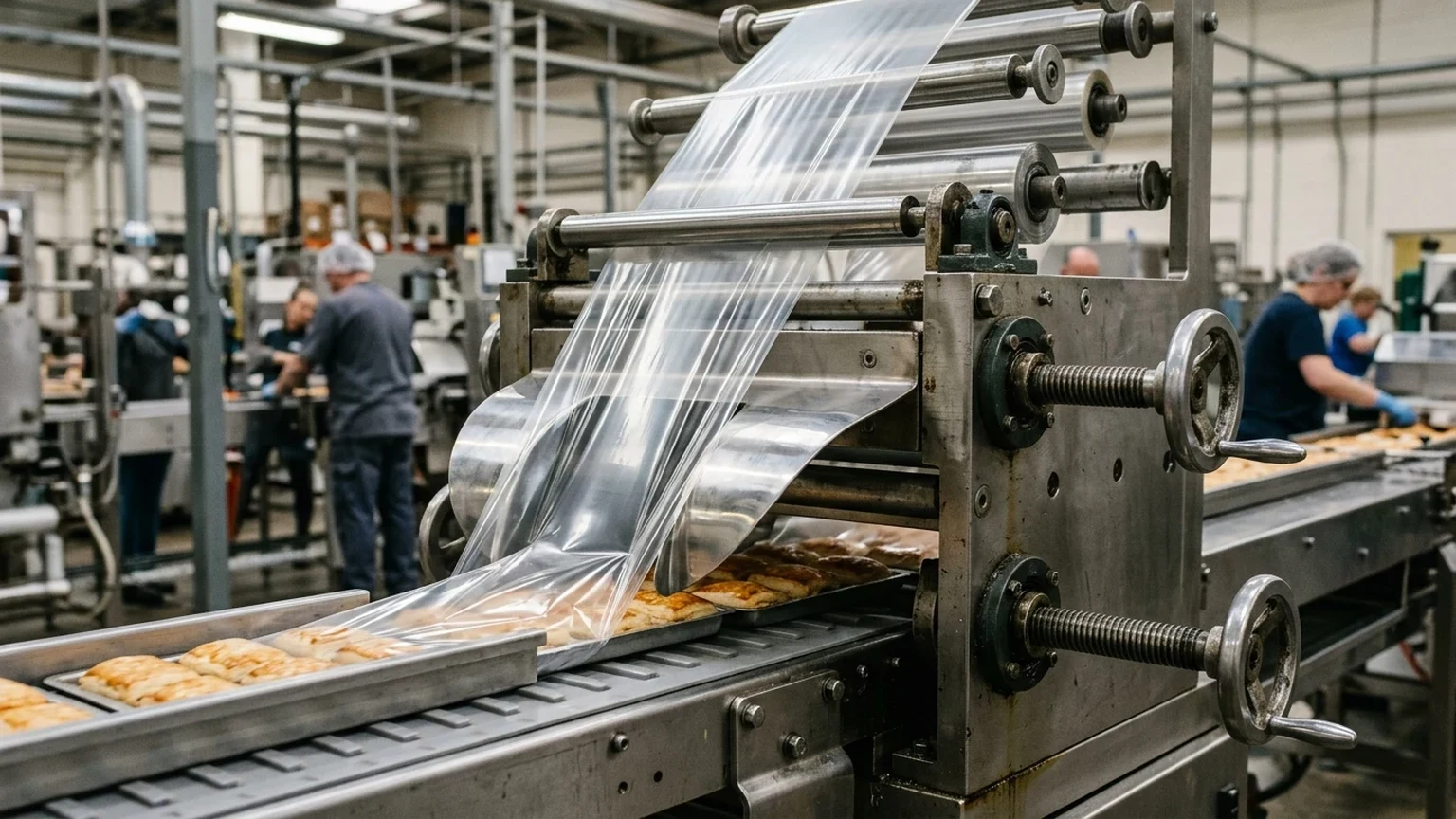
Compare broader machine categories in HFFS machines, flow wrap vs shrink wrap, and HFFS vs VFFS.
| Machine frame tier & OEM reference baseline | Product size envelope (L_prod x W_prod x H_prod) | Reel width (W_web) & cut-pitch (L_cut) baseline | Dominant Failure Mode & Mechanical Prevention |
|---|---|---|---|
| Narrow-Web High-Speed Rotary Frame (Syntegon Pack 403 baseline) | Length: 40–565 mm; Width: 12–120 mm; Height: 6–90 mm (single bars, cookies, chocolate, wafers at 200–600+ packs/min) | Up to 450 mm film reel width; tool-less drop-in fixed forming boxes with deckplate numerical scale markings | High-speed web tracking wander or corner wrinkling on thin laminates -> Use dedicated fixed forming boxes (+2 to +5 mm throat clearance) and servo web-edge guiding |
| Compact Multi-SKU Entry/Mid Rotary Frame (Syntegon Pack 103 / Pack 202 baseline) | Length: 25–457 mm (Pack 103 w/ Ø100 mm short-cut head) or 40–565 mm (Pack 202); Width: 12–250 mm; Height: 6–110 mm; up to 150–175 packs/min | 450 mm standard / 650 mm optional film reel width; 300 mm roll OD; fixed or adjustable forming box | Short products (<55 mm) stall on deadplate between fin wheels and rotary jaws -> Specify Ø100 mm small-center cutting head and short-parts discharge chute |
| Wide-Web Tray & Bakery Rotary Frame (ULMA FR 100 / FR 200 baseline) | Length: 90–500 mm (FR 100) or 100 mm–infinity (FR 200 photo-sensor mode); Width: 10–250/300 mm; Height: 5–150 mm (up to 225 mm option); up to 100–120 packs/min | Up to 700 mm flat film width; 90–625 mm standard bag cut length; 2.0 m lugged or belt infeed; crank-adjustable forming box | Variable-length produce or bakery trays clipped by fixed cut pitch -> Activate infeed photoelectric length-measuring eye to auto-scale L_cut to each item |
| Bottom-Reel Inverted Multi-Format Frame (ULMA FR 305 baseline) | Irregular, soft, limp, or trayless multi-piece products across bakery, confectionery, and medical applications | 500–700 mm bottom-mounted film reel; height-adjustable longitudinal sealing rollers; rotary or optional D-cam jaws; 99-recipe HMI memory | Soft or sticky product jams against lug chain and forming entry plate -> Carry product directly on the bottom-unwound film web into the forming box |
| Tall-Profile & Hermetic MAP Box-Motion Frame (ULMA FM 300 baseline) | Tall bakery loaves, stacked meat/cheese trays, and barrier MAP packs up to 150–200 mm height at up to 150 packs/min (30 m/min web speed) | 600–700 mm barrier film reel; twin-motor orbital box-motion cross-sealing head; automatic recipe recall of fin-roller and jaw-center height | Leaking end seals on thick (>50 um) barrier films or crushed tall tray rims -> Use parallel orbital box-motion jaws (150–350 ms dwell) with motorized jaw-center height |
Step 3 — How Do Product Height and Cut Pitch Govern Cross-Sealing Jaw Clearance?
A frequent sizing error occurs when buyers verify that their product fits inside a catalog's W_prod and H_prod table, but overlook the kinematic interference between product height (H_prod), infeed pitch (P_lug), and the rotary cross-sealing jaw sweep radius (R_jaw). As analyzed in Syntegon's engineering guide to sealing and cutting for horizontal flow wrappers and PFM's Sealing Systems documentation, rotary cross-sealing shafts carry 1, 2, 3, or 4 heated serrated jaws rotating along a circular path above and below the film tube.
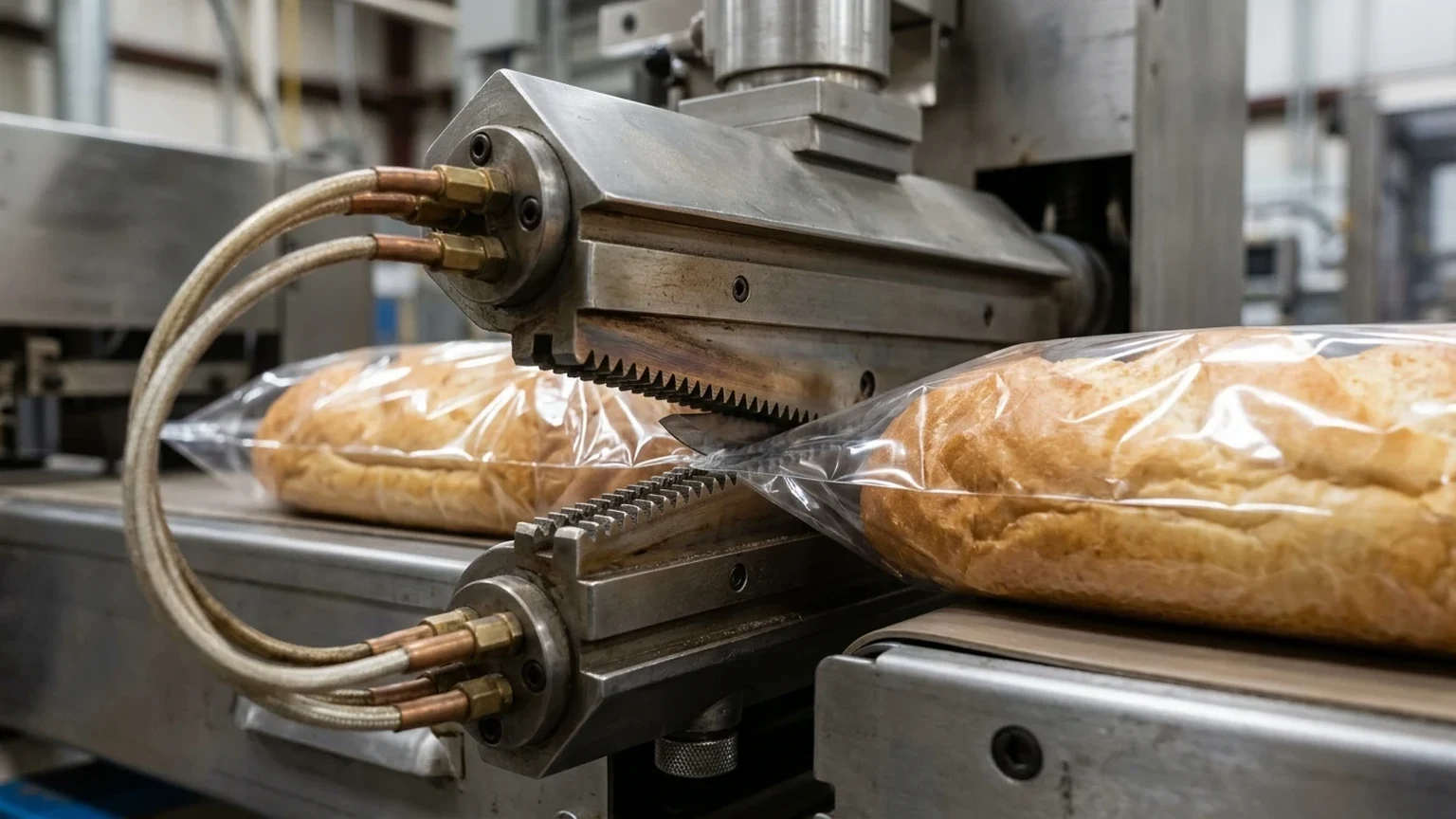
When a product is tall (H_prod > 65 to 85 mm), the upper and lower jaws begin descending into (and ascending out of) the product path well before and after the vertical dead-center pinch line:
- Radial sweep interference: Increasing the number of jaws per shaft (
from Z_jaws = 2 to Z_jaws = 3 or 4) multiplies maximum cutting frequency (packs/min) for short, flat bars, but shrinks the chordal opening between adjacent jaw lobes. If a tall bakery loaf or punnet runs on a 3-jaw or 4-jaw head, the trailing jaw lobe strikes the top rear shoulder of the outgoing product while the leading lobe strikes the front shoulder of the incoming product. - Film drape and hot-tack peel stress: As product height increases, the film tube transitions from a rectangular cross-section (
width W_prod by height H_prod) down to a flat two-layer line (0 mm height) at the transverse crimp jaw, consuming0.8 * H_prodto1.0 * H_prodof longitudinal film length. IfL_cutis sized too short, the steep film gusset pulls outward against the freshly welded longitudinal fin seam and end crimp while the polymer is still molten—causing immediate seam splitting unless the sealant layer satisfiesASTM F1921hot-tack strength andASTM F88cooled peel strength requirements (seeflow wrap film guide and bread flow wrap vs bagging). - Center-height elevation adjustment: To prevent the bottom of the pack from dragging across the lower jaw or pulling the end seal off-center, the vertical elevation of the cross-sealing shaft centerline must be positioned at half the product height (
H_center = H_prod / 2) above the transfer bed.
Physical-Threshold Engineering Rules for Flow Wrapper Size Selection
Apply these four physical-threshold rules during initial equipment sizing to eliminate frame and tooling mismatches before requesting quotations:
- Product Height vs Cross-Jaw Kinematics (
Rotary Multi-Jaw vs Box-Motion Long-Dwell): If maximum product heightH_prod_max > 75 to 90 mm(or if H_prod_max exceeds 45% of the rotary jaw radius R_jaw), or if barrier laminate thickness exceeds50 to 60 umfor Modified Atmosphere Packaging (MAP) -> prioritize a box-motion (orbital D-cam) cross-sealing head (or a wide-center 1-jaw/2-jaw rotary head with extended lug pitch) over a 3-jaw or 4-jaw high-speed rotary head because box-motion jaws travel vertically straight into the gap and horizontally parallel with the web for150 to 350 ms, eliminating circular sweep clipping on tall product shoulders. - Forming-Box Architecture (
Dedicated Fixed Former vs Crank-Adjustable Former): If a production line executes more than2 to 3 format changeovers per 8-hour shiftacross SKUs whose width or height differs by more than8 to 10 mm, and target speed is<= 180 to 220 packs/min-> prioritize a handwheel- or servo-adjustable forming box with numerical counter scales; conversely, if running a single high-volume SKU at> 250 to 600 packs/minor running thin gauge films (< 20 to 25 um) where product cross-perimeter2(W_prod + H_prod)changes by more than25 to 35 mmbetween SKUs -> prioritize dedicated drop-in fixed forming boxes (machined to +2 to +5 mm throat clearance) because oversized adjustable throats allow thin film tubes to wander laterally and wrinkle at the fin wheels. - Length Tolerance & Pitch Metering (
Fixed Lug Chain vs Photoelectric Length-Sensing Belt): If natural product length variation within a batch exceeds±8 to ±12 mm(such as artisan sourdough loaves, fresh celery/leeks, or hand-loaded produce trays) -> prioritize a belt infeed with an inline photoelectric product-length sensor (variable bag-length mode, 100 mm to infinity) over a fixed-pitch lugged chain conveyor because the optical sensor measures the trailing edge of each item and dynamically stretchesL_cutin real time, preventing long pieces from being guillotined by the cross jaws. - Short-Pitch Micro Formats (
Standard Jaw Center vs Ø100 mm Short-Cut Head): If minimum product lengthL_prod_minfalls between25 and 55 mm(such as bite-size chocolates, biscuit miniatures, or hotel soap bars) -> prioritize a short-centerØ100 mmrotary cutting head paired with a short-parts transfer chute (as engineered on the Syntegon Pack 103 short-pitch option) over a standardØ150 to Ø180 mmjaw center because standard jaw centers cannot place the fin-wheel exit nip close enough to the cross-jaw nip to support sub-60 mmpacks without stalling on the deadplate.
Quantitative Sizing Equations and Worked Arithmetic Examples
Every flow wrapper sizing study must convert physical product measurements (L_prod, W_prod, H_prod) into exact rollstock slitting width, cut-off pitch, rotary jaw clearance, and multi-SKU film waste. For a companion worksheet focused on rollstock purchasing, see flow wrap film width and bag length guide.
1. Flat Film Web Width (W_web) — Fin Seal vs Lap Seal
W_web_fin = 2 * (W_prod_max + H_prod_max) + 2 * F_fin + C_forming
W_web_lap = 2 * (W_prod_max + H_prod_max) + O_lap + C_forming
- Variables:
W_prod_max= maximum product or tray width across travel (mm);H_prod_max= maximum product or stack height above bed (mm);F_fin= single folded longitudinal fin-seal flange (12 to 15 mm);O_lap= flat inner-to-outer lap-seal overlap (15 to 20 mm);C_forming= forming-box folding and tracking clearance (8 to 12 mmfixed former;12 to 18 mmadjustable former). - Worked example: Sizing a bakery flow wrapper for a loaded paperboard tray with
W_prod_max = 140 mmandH_prod_max = 55 mm, using aF_fin = 15 mmfin seal and an adjustable forming-box allowance ofC_forming = 14 mm, yieldsW_web_fin = 2 * (140 + 55) + 2 * (15) + 14 = 390 + 30 + 14 = 434 mm(specify a 435 mm or 440 mm slitted reel). Because435 mmleaves only15 mmof margin on a450 mmcompact backstand, any wider SKU requires a650 to 700 mmwide-reel frame. Switching to aO_lap = 18 mmlap seal reduces web width toW_web_lap = 390 + 18 + 14 = 422 mm(a 2.8% rollstock width reduction).
2. Cut-Off Bag Pitch (L_cut), Infeed Lug Pitch (P_lug), and Linear Film Speed (V_film)
L_cut = L_prod_max + H_prod_max + 2 * W_crimp + C_jaw
V_film (m/min) = (N_ppm * L_cut) / 1000
P_lug >= L_cut + L_lug_finger + C_infeed_margin
- Variables:
L_prod_max= maximum product length along travel (mm);H_prod_max= vertical height allowance for film end-drape at both ends (mm);W_crimp= width of one serrated transverse end seal (12 to 18 mm);C_jaw= total clearance between product ends and the inner edge of the heated jaw crimp (16 to 28 mm total);N_ppm= target throughput (packs/min). - Worked example: For the same tray with
L_prod_max = 185 mm,H_prod_max = 55 mm, twoW_crimp = 16 mmserrated end seals (32 mm total), andC_jaw = 24 mmtotal jaw clearance (12 mm per end), cut-to-cut bag length isL_cut = 185 + 55 + 32 + 24 = 296 mm. Running atN_ppm = 110 packs/minrequires a linear film velocity ofV_film = (110 * 296) / 1000 = 32.56 m/min(0.543 m/s) and an infeed chain lug spacing ofP_lug = 330 mm.
3. Rotary Cross-Jaw Chordal Opening (H_clear_max) and Swept Product Gap (G_min)
H_clear_max = 2 * R_jaw * sin(180 deg / Z_jaws) - W_crimp_head
G_min = 2 * sqrt(R_jaw^2 - (R_jaw - H_prod_max)^2) + W_crimp_head + C_safety
- Variables:
R_jaw= rotary cross-sealing jaw pitch radius (mm, half of shaft center distanceD_jaw);Z_jaws= number of sealing jaws per shaft (1, 2, 3, or 4);W_crimp_head= physical thickness of the heated jaw body (20 to 26 mm);C_safety= dynamic phase safety clearance (10 to 16 mm). - Worked example: On a standard
D_jaw = 150 mm(R_jaw = 75 mm) rotary shaft withW_crimp_head = 22 mm, a twin-jaw head (Z_jaws = 2) provides a maximum chordal opening ofH_clear_max = 2 * 75 * sin(90 deg) - 22 = 128 mm, whereas a 3-jaw head (Z_jaws = 3) shrinks the chordal opening to2 * 75 * sin(60 deg) - 22 = 107.9 mm. For a tall product ofH_prod_max = 55 mm, the horizontal chord swept by aR_jaw = 75 mmcircle across a55 mmvertical drop is2 * sqrt(75^2 - (75 - 55)^2) = 144.6 mm, showing why products taller than75 to 90 mmrequire a larger jaw center distance (D_jaw >= 180 to 220 mm), wider pitch, or a box-motion head.
4. Multi-SKU Shared-Reel Over-Width Film Waste (M_waste)
M_waste (kg/year) = N_packs_yr * (L_cut / 1000) * ((W_web_shared - W_web_opt) / 1000) * (GSM / 1000)
- Variables:
N_packs_yr= annual pack volume of a smaller SKU run on an oversized shared film reel;W_web_shared= width of the shared film reel sized for the widest SKU (mm);W_web_opt= optimal calculated web width for the smaller SKU (mm);GSM= film basis weight (g/m²). - Worked example: Running
8,000,000 packs/yearof a smaller biscuit SKU (L_cut = 220 mm, optimalW_web_opt = 360 mm) using aW_web_shared = 435 mmreel (75 mmexcess width) on40 g/m²BOPP/CPP laminate ($3.50/kg) generatesM_waste = 8,000,000 * 0.220 * 0.075 * 0.040 = 5,280 kg/year, costing5,280 * $3.50 = $18,480/yearin avoidable film waste—paying back a dedicated$1,400fixed forming box and slitted360 mmreel in28 days.
Total Cost of Ownership (TCO) Tooling & Film Waste Ledger
Forcing an extreme range of small and large SKUs through a single forming box, single reel width, and single lug pitch creates hidden TCO penalties that dwarf initial tooling savings. Compare capital equipment pricing tiers in flow wrapper price guide, upstream automation boundaries in manual vs automatic feeding, and our flow wrapper requirements checklist.
| Sizing & tooling cost driver | Compromised single-setup line impact | Properly sized multi-format line impact | Engineering specification to lock in RFQ |
|---|---|---|---|
| Shared-reel over-width film scrap | Running smaller SKUs on a reel sized for the widest SKU wastes 30–80 mm of web width ($8,000–$22,000/yr at 5–10M packs/yr) | Dedicated slitted reel widths matched within ±5 mm of each SKU’s W_web formula cut rollstock waste below 1% | Group SKUs into 20–30 mm perimeter bands and specify dedicated slitted reel widths for any SKU >1.5M packs/yr |
| Forming-box changeover & tracking rejects | 15–35 min of manual trial-and-error per width change; 50–120 m of wrinkled film scrap when folding ratio is off-center | 3–6 min repeatable changeover using drop-in fixed forming boxes or digital lead-screw counter coordinates | Order quick-release fixed forming boxes for high-volume hero SKUs and a counter-indexed adjustable former for short runs |
| Infeed lug pitch & jaw-crush downtime | Fixed chain lugs spaced for longest SKU cap line speed on short SKUs; tight pitch on long SKUs causes jaw crushes (20–40 min cleanout) | Dual-chain alternating lug release, servo phasing belt, or photoelectric length-sensing eye adapts pitch in <2 min | Specify optical Misplaced Product Detection (MPD), servo NPNB phase inhibit, and quick-release polymer pusher lugs |
| Jaw center-height & center-fin leak rejects | Unadjusted jaw centerline on tall SKUs pulls end seals downward and creates 2–6% micro-channel leaks under ASTM F88 / F1921 testing | Recipe-driven or handwheel-indexed fin-roller and cross-jaw center-height adjustment keeps crimp centered at H_prod / 2 | Mandate calibrated vertical height adjustment on both the longitudinal fin assembly and cross-sealing jaw housing |
What to Send Us for a Multi-SKU Flow Wrapper Sizing Audit
| Item to provide | Why our engineers need it | Acceptable engineering format |
|---|---|---|
| Complete SKU dimension matrix (min / nom / max L x W x H & weight) | Calculates W_web, L_cut, forming-box throat spans, and checks whether one frame covers all combinations | Spreadsheet listing every SKU (e.g., SKU-A: 110x40x22 mm ±2 mm, 48 g; SKU-B: 185x140x55 mm tray, 240 g) |
| Conditioned product & carrier tray photos (with scale) | Verifies travel orientation, tray rim flare, bottom chocolate tails, stack stability, and deadplate stiffness | Top, side, and end photos next to a steel millimeter scale; 15–30 physical sample units for factory trial |
| Film laminate specification & seal geometry | Sets fin-seal (2 x 12–15 mm) vs lap-seal allowance, ASTM F1921 hot-tack window, and rotary vs box-motion dwell | 20 um BOPP / 25 um CPP heat-seal laminate (or cold-seal / barrier PET/PE), target fin width, and artwork dieline |
| Target speed (packs/min) & changeover frequency | Determines linear web velocity (V_film), rotary jaw lobe count (Z_jaws), and fixed vs adjustable forming-box ROI | 120 packs/min on trays, 220 packs/min on single bars, two 8-hour shifts, 3 SKU changeovers per shift |
| Upstream infeed arrival & plant space constraints | Sizes infeed conveyor length (2.0 m standard vs extended auto-feed), floor envelope, and 3-phase power / air supply | Hand-fed by 2 operators or inline from 900 mm cooling tunnel; max 5.2 m floor length, 380–480 V 3-phase + 6 bar air |
Send Your SKU Dimension Matrix & Sample Photos on WhatsApp for a Sizing Review
Common Questions on Flow Wrapper Size Selection
Why can a flow wrapper not run its catalog maximum product width and maximum product height at the same time?
Both product width (W_prod) and product height (H_prod) draw from the same flat film reel width according to W_web = 2(W_prod + H_prod) + 2F_fin + C_forming. On a wrapper with a 450 mm maximum reel width, a 200 mm wide tray and a 100 mm tall loaf require W_web = 2(200 + 100) + 30 + 14 = 644 mm of film, exceeding the 450 mm backstand by 194 mm even though 200 mm width and 100 mm height each appear inside the brochure table individually.
When do I need dedicated fixed forming boxes instead of one adjustable forming box?
An adjustable forming box handles multi-SKU width and height variations efficiently at speeds up to 180–220 packs/min when product cross-perimeters stay within a moderate band. When running thin films (<20–25 um), speeds above 250–600 packs/min, or SKUs whose cross-perimeter 2(W_prod + H_prod) differs by more than 25–35 mm, dedicated drop-in fixed forming boxes machined to +2 to +5 mm throat clearance prevent corner dog-ears, fin wander, and changeover waste.
How does rotating a rectangular product 90 degrees on the infeed change machine sizing?
Feeding a product narrow-end leading minimizes cross-machine width (W_prod), reducing required flat film width (W_web) and allowing a narrower forming box and reel backstand, but increases length along travel (L_prod), which increases cut pitch (L_cut) and linear film velocity (V_film) at a given packs-per-minute rate. Feeding wide-edge leading shortens cut pitch and lowers linear web speed, but requires a wider forming throat, wider film reel, and wider cross-sealing jaws.
How do flow wrappers handle natural length variations in baked bread or fresh produce without cutting into the product?
When product length varies by more than ±8 to ±12 mm from piece to piece, engineers replace fixed-pitch lugged chains with a belt infeed and an inline photoelectric product-length sensor (such as on the ULMA FR 200 variable-length configuration). The optical sensor detects the leading and trailing edges of each item and dynamically adjusts the servo cross-jaw cut cycle so every bag length matches the individual product.
Related guides
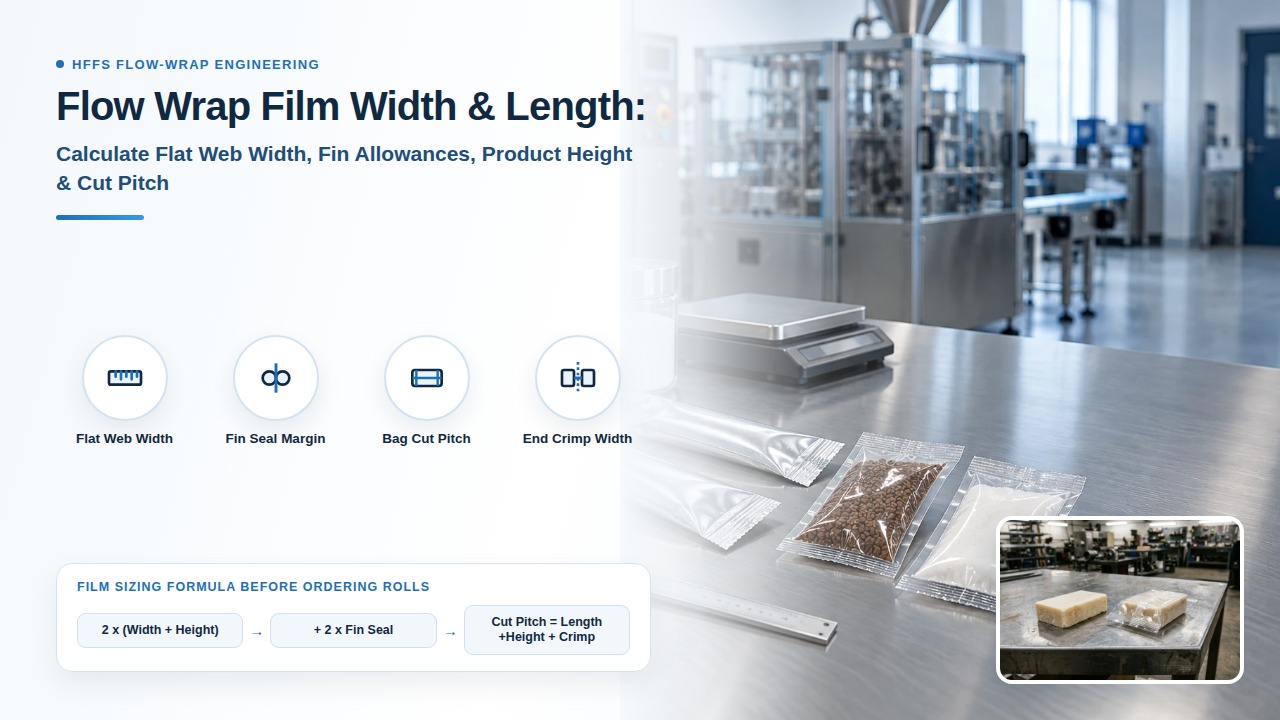
Flow Wrap Film Width and Bag Length: Sizing Guide
Calculate flow wrap film web width (W_web) for fin vs lap seals, cut-to-cut bag length (L_cut), side gussets, eye-mark repeat pitch, and packs per roll yield.
Read more
Flow Wrapper Price: What Determines Your Project Cost?
What is included in a flow wrapper quote? Check feeding equipment, options, freight and installation before comparing prices.
Read more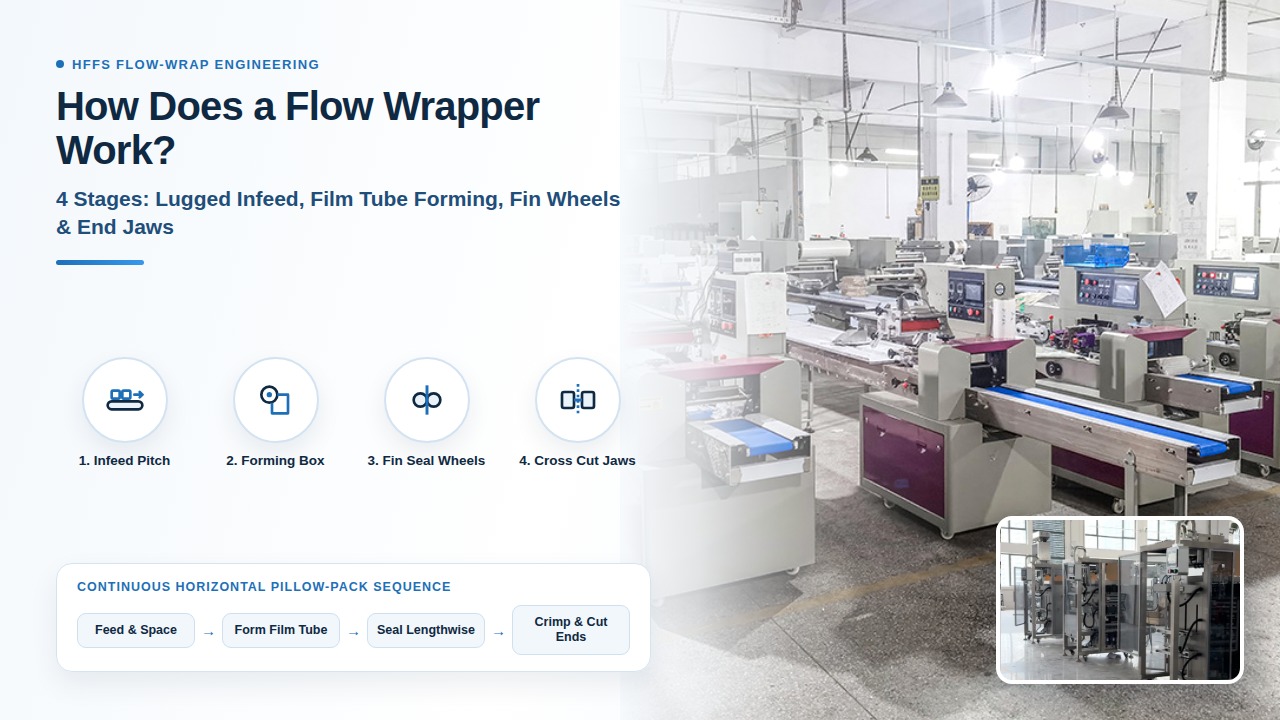
How Does a Flow Wrapper Work? Step-by-Step Process
Learn how a horizontal flow wrapper works across 5 stages: pitch infeed, tube forming, fin-wheel sealing, cross-sealing jaws, and discharge calculations.
Read more