
Updated 2026-10-17
Choosing between individual and multipack cookie flow wrapping without calculating post-opening moisture ingress, biscuit thickness stack-up, and upstream-to-downstream speed ratios causes 2.5% to 5.0% mechanical edge breakage, crushed leading biscuits inside rotary cross-jaws, and up to $350,000 per year in avoidable film and plastic tray waste. Accurate individual vs multipack cookie packaging selection requires matching your retail portion target and shelf-life barrier limit to one of five horizontal Form-Fill-Seal (HFFS) architectures: single-piece portion wraps (1 cookie), flat-stacked pile-packs (2 to 6 cookies stacked vertically), on-edge biscuit slugs (8 to 25+ cookies standing upright in a row), loaded paperboard or thermoformed plastic trays, and two-stage primary-plus-secondary multipacks ("two-in-one" bag-in-bag collations). Each format imposes a distinct three-axis product envelope (L_prod x W_prod x H_prod), feeding mechanism, flat film web width (W_web), and seal-integrity boundary governed by ASTM F1249 water vapor transmission rate (WVTR), ASTM F88 seal peel strength, ASTM F1921 hot-tack resistance, and FDA 21 CFR 177.1520 food-contact polyolefin standards.
Engineering summary: Select single-piece or 2-to-4 piece flat pile-packs (running at 175 to 600+ packs/min on narrow-web rotary wrappers such as the Syntegon Pack 403 or Pack 202) when portion control and post-opening crispness (keeping biscuit water activity aw < 0.35 to 0.40 under ASTM F1249 WVTR < 0.8 to 2.0 g/m²·24h) are mandatory, and pair them with a secondary multipack wrapper (Q_sec = Q_prim / N_group) for retail family packs; select direct on-edge slugs (running at 145 to 400 slugs/min on volumetric or count loaders such as the Syntegon Pack 301 LS with Smart Duplex Measuring Loader SDML) or bottom-reel trayless pile wrappers (such as the ULMA FR 305 or LTC-320) when minimizing rollstock area per biscuit (reducing film consumption by 51% to 73% vs single wraps) and eliminating thermoformed plastic trays are the primary cost drivers.
| Cookie pack parameter or subsystem | Standard engineering baseline or formula | Why it governs wrapper architecture & feeder selection |
|---|---|---|
| Single-piece & flat pile-pack envelope (1 to 6 biscuits) | 175–600+ packs/min (Syntegon Pack 103/202/403 baseline); 50–320 pile packs/min via servo penny stacker or linear-motor belt; W_web <= 450 mm | Preserves single-serve crispness after outer pack opening; requires tight forming box (+2 to +5 mm) and high-speed 2-up/3-up rotary jaws |
| On-edge biscuit slug envelope (8 to 25+ biscuits) | 145–400 slug packs/min (Syntegon Pack 301 LS + SDML / On-Edge Turbo Loader baseline); <10 min slug-length changeover; optional roll-fed corrugated U-card | Cuts film area per biscuit by 65–75% vs individual wraps; requires volumetric slug measurement when biscuit thickness varies by > ±0.6 mm |
| Trayed vs trayless / U-card multipack support | Up to 350 tray wraps/min (Syntegon tray feeder) or 100–200 ppm on wide-web HFFS (ULMA FR 100/200/305 & FM 300, up to 700 mm web width) | Pre-made plastic trays protect ultra-fragile cookies (<8 N breaking force) but add $0.025–$0.045/pack; roll-fed U-cards or bottom-reel FR 305 cut material cost |
| Primary-to-secondary multipack speed balance | Q_prim = Q_oven / N_prim; Q_sec = Q_prim / N_group; M_prim = ceil(Q_prim / (Q_cap_prim * OEE)) across primary & secondary HFFS | Determines how many high-speed primary wrappers (400–600 ppm) must feed one secondary family-pack wrapper or cartoner (60–200 ppm) |
| Flat film web width (W_web) & cut pitch (L_cut) | W_web = 2(W_prod + H_prod) + 2F_fin + C_forming; L_cut = L_prod + k_H * H_prod + 2W_crimp + C_jaw (side-gusset tuck G_gusset <= 0.45 * H_prod) | Standing round biscuits on edge swaps H_prod from n*t_b to biscuit diameter D_b, shifting machine sizing from narrow-web to wide-web frames |
| Moisture barrier, seal & guarding standards | ASTM F1249 WVTR < 0.8–2.0 g/m²·24h (37.8 °C / 90% RH); ASTM F88 peel & ASTM F1921 hot-tack; FDA 21 CFR 177.1520; OSHA 29 CFR 1910.212 / ISO 12100 | Prevents biscuit water activity from rising above aw = 0.35–0.40 (loss of crunch) and prevents crumb/shortening contamination from splitting end seals |
How Do the Five Cookie Flow-Wrapping Formats Compare in Geometry, Speed, and Failure Modes?
Before requesting a horizontal flow wrapper proposal, engineering teams must distinguish between primary direct-contact formats (where bare baked cookies touch the inner sealant layer of the film or carrier tray) and secondary multipack formats (where already flow-wrapped primary portion packs are collated inside an outer overwrap or carton). As documented across Syntegon's horizontal flow wrapper portfolio (covering the Pack 103, Pack 202, Pack 403, and Pack 301 LS series) and ULMA Packaging's Flow Pack HFFS solutions (covering the FR 100, FR 200, FR 305, and FM 300 series), changing how cookies are oriented inside the wrapper completely alters the machine's feeding boundary, forming-box cross-section, and rotary jaw clearance. Review our cookie and biscuit packaging machine guide and bakery packaging machine overview for the broader application framework.
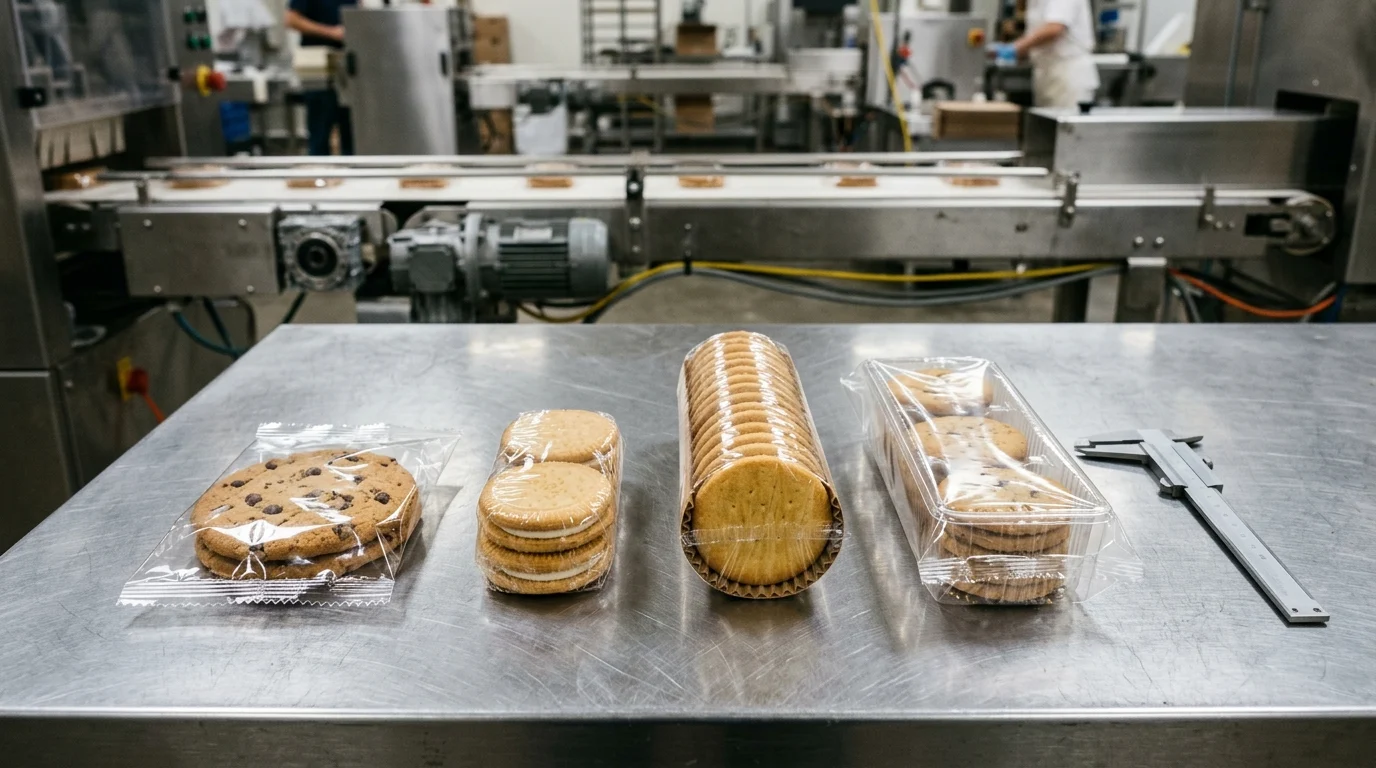
Each of the five core cookie flow-wrap configurations addresses a specific retail and mechanical boundary:
- Single-Serve Individual Pack (
1 Biscuit per Primary Wrapper): A single cookie, sandwich biscuit, or enrobed wafer travels flat on its base (H_prod = t_b = 5 to 15 mm) through a narrow fixed forming box at175 to 600+ packs/min. Because each piece is hermetically sealed in its own barrier pouch (typically 20 to 30 um BOPP/Met-BOPP or BOPP/CPP), every cookie retains oven-fresh crispness until the moment of consumption, making it the standard for foodservice, airline catering, hospitality, and single-serve vending. - Flat-Stacked Pile-Pack (
2 to 6 Biscuits Stacked Flat, 1x2 to 1x6 or 2x2): Two to four round, square, or rectangular biscuits are stacked flat on top of one another (or in two side-by-side 2-high/3-high piles) without an internal tray, running at150 to 320 packs/min. Flat pile-packs provide an ideal portion-control unit (30 to 60 g) while cutting film usage per biscuit by45% to 65%compared to single wraps. - On-Edge Biscuit Slug (
8 to 25+ Biscuits Standing Upright on Edge): Biscuits are rotated90 degreesonto their bottom edges to form a horizontal cylinder or rectangular column (L_prod = N_slug * t_b), wrapped either directly in film (portion slug) or inside an inline-formed 2-wall corrugated paperboard U-card or 3-wall tray at145 to 400 slugs/min(Syntegon Pack 301 LS / On-Edge Turbo Loader baseline). Side-gusset tucking fingers fold the end walls inward so the cross-sealing jaws produce a tight, square-ended retail roll. - Loaded Thermoformed Tray or Paperboard Punnet Multipack (
8 to 36+ Biscuits): Loose or stacked cookies are placed into a multi-cavity thermoformedPP/PETor fluted paperboard tray—either manually, by magazine drop, or by high-speed vision delta robots (up to 600 trays/min / 1,200 sandwich cookies/min on Syntegon RPP cells)—before passing through a wide-web flow wrapper (ULMA FR 100 / FR 200 / FM 300,up to 700 mmfilm width) at100 to 350 packs/min. - Two-Stage Secondary Multipack (
"Two-in-One" Primary HFFS + Secondary HFFS / VFFS / Cartoner): Cookies are first wrapped as individual pieces (1x1) or portion pile-packs (1x2to1x4) on2 to 4high-speed primary flow wrappers (400 to 600 packs/min each). The sealed primary packs are then collated (in 1x6, 2x3, or 2x5 arrays) into a wide-web secondary horizontal flow wrapper (or vertical VFFS bagger / endload cartoner; seeHFFS vs VFFS comparison) running at50 to 150 multipacks/min.
| Cookie pack format & OEM baseline | Piece count & three-axis geometry (L_prod x W_prod x H_prod) | Baseline HFFS speed & feeder architecture | Dominant Failure Mode & Mechanical Prevention |
|---|---|---|---|
| Single-Serve Individual Pack (Syntegon Pack 403 / Pack 103 baseline) | 1 piece; L_prod = D_b (40–110 mm), W_prod = D_b (40–110 mm), H_prod = t_b (6–18 mm); W_web = 120–280 mm | 175 ppm (Pack 103) to 400–600+ ppm (Pack 403 w/ PF5 smart belt & 2-up/3-up rotary jaws) | Failure mode: Crumb & fat seal contamination or thin-edge chipping against chain lugs -> Prevention: Cantilevered drop-through infeed, vacuum crumb hood, servo smart-belt phasing, and ASTM F88 peel verification |
| Flat-Stacked Pile-Pack (Syntegon Pile Line / LTC-320 / ULMA FR 305 baseline) | 2–6 pieces (1x2 to 1x4 or 2x2); L_prod = D_b (or 2*D_b), W_prod = D_b, H_prod = N_stack * t_b (18–65 mm) | 150–320 pile packs/min via servo penny stacker, vibratory channels, or linear-motor belt | Failure mode: Top-biscuit shingle slippage (+4 to +8 mm length growth) leading to rotary jaw crush -> Prevention: Bottom-reel inverted web carry (ULMA FR 305) or overhead top hold-down belt + optical MPD sensor |
| On-Edge Portion / Family Slug (Syntegon Pack 301 LS + SDML / Turbo Loader baseline) | 8–25+ pieces on edge; L_prod = N_slug * t_b (60–280 mm), W_prod = D_b (40–85 mm), H_prod = D_b (40–85 mm) | 145–250 slugs/min (Pack 301 LS + SDML) up to 400 slugs/min (On-Edge Turbo Loader) | Failure mode: Cumulative baking thickness variation (±0.8 mm/piece = ±16 mm/slug) or leading-biscuit tip-over -> Prevention: Volumetric SDML slug loader, servo cross-chain pre-acceleration, and inline roll-fed U-card former |
| Thermoformed / Paperboard Tray Multipack (ULMA FR 200 / FM 300 / Pack 202 baseline) | 8–36+ pieces in 2–4 cavities; L_prod = 140–320 mm, W_prod = 90–240 mm, H_prod = 35–85 mm (W_web = 350–650 mm) | 100–200 ppm (ULMA FR 200 / FM 300) up to 350 ppm (Syntegon high-speed tray loader line) | Failure mode: Flared tray flange binding in forming throat or steep end-drape splitting molten seal -> Prevention: Size forming throat +4 to +6 mm over max rim flare and verify ASTM F1921 hot-tack or box-motion dwell |
| Two-Stage Primary + Secondary Multipack (Two-in-One HFFS-to-HFFS baseline) | 4–12 primary packs (1x1 or 1x3 inside) collated into 1x5, 2x3, or 2x4 outer pillow pack (W_web = 420–680 mm) | Primary: 2–4 x 450 ppm wrappers; Secondary: 1 x 75–150 ppm wide-web bottom-reel HFFS | Failure mode: Slippery primary BOPP packs sliding apart during secondary transfer or trapped air ballooning -> Prevention: Bottom-reel secondary wrapper, low-COF side-belt compression, and micro-perforator / air evacuator |
How Do Flat Pile-Packs and On-Edge Slugs Differ in Feeding Mechanics and Dimensional Tolerances?
The most frequent engineering confusion in biscuit packaging occurs between flat-stacked pile-packs (where cookies lie flat and stack vertically along H_prod) and on-edge slug packs (where cookies stand vertically on their rims and stack horizontally along L_prod). Although both formats group multiple bare biscuits inside a single pillow wrapper without a rigid plastic tray, their kinematics, sensitivity to oven baking tolerances, and machine frame requirements are fundamentally opposite. See flow wrapper types, flow wrapper size selection, and manual vs automatic feeding for detailed subsystem breakdowns.
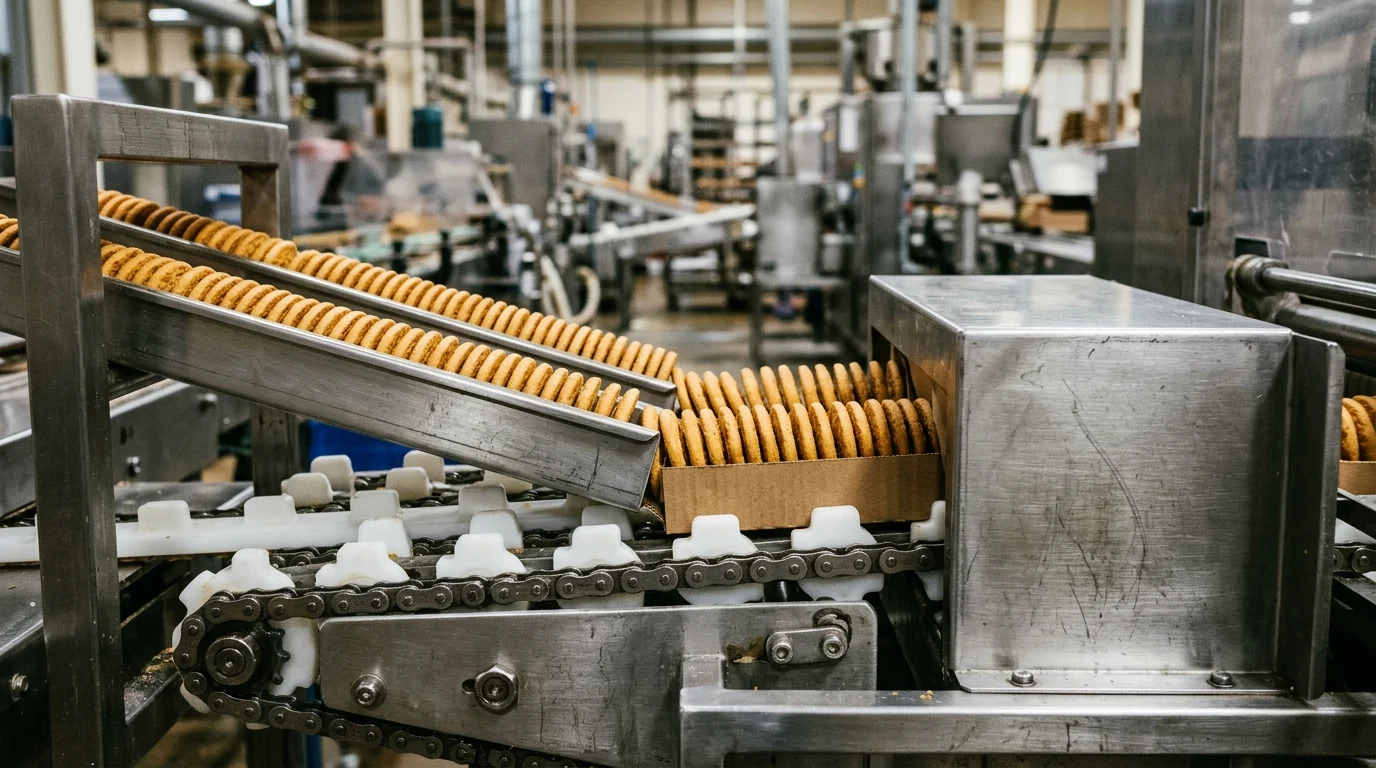
When evaluating flat pile-packs versus on-edge slugs for your biscuit recipe, audit three physical interactions:
- Baking Thickness Variation vs Diameter Variation (
L_prodvsW_prod / H_prodStack-Up): During rotary molding, wire-cutting, or rotary cutting and tunnel baking, a biscuit's thickness (t_b, leavening lift / oven spring) fluctuates by±6% to ±12%(±0.5 to ±1.0 mm per biscuit), whereas its diameter or width (D_b) fluctuates by only±1.5% to ±3%(±1.0 to ±1.5 mm).- In a 3-biscuit flat pile-pack, thickness variation accumulates vertically (
H_prod = 3 * 7 mm ± 2.4 mm), which is easily absorbed by the forming box and flat film web width without changing bag cut length (L_cut). - In a 20-biscuit on-edge family slug, thickness variation accumulates horizontally along the direction of travel (
L_prod = 20 * 7 mm ± 16 mm = 124 to 156 mm). If the line uses fixed-count pin indexing, a batch of thick biscuits overfills the infeed lug pitch (P_lug) and gets crushed by the rotary cross-sealing jaws, while thin biscuits leave a15 mmloose gap inside the wrapper—causing the first three cookies to tip flat and jam the forming box. Consequently, on-edge slugs ofN_slug >= 12pieces use volumetric slug measurement (Smart Duplex Measuring Loader SDML) that measures a fixed column length (e.g., 140 mm ± 3 mm) rather than a fixed piece count, or pair count feeding with a photoelectric variable bag-length sensor (as on the ULMA FR 200).
- In a 3-biscuit flat pile-pack, thickness variation accumulates vertically (
- Pre-Acceleration Transfer and Deadplate Support (
Top-Reel Lug vs Bottom-Reel Web vs Roll-Fed U-Card): Pushing an unsupported stack or on-edge row of brittle biscuits from zero velocity using a metal chain lug shatters the trailing biscuit edge. High-speed biscuit lines (such as the Syntegon Pack 301 LS with SDML) use full-servo cross-chain pre-acceleration to bring the grouped slug up to the exact linear speed of the wrapper infeed chain before transfer, or feed the group onto an inline roll-fed corrugated paperboard U-card (or bottom-unwound film web on an inverted ULMA FR 305) so the carrier absorbs all lug pushing force and bridges deadplate gaps. - Side-Gusset Tucking and Transverse Seal Clearance: Because both a 4-high pile pack (
H_prod = 32 to 50 mm) and an on-edge slug (H_prod = D_b = 45 to 75 mm) present a tall vertical wall at the ends of the pack, standard pillow crimps create protruding triangular "dog-ears" and highASTM F1921hot-tack peel stress. As detailed in Syntegon's sealing and cutting engineering guide, pneumatic or cam-driven side-gusset tucking fingers fold the side walls inward (G_gusset <= 0.45 * H_prod) immediately before the rotary jaws close, creating a flat, brick-like end profile ready for automated cartoning.
| Feeding & grouping subsystem | Target cookie format & throughput baseline | Grouping & transfer kinematics | Dominant Failure Mode & Mechanical Prevention |
|---|---|---|---|
| Gravity Magazine Chute + Servo Pusher / Penny Stacker (LTC-320 baseline) | Flat pile-packs (1x2 to 1x6, 2x2) of firm plain biscuits or crackers at 50–200 packs/min | Operators or vibratory lanes load vertical magazines; servo stripping pins or shingling wheels release N_stack pieces per lug | Failure mode: Bottom biscuit edge shearing in magazine gate when biscuit warp/cupping exceeds 1.5 mm -> Prevention: Replace rigid gate knife with servo rotary stripping wheel and spring-loaded side guides |
| Multi-Lane Vibratory Channels + Smart Duplex Measuring Loader (Syntegon Pack 301 LS + SDML baseline) | On-edge slugs (8–25+ pieces) of round, square, or sandwich biscuits at up to 250–400 slugs/min | Vibratory lanes orient biscuits on edge; simplex/duplex loader measures volumetric length or count with Dual Drop and servo pre-acceleration | Failure mode: Leading/trailing biscuit tipping flat during cross-chain transfer -> Prevention: Synchronize servo pre-acceleration to lug velocity and form an inline 2-wall corrugated U-card under the slug |
| Cascaded Servo Smart-Belt Phase Feeder (Syntegon PF5 / Pack 403 baseline) | Single-serve cookies (1x1) or pre-stacked 2-high piles at 200–600+ packs/min | 4 to 6 independent servo speed-regulating PU belts detect product edges via optical sensors and phase items into lugs without backpressure | Failure mode: Chocolate or cream smear on deadplates and belt transfers above 26 °C -> Prevention: Specify water-cooled transfer plates, low-friction release belts, and carrier flat-top lugs |
| Bottom-Reel Inverted Web Carry (ULMA FR 305 baseline) | Trayless multi-piece cookie piles (2x2, 3x2), soft American-style cookies, or sticky glazed biscuits at 60–180 packs/min | Film unwinds from below; grouped cookies transfer directly onto the flat film web before entering the forming box (top fin seal) | Failure mode: Loose multi-column piles collapsing across deadplate gaps on top-reel wrappers -> Prevention: Carry the ungrouped/grouped pile continuously on the bottom film web with top-mounted fin wheels |
| Linear-Motor / Vision Delta-Robot Pick & Place (Syntegon RPP / IDH baseline) | Ultra-fragile oatcakes, random-belt oven output, or multi-cavity tray loading at 95–320 pile/slug ppm or 600 trays/min | Vision cameras track random biscuits; 35–40 vacuum grippers on linear-motor bars or delta robots place groups into trays or lugs at <=120 cycles/min | Failure mode: Vacuum cup cracking thin brittle crackers (<8 N strength) or clogging with crumbs -> Prevention: Use compliant dual-durometer bellows suction cups, Venturi vacuum blow-off filters, and linear-motor S-curve acceleration |
When Should You Use a Two-Stage Secondary Multipack ("Two-in-One") Instead of a Single-Wrapper Tray or Slug?
A single-wrapper family pack (such as a 20-cookie on-edge slug or a 24-cookie thermoformed plastic tray) minimizes total packaging film weight, but exposes every remaining cookie to ambient humidity the moment the consumer tears open the outer wrapper. Baked biscuits and crackers exit the oven cooling tunnel at a low equilibrium water activity of aw = 0.15 to 0.25 (1.5% to 3.5% moisture content by weight). Once ambient water vapor permeates the package or enters an opened bag and raises biscuit water activity above the critical starch/sucrose glass-transition threshold (aw_crit = 0.35 to 0.40), the biscuit matrix transitions from a glassy crisp state to a rubbery, soggy texture.
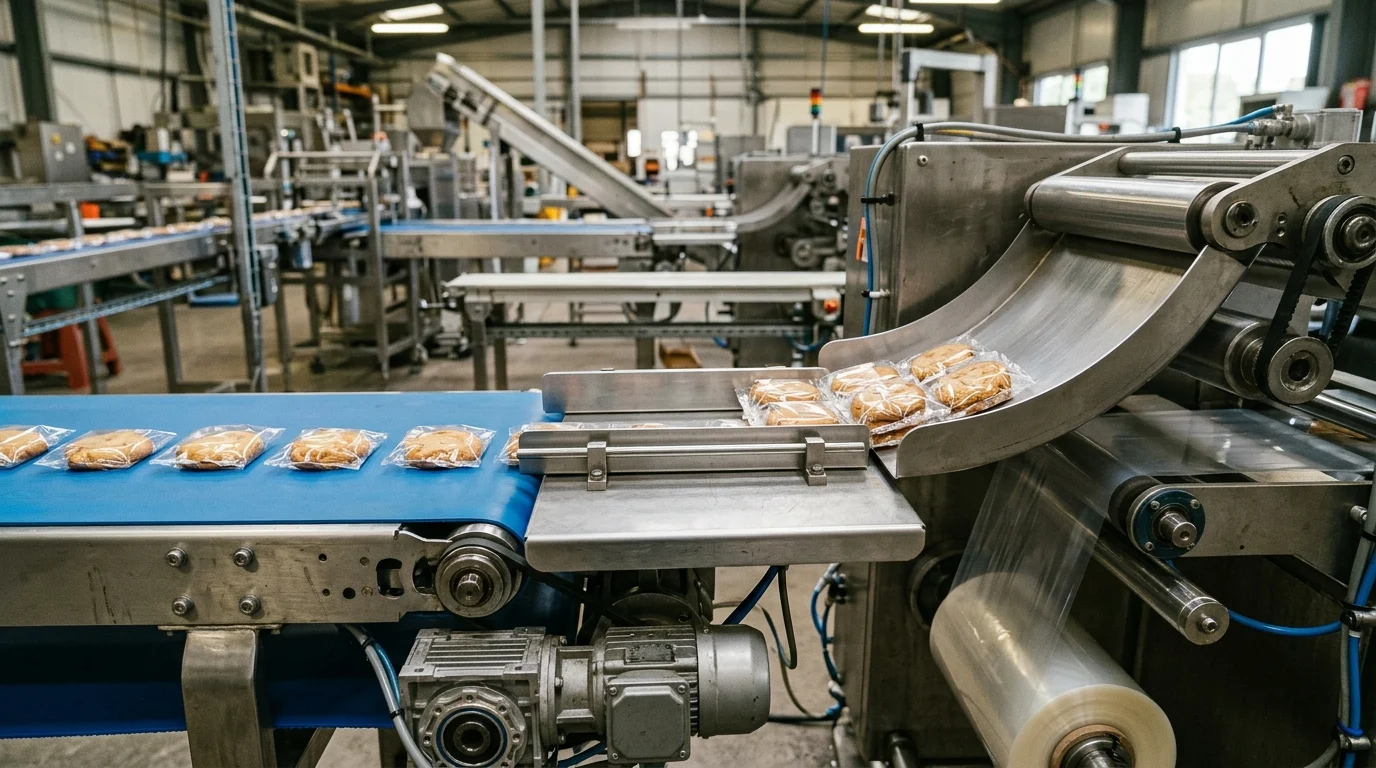
To solve the trade-off between bulk retail value and single-serve freshness, high-volume bakeries deploy two-stage primary-to-secondary multipack lines ("Two-in-One" or Bag-in-Bag HFFS systems):
- Stage 1 — High-Speed Primary Portion Wrapping (
Moisture & Portion Lock): Individual cookies (1x1), twin-packs (1x2), or 3-high portion piles (1x3) are hermetically wrapped at300 to 600 packs/minon narrow-web rotary wrappers using20 to 30 ummetallized or high-barrier BOPP film (verified under ASTM F1249 to WVTR < 0.5 to 1.0 g/m²·24h at 37.8 °C and 90% RH). - Stage 2 — Secondary Multipack Collation & Overwrapping (
Retail Bundle Formation): A servo collation unit (flat-belt phase grouper, bucket cascade, or robotic loader) collectsN_group = 4, 6, 8, 10, or 12sealed primary packs—either stacked in2x3/2x4layers or arranged on-edge—and feeds them into a wide-web secondary horizontal flow wrapper (such as an ULMA FR 200 / FR 305 with 600–700 mm reel width, a vertical VFFS bagger, or an endload cartoner; compare flow wrap vs shrink wrap and flow wrap film width and bag length). Because the inner primary film already provides the moisture and oxygen barrier, the outer secondary wrapper can run a thinner, lower-cost clear printed BOPP or recyclable mono-PE film (25 to 35 um) with an air-evacuation paddle or micro-perforator (as listed in Syntegon Pack 202 options) so the outer multipack compresses tightly inside shipping cases without pillowing.
Physical-Threshold Engineering Rules for Cookie Pack Format Selection
Apply these four physical-threshold rules during line concept engineering to select between individual wraps, pile-packs, on-edge slugs, trays, and two-stage secondary multipacks:
- Post-Opening Crispness & Tropical Humidity Rule (
Two-Stage Secondary Multipack vs Single-Wrapper Family Slug/Tray): If target retail distribution includes high-humidity zones (> 65% to 75% ambient RH) or consumer usage spans more than24 to 48 hoursafter first opening on a low-moisture biscuit (initial aw = 0.15 to 0.25, critical loss-of-crunch thresholdaw_crit = 0.35 to 0.40) -> prioritize a two-stage secondary multipack containing individually sealed1- to 3-cookieprimary portion packs (wrapped in Met-BOPP or barrier laminate with ASTM F1249 WVTR < 0.8 g/m²·24h) over a single-wrapper16- to 24-cookiefamily slug or tray because each unopened inner portion pack maintains full hermetic barrier integrity after the outer multipack is opened. - Biscuit Thickness Tolerance & Slug Length Rule (
Volumetric SDML Slug Loader vs Fixed-Count Magazine): If individual biscuit baking thicknesst_bvaries by more than±0.6 to ±0.8 mmper piece and target on-edge slug count exceedsN_slug >= 12 to 20 biscuits(generating cumulative slug-length swing > ±8 to ±15 mm) -> prioritize a volumetric length-measuring slug loader (such as the Syntegon Pack 301 LS with Smart Duplex Measuring Loader SDML) or an inline photoelectric product-length sensor (ULMA FR 200 variable-cut mode) over a fixed-count pin magazine because fixed-count slugs of thick biscuits exceed the infeed lug pitch and get crushed by the rotary cross-sealing jaws. - Biscuit Flexural Fragility & Tray Elimination Rule (
Trayless Pile/Slug vs Roll-Fed Corrugated U-Card vs Thermoformed Tray): If single-biscuit three-point flexural breaking strength is< 8 to 12 N(such as thin 3 mm gluten-free oatcakes, high-butter shortbread with > 22% fat, or soft-baked cookies) or if a multi-column pile (2x2or2x3) lacks lateral stability across transfer deadplates -> prioritize an inline roll-fed 2-wall corrugated paperboard U-card former (or a bottom-reel inverted wrapper such as the ULMA FR 305 paired with linear-motor belt transfer); reserve pre-made thermoformed multi-cavity plastic trays for ultra-delicate iced, chocolate-enrobed, or open-faced jam biscuits that cannot tolerate piece-to-piece contact duringASTM D4169distribution vibration. - Crumb Shedding, Fat Smear & Seal Integrity Rule (
Cantilevered Crumb Drop + ASTM F88 / F1921 Verification): If loose crumb shedding exceeds0.3% by weightacross feeding transfers or if surface chocolate/cream coatings soften below28 to 32 °C-> prioritize sloped cantilevered drop-through infeed beds, vacuum crumb extraction nozzles upstream of the fin wheels, and water-cooled deadplates (or ambient pressure-sensitive cold-seal film for heat-sensitive chocolate; seechocolate bar packaging machines and sticky bar flow wrapping) while verifying>= 2.5 to 3.5 N/15 mmcooled seal peel strength underASTM F88and molten hot-tack resistance underASTM F1921.
Quantitative Cookie Packaging Equations and Worked Arithmetic Examples
Use these four explicit engineering equations to balance primary-to-secondary wrapper counts, compare flat film web width and cut length across pile versus slug orientations, and calculate annual material savings when replacing plastic trays. For complete rollstock slitting math, see flow wrap film width and bag length and flow wrap film guide.
1. Primary-to-Secondary Multipack Line Speed and Machine Count Balancing (Q_prim, Q_sec, M_prim)
Q_prim (packs/min) = Q_oven / N_prim
Q_sec (multipacks/min) = Q_prim / N_group = Q_oven / (N_prim * N_group)
M_prim (wrappers) = ceil(Q_prim / (Q_cap_prim * OEE))
- Variables:
Q_oven= continuous biscuit discharge rate from the upstream baking oven and cooling conveyor (biscuits/min);N_prim= number of biscuits inside each primary flow wrap (1for individual wrap,2 to 4for flat pile pack,12 to 20for direct on-edge slug);N_group= number of primary packs collated into one secondary multipack;Q_cap_prim= rated maximum speed of one primary HFFS machine (packs/min);OEE= effective line utilization factor (typically 0.82 to 0.88with automatic film splicing and FIFO buffering). - Worked example: A rotary-molded biscuit oven lane discharges
Q_oven = 2,400 biscuits/min.- Option A (
Direct 12-biscuit on-edge slug,N_prim = 12): Primary wrapper demand isQ_prim = 2,400 / 12 = 200 slugs/min, which is handled byM_prim = 1duplex on-edge flow wrapper (such as a Syntegon Pack 301 LS with SDML rated at 250 slugs/min, running at80%load). - Option B (
Two-stage 2-biscuit portion pile-pack inside a 6-pack secondary multipack,N_prim = 2,N_group = 6, still12 biscuitsper retail multipack): Primary wrapper demand jumps toQ_prim = 2,400 / 2 = 1,200 primary pile-packs/min. Using high-speed primary wrappers rated atQ_cap_prim = 400 packs/minandOEE = 0.85(340 net packs/min per machine) requiresM_prim = ceil(1,200 / 340) = 4 primary flow wrappersfeeding1secondary multipack flow wrapper operating atQ_sec = 1,200 / 6 = 200 multipacks/min.
- Option A (
2. Flat Pile-Pack vs On-Edge Slug Envelope & Specific Film Area per Biscuit (W_web, L_cut, A_biscuit)
W_web = 2 * (W_prod + H_prod) + 2 * F_fin + C_forming
L_cut = L_prod + k_H * H_prod + 2 * W_crimp + C_jaw
A_film_per_biscuit (cm²/biscuit) = (W_web * L_cut) / (100 * N_pieces)
- Variables: For a round biscuit of diameter
D_b(mm) and thicknesst_b(mm):- Single-piece flat wrap (
N = 1):L_prod = D_b,W_prod = D_b,H_prod = t_b. - Flat vertical pile-pack (
N = N_stack):L_prod = D_b,W_prod = D_b,H_prod = N_stack * t_b. - On-edge slug with corrugated U-card (
N = N_slug, card wall thicknesst_card):L_prod = N_slug * t_b + 2 * t_card,W_prod = D_b + 2 * t_card,H_prod = D_b + t_card.
- Single-piece flat wrap (
- Worked example: Packaging a round biscuit of diameter
D_b = 50 mmand thicknesst_b = 7 mm(with F_fin = 12 mm,k_H = 1.0):- Format 1 (
Individual 1-cookie pack,N = 1,C_forming = 8 mm,W_crimp = 12 mm,C_jaw = 16 mm):W_web = 2(50 + 7) + 24 + 8 = 146 mm;L_cut = 50 + 7 + 24 + 16 = 97 mm; film area per pack =(146 * 97) / 100 = 141.62 cm², equal to141.62 cm²/biscuit. - Format 2 (
3-cookie flat pile-pack,N = 3,H_prod = 21 mm,C_forming = 10 mm,W_crimp = 14 mm,C_jaw = 18 mm):W_web = 2(50 + 21) + 24 + 10 = 176 mm;L_cut = 50 + 21 + 28 + 18 = 117 mm; film area per pack =(176 * 117) / 100 = 205.92 cm², or68.64 cm²/biscuit(51.5% less film per biscuit than individual wrapping). - Format 3 (
12-cookie on-edge slug in 1 mm U-card,N = 12,L_prod = 86 mm,W_prod = 52 mm,H_prod = 51 mm,F_fin = 13 mm,C_forming = 12 mm,W_crimp = 16 mm,C_jaw = 20 mm):W_web = 2(52 + 51) + 26 + 12 = 244 mm;L_cut = 86 + 51 + 32 + 20 = 189 mm; film area per pack =(244 * 189) / 100 = 461.16 cm², or38.43 cm²/biscuit(72.9% less film per biscuit than individual wrapping). Adding a secondary overwrap around six 2-cookie pile-packs (W_web_sec = 340 mm, L_cut_sec = 230 mm = 782 cm² / 12 biscuits = +65.2 cm²/biscuit) brings a two-stage6 x 2multipack to141.5 cm²/biscuittotal (3.68xthe total film mass of a single-wrapper 12-cookie slug).
- Format 1 (
3. Thermoformed Plastic Tray vs Roll-Fed Corrugated U-Card / Trayless Material Cost Savings (Delta_Cost_yr)
Delta_Cost_yr ($/year) = N_packs_yr * ((C_tray_unit + m_film_tray * P_film) - (C_ucard_unit + m_film_slug * P_film))
- Variables:
N_packs_yr= annual multipack output (packs/year);C_tray_unit= unit purchase price of a pre-made thermoformed PP/PET cavity tray ($/tray);C_ucard_unit= unit cost of an inline roll-fed fluted paperboard U-card ($/card, or$0for trayless pile/slug);m_film_trayandm_film_slug= outer film mass per pack (kg/pack);P_film= laminated film price ($/kg). - Worked example: A bakery producing
N_packs_yr = 15,000,000 packs/year(200 packs/min x 1,250 hours/year) of a 12-biscuit pack replaces a pre-made11.5 gthermoformed PP tray (C_tray_unit = $0.0320/tray, requiring aW_web = 310 mm x L_cut = 220 mmouter film wrap =2.39 gof35 g/m²film at$3.60/kg=$0.0086/pack, total$0.0406/pack) with an inline roll-fed4.2 gcorrugated paperboard U-card (C_ucard_unit = $0.0085/card,W_web = 244 mm x L_cut = 189 mmfilm =1.61 g=$0.0058/pack, total$0.0143/pack). Annual packaging material cost drops by15,000,000 * ($0.0406 - $0.0143) = $394,500/yearwhile eliminating172.5 metric tons/yearof rigid plastic—paying back an inline$95,000roll-fed U-card forming module in2.9 months.
3-Year Total Cost of Ownership (TCO) Ledger Across Cookie Pack Formats
Evaluating cookie packaging lines on single-machine sticker price alone hides the dominant 3-year cost drivers: multi-machine primary wrapper capital, thermoformed tray consumables, mechanical biscuit breakage scrap, and format changeover downtime. Compare machine capital tiers in our flow wrapper price guide and prepare your project scope with the flow wrapper requirements checklist.
| TCO cost & operational driver | Direct On-Edge Slug w/ Roll-Fed U-Card (1 x Duplex Wrapper) | Trayless Flat Pile-Pack (2 x 6-Cookie Pile Wrappers) | Pre-Made Plastic Tray Multipack (1 x Tray Loader + Wrapper) | Two-Stage "Two-in-One" Multipack (4 x Primary + 1 x Secondary HFFS) |
|---|---|---|---|---|
| Primary & secondary HFFS capital & floor space | 1 duplex slug wrapper + SDML loader; compact 12–16 m line length (1.0x baseline capex) | 1–2 pile wrappers w/ penny stackers or bottom-reel web; 14–18 m floor length (1.1x capex) | 1 wide-web wrapper + denester + robotic/drop tray loader; 18–22 m length (1.35x capex) | 4 high-speed primary wrappers + collator + 1 secondary wide-web wrapper; 28–38 m length (2.6x–3.2x capex) |
| Annual film & carrier consumable spend (15M retail units/yr) | $214,500/yr ($0.0058 film + $0.0085 roll-fed kraft U-card per 12-cookie slug) | $165,000/yr (film only; zero tray or U-card cost across two 6-cookie pile packs) | $609,000/yr ($0.0320 pre-made PP tray + $0.0086 wide-web outer film per pack) | $485,000/yr (6 inner metallized BOPP primary wraps + 1 outer printed BOPP multipack film) |
| Mechanical biscuit breakage & seal-contaminant scrap | 0.4%–0.8% scrap when equipped with servo pre-acceleration & U-card support (2.5%–4.0% on manual/unbuffered chutes) | 0.5%–1.0% scrap on bottom-reel inverted web or linear-motor belt (2.0%–3.5% on unguided top-reel lugs) | 0.3%–0.6% wrapping scrap; best transit crush protection for delicate cookies (<8 N strength) | 0.6%–1.1% combined primary + secondary scrap; inner wrap cushions biscuits during secondary collation |
| Format changeover downtime & staffing per shift | <10 min tool-less slug-length changeover (Syntegon Turbo/SDML baseline); 1 operator/shift | 10–15 min stack-count & former adjustment; 1–2 operators/shift | 20–35 min tray denester cassette, lug pitch, and adjustable forming-box change; 2 operators/shift | 25–45 min coordinated changeover across 4 primary + 1 secondary machines; 2–3 operators/shift |
What to Send Us for a Cookie Pack Format & Flow Wrapper Engineering Audit
| Engineering input to provide | Why our engineers need it | Acceptable engineering format |
|---|---|---|
| Biscuit physical specs & baking tolerances (D_b, t_b, weight, breaking force) | Determines volumetric vs count-based grouping, flat pile vs on-edge slug envelope, and trayless vs U-card support | Min / nominal / max diameter, width, and thickness in mm (e.g., Ø50 ±1.2 mm x 7.0 ±0.7 mm, 9.5 g, plain vs cream sandwich) |
| Target pack arrangement & piece count (primary & secondary) | Sets machine architecture (single wrapper vs two-stage primary + secondary line) and calculates W_web and L_cut | Photos or sketches of 1 complete pack unit (e.g., 1x3 flat pile inside a 2x3 six-pack secondary overwrap, or 14-piece on-edge slug in U-card) |
| Upstream oven discharge rate (Q_oven) & lane configuration | Balances Q_prim = Q_oven / N_prim and sizes vibratory channels, smart-belt phase feeders, or FIFO buffers | Total biscuits/min exiting cooling conveyor, belt width (e.g., 1,000 mm steel band, 2,400 biscuits/min in 16 rows), and product arrival temperature (°C) |
| Shelf-life target, distribution climate & barrier structure | Selects BOPP/CPP vs Met-BOPP laminate (ASTM F1249 WVTR < 0.8–2.0 g/m²·24h), cold seal vs heat seal, and MAP gas flushing | Target shelf life (e.g., 6 months vs 12 months tropical), film structure/caliper (um), and whether post-opening portion freshness is required |
| Carrier tray / U-card drawing & changeover matrix | Sizes forming-box throat clearance (+2 to +8 mm), roll-fed U-card former, or tray denester and rotary vs box-motion jaws | Dimensioned PDF of tray or U-card (outer L x W x H mm including rim flare) and list of all SKUs sharing the line |
Send Your Cookie Dimensions, Pack Format Sketch & Target Speed on WhatsApp for a Line Engineering Review
Common Questions on Individual vs Multipack Cookie Flow Wrapping
Does a cookie multipack mean bare cookies grouped in one wrapper or individually wrapped cookies inside an outer bag?
In horizontal flow wrapping, the term multipack covers two distinct line architectures: (1) a primary multipack where 2 to 25+ bare cookies share a single barrier wrapper (as a flat vertical pile-pack, an on-edge slug, or a loaded tray), and (2) a two-stage secondary multipack ("two-in-one" bag-in-bag) where single cookies or 2-to-4 cookie portion piles are first sealed on high-speed primary flow wrappers and then collated into an outer secondary flow wrap or carton. Always specify both primary and secondary piece counts in your RFQ.
Why do on-edge cookie slugs use volumetric measuring loaders instead of counting exact biscuit pieces?
During tunnel baking, individual biscuit thickness (oven spring) typically varies by ±0.5 to ±1.0 mm per piece. Across an on-edge family slug of 16 to 24 biscuits, that thickness tolerance accumulates into ±10 to ±20 mm of total slug length variation. A fixed piece count causes thick batches to jam the infeed lugs and get crushed by the cross-sealing jaws, whereas a volumetric Smart Duplex Measuring Loader (SDML) indexes a constant column length so every slug fits cleanly inside the wrapper and downstream carton.
When can we eliminate a thermoformed plastic cookie tray and use a roll-fed paperboard U-card or trayless wrapper?
If your biscuit has a flexural breaking force above 8 to 12 N (such as standard digestive biscuits, rotary-molded shortbread, crackers, or cream sandwiches) and does not have soft top icing that smears on contact, you can replace pre-made thermoformed plastic trays either with an inline roll-fed 2-wall corrugated paperboard U-card (for on-edge slugs) or with a bottom-reel inverted flow wrapper (such as the ULMA FR 305) or penny-stacker pile wrapper (for 2-to-4 high stacks), cutting packaging material costs by 50% to 65%.
How do you prevent biscuit crumbs and shortening fat from causing leaking end seals on a flow wrapper?
Loose biscuit crumbs and shortening oils trapped in the transverse cross-sealing nip prevent thermoplastic sealant layers from fusing, reducing ASTM F88 peel strength by more than 50%. Engineers prevent seal contamination by specifying cantilevered drop-through infeed beds where crumbs fall clear of the product path, vacuum crumb-extraction hoods immediately ahead of the forming box, servo phased smart-belt transfers that eliminate mechanical scraping, and serrated rotary jaws with matched 4-layer center-fin relief.
Related guides
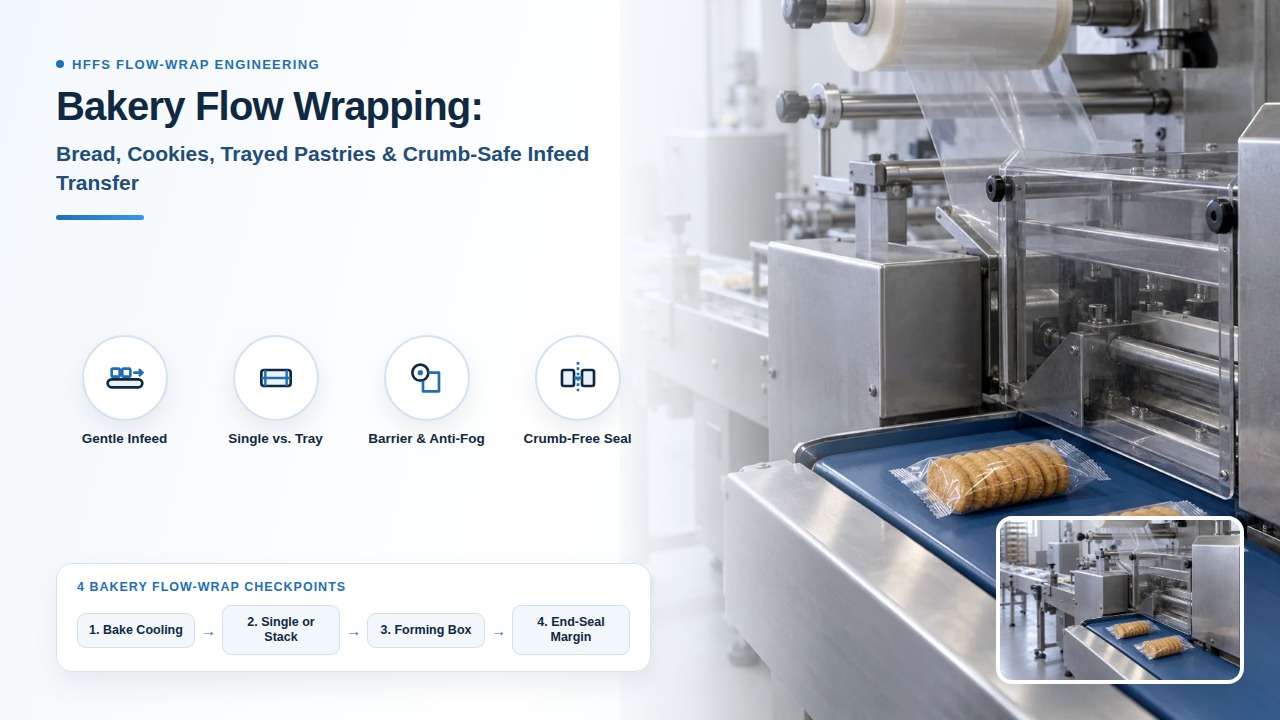
Bakery Packaging Machines for Flow-Wrapped Products
Packing bread, cookies or cakes? Describe the finished pack, product condition and tray use to work out which bakery packaging options need testing.
Read more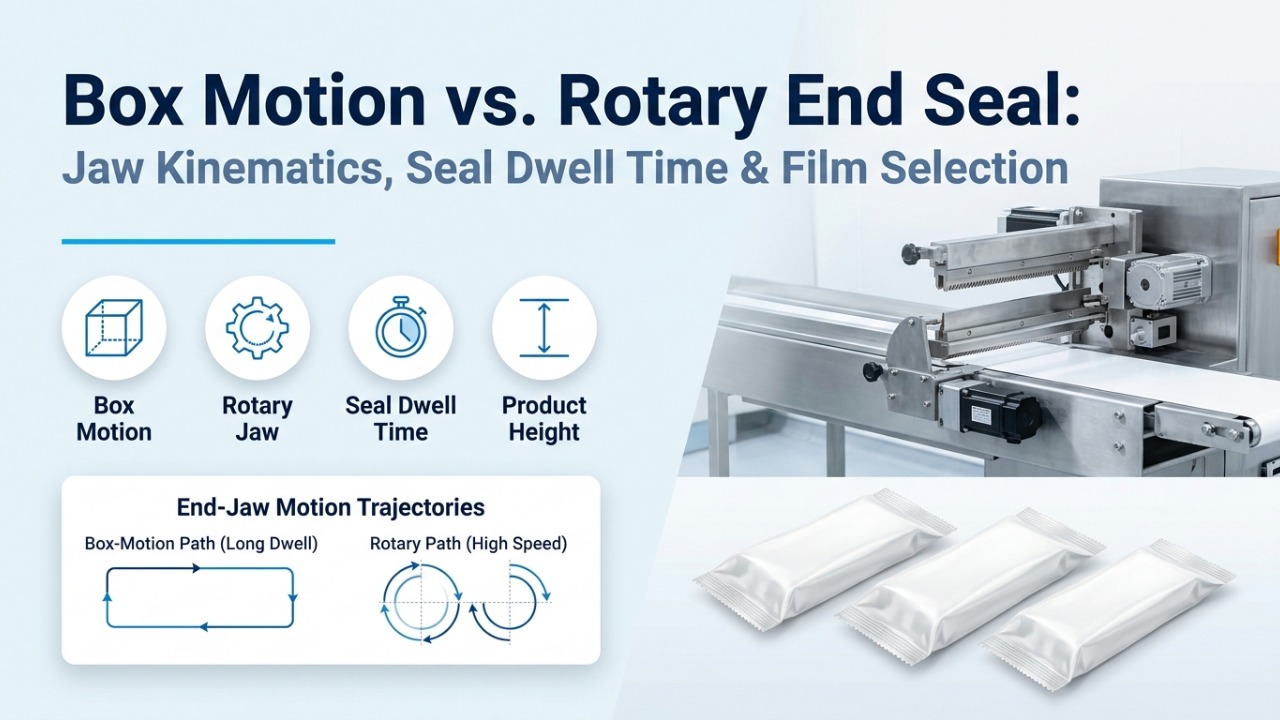
Compare Flow Wrapper Types and Configurations
Rotary or box motion? Top film or bottom film? Compare the feeding, film path and end-seal choices in a flow wrapper proposal.
Read more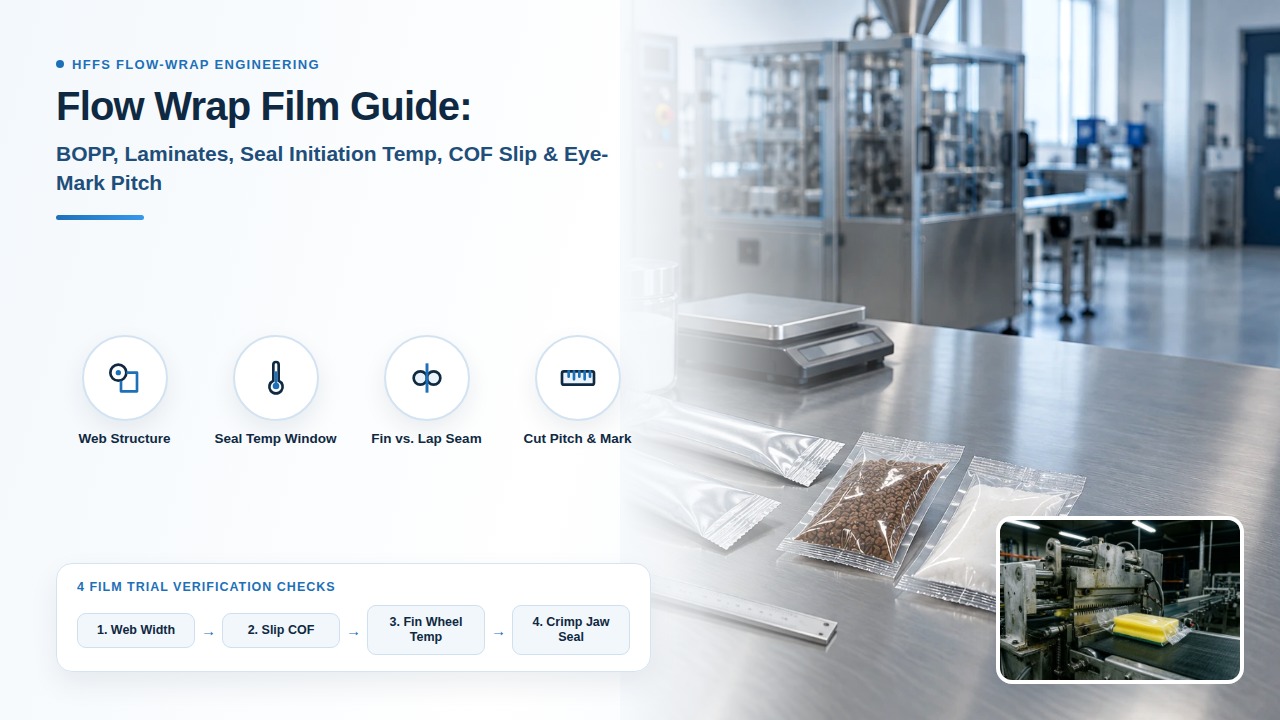
Choosing Flow Wrap Film for Your Product and Machine
Choosing flow wrap film starts with the product and required seal. Gather the film specification, reel dimensions and samples for compatibility testing.
Read more