
Updated 2026-10-17
Specifying an automatic horizontal flow wrapper without engineering the upstream product handoff leaves plants paying for a 200 to 400 packs/min servo wrapping frame that runs throttled at 55 to 95 packs/min behind fatigued hand-loaders, while generating 3% to 8% empty-bag film waste and recurring cross-jaw product crushes. Evaluating a manual vs automatic feeding flow wrapper requires separating the film-forming and sealing machine from the five upstream product-handling tasks—row distribution, surge buffering, orientation, multi-piece grouping, and pitch-phased lug injection—and matching those tasks against your sustained throughput (Q_line), operator ergonomic pitch ceiling (r_ergo <= 60 to 80 ppm), product compressive fragility, and changeover frequency.
Engineering summary: Use manual lug-chain hand loading (1 to 2 operators on a 2.0 to 4.0 m infeed bed with optical No-Product-No-Bag NPNB and Misplaced Product Detection MPD) when sustained line output is <= 60 to 100 packs/min or when running > 4 to 6 irregular multi-SKU changeovers per shift; upgrade to a vertical magazine feeder (80 to 220 ppm for rigid cards, trays, or flat biscuits), a 3-to-6 stage servo smart-belt phase feeder (100 to 500+ ppm, ±0.5 to ±1.5 mm lug registration), or vision-guided robotic pick-and-place (120 to 800 ppm) whenever sustained demand exceeds 60 to 80 packs/min per operator or multi-shift labor payback (N_op = ceil(Q_line / (r_ergo * eta_sync))) crosses under 12 to 18 months.
| Feeding parameter or subsystem | Standard engineering baseline or source | Why it governs manual vs automatic feeding selection |
|---|---|---|
| Single-operator hand-load ceiling (r_ergo) | 50–65 packs/min sustained (60–80 ppm max for rigid single bars; 30–45 ppm for grouped/trayed items) | Human reach-and-place ergonomics (>1.0–1.33 Hz) decay after 20–30 min, capping 1-operator manual lines regardless of wrapper jaw speed |
| Multi-operator manual lug chain (2–4 operators) | 80–160 packs/min across 3.0–6.0 m modular infeed conveyor (Syntegon Pack 202 2M–10M & ULMA FR 100/200 baselines) | Downstream operators hunting empty moving flights drop sync efficiency (eta_sync = 0.80–0.88) and cause 3–8% missed lugs without NPNB |
| Vertical / inclined magazine & card feeder | 80–220 packs/min per lane for flat rigid items, paperboard U-cards, thermoformed trays, or stacked cookie slugs | Allows 1 operator to bulk-load 300–600 pieces/min into vertical hoppers instead of timing individual moving chain lugs |
| Cascaded servo smart-belt phase feeder | 100–500+ packs/min via 3–6 independent servo PU belts with optical edge tracking (Syntegon Pack Feeder PF5 baseline) | Dynamically closes random arrival gaps and phases products into chain lugs within ±0.5 to ±1.5 mm without mechanical pushing damage |
| Row distribution (RDS) & robotic pick-and-place | 120 picks/min per delta cell (Syntegon RPP) up to 800 products/min on 40-picker linear-motor IDH & pullnose RDS lines | Required when wide multi-row ovens, cooling tunnels, or enrobers discharge continuous streams that cannot stop for film splices |
| Safety, seal & food-contact standards | OSHA 29 CFR 1910.212 / ISO 12100 guarding, ASTM F88 / F1921 seal integrity across speed ramps, FDA 21 CFR 177.1520 | Mandates interlocked forming-entry tunnel guards, auto-opening heated finwheels on line stops, and food-grade PU/POM contact surfaces |
Step 1 — Where Does the Flow Wrapper End and the Feeding System Begin?
Every horizontal Form-Fill-Seal (HFFS) machine is automatic from the forming box forward: it unwinds flat rollstock, folds the film around the product throat, welds the longitudinal fin or lap seam, and crimps and cuts transverse end seals (see how a flow wrapper works and flow wrapper types guide). The distinction between a manual feeding flow wrapper and an automatic feeding flow wrapper occurs entirely upstream of the forming shoulder across five discrete mechanical functions documented in Syntegon's horizontal flow wrapper portfolio (Pack 103, Pack 202, and Pack 403) and ULMA Packaging's Flow Pack HFFS specifications:
- Row distribution and lane dividing (
RDS): Taking a wide multi-row array exiting an oven, cooling tunnel, or extruder (8 to 24 rows wide) and deflecting or pulling single rows onto individual wrapper lanes via90-degreepullnose conveyors. - Surge accumulation and buffering: Absorbing
30 to 180 secondsof upstream flow during rollstock splicing (or feeding the wrapper during brief upstream micro-stops) using First-In-First-Out (FIFO) gondola buffers, rotary accumulation tables, or inline belt buffers. - Orientation, inspection, and reject culling: Turning skewed items parallel to travel (
L_prod), removing broken twin-bars or deformed baked goods, and verifying height/length tolerances (seeflow wrapper sizing guide). - Collating, stacking, and carrier boarding: Grouping multi-piece packs (
such as 2-high biscuit stacks or on-edge cracker slugs) or feeding a paperboard U-card or thermoformed tray beneath the product. - Pitch metering and phase synchronization: Accelerating or decelerating each item so its trailing edge enters the flighted infeed chain (
or bottom-film web) at the exact center of the cut pitch (L_cut) without intersecting the rotating cross-sealing jaws.
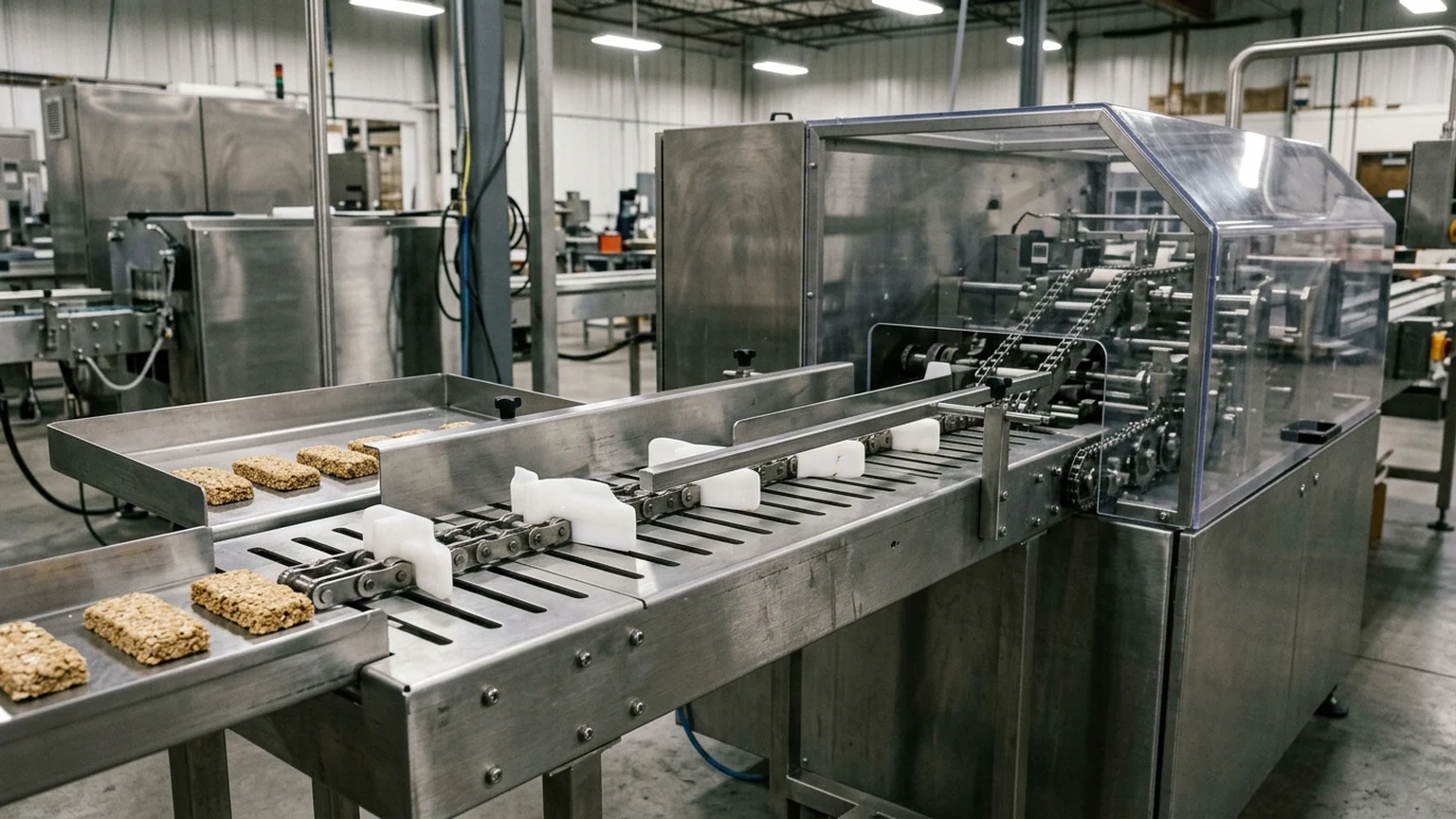
When a quotation lists a standard 2.0 m lugged infeed conveyor (as on the baseline ULMA FR 100 or Syntegon Pack 103/202), the machine performs only pitch transport once the product is already seated between two chain lugs—meaning human operators must execute orientation, visual culling, grouping, and timed slot placement by hand.
| Feeding architecture & OEM reference baseline | Sustained throughput & staffing baseline | Product geometry & changeover profile | Dominant Failure Mode & Mechanical Prevention |
|---|---|---|---|
| 1. Manual Flighted Lug-Chain Infeed (ULMA FR 100 / Syntegon Pack 103 & 202 hand-fed baseline) | 35–80 packs/min (1 operator); 80–160 packs/min (2–4 operators along 3.0–6.0 m modular infeed conveyor) | Rigid bars, bakery trays, soaps, medical kits, or irregular produce; <2–5 min manual format changeover | Late-release skewed placement or missed chain flights at >65 ppm/operator -> Enable servo No-Product-No-Bag (NPNB) and optical Misplaced Product Detection (MPD) |
| 2. Vertical / Inclined Magazine & Pusher Feeder (Drop-hopper / rotary placer / U-card feeder) | 80–220 packs/min per lane; 1 operator tends 2–3 magazines simultaneously (bulk stack loading) | Flat rigid biscuits, crackers, wafers, blister cards, or paperboard U-cards / punnets (±1.5 mm stack uniformity); 5–12 min magazine rail adjustment | Double-shingled or warped piece jams lower magazine escapement gate -> Install micrometer gate-gap gauges, dual-sheet sensor, and low-stack beacon |
| 3. Cascaded Servo Smart-Belt Phase Feeder (Syntegon Pack Feeder PF5 3-to-6 stage belt baseline) | 100–500+ packs/min per lane; 0.25–0.5 operator/line supervisory staffing; ±0.5 to ±1.5 mm phase accuracy | Continuous single-file stream of bars, cookies, buns, or trays arriving with random spacing from upstream tunnel; 1–3 min HMI recipe recall | Sticky chocolate bottoms or crumb buildup cause slip on acceleration belts -> Specify quick-release cantilevered PU belts, belt scrapers, and closed-loop encoder tracking |
| 4. Multi-Row Pullnose Distribution (RDS) + FIFO Buffer (ULMA RDS & Syntegon multi-leg bar/biscuit line) | 300–1,200+ pieces/min total across 2–6 parallel flow wrappers with 60–180 sec automatic surge buffering | Direct coupling to continuous multi-row bakery ovens, cooling tunnels, or enrobers; 10–25 min line-wide recipe & rail changeover | Row skew across wide cooling belt causes double-row collisions at pullnose transfer -> Install optical row-straightening bars and variable-stroke servo pullnose noses |
| 5. Vision-Guided Robotic Pick-and-Place (Syntegon RPP Delta 120 ppm/cell & IDH Linear-Motor up to 800 ppm) | 120 picks/min per delta robot cell; up to 800 products/min on 40-picker linear-motor IDH with integrated mini-buffer | Randomly oriented, fragile, sticky, or on-edge/stacked cookies, crackers, and delicate pastries; 2–5 min vision recipe & vacuum-cup swap | Crumb or oil fouling clogs vacuum cups and drops product mid-transfer -> Use food-grade dual-circuit venturi ejectors, auto-purge blow-off, and vision reject tracking |
Step 2 — What Are the Ergonomic and Mechanical Limits of Manual Loading?
Plant managers frequently overestimate manual feeding capacity by timing an experienced operator for 60 seconds during a factory trial. Over an 8-hour shift, human hand-loading into a moving lugged chain conveyor is governed by repetitive reach kinematics, visual flight tracking, and piece-handling complexity:
- Single-operator reach-and-place cycle (
r_ergo): When picking rigid single items (such as granola bars, wrapped soap bars, or pre-loaded bakery trays) from an angled staging shelf mounted150 to 250 mmfrom the infeed chain centerline, one operator sustains50 to 65 placements/min(0.83 to 1.08 Hz), with an ergonomic ceiling of60 to 80 placements/min(1.00 to 1.33 Hz) only when pieces require zero orientation flip. If the operator must assemble a2-pieceor3-piecegroup, seat items into a U-card, or handle soft/fragile bakery items (seebakery packaging machines and bread & bun flow wrappers), sustainable pace drops to30 to 45 packs/min. - Multi-operator slot-hunting penalty (
eta_sync): To run a manual flow wrapper at100 to 150 packs/min, plants specify a3.0 to 6.0 mextended infeed bed (Syntegon Pack 202 offers modular 2 m to 10 m infeeds) with2 to 4operators standing in series. While Operator #1 loads consecutive empty lugs at the tail pulley, Operators #2 and #3 must visually track a chain moving at20 to 40 m/min, identify which flights are still empty, and drop products into moving gaps between already-loaded flights. This visual slot-hunting reduces per-person output efficiency toeta_sync = 0.88for 2 operators andeta_sync = 0.80for 3 to 4 operators, while increasing late-release skewed placements that ride up onto the polymer lug finger. - Point-of-operation guarding (
OSHA 29 CFR 1910.212&ISO 12100): Manual loading stations must never allow an operator's hand to chase a crooked product into the forming box or fin wheels. UnderOSHA 29 CFR 1910.212andISO 12100machinery safety standards, manual infeeds require shrouded chain-return sprockets, snap-out polymer safety lugs that pivot or release if pinched, full-length E-stop pull cords or palm buttons, and a fixed or interlocked polycarbonate tunnel guard extending at least350 to 500 mmahead of the forming shoulder and fin-seal nip.
Step 3 — How Do Magazine, Smart-Belt, and Robotic Feeders Automate the Handoff?
When target speed, multi-shift labor cost, or product delicacy rules out direct hand placement into chain lugs, engineers select from three progressive automation tiers depending on how products arrive from upstream processing (see cereal bar packaging machines, cookie packaging machines, and chocolate bar packaging machines):
- Magazine and rotary-placer feeding (
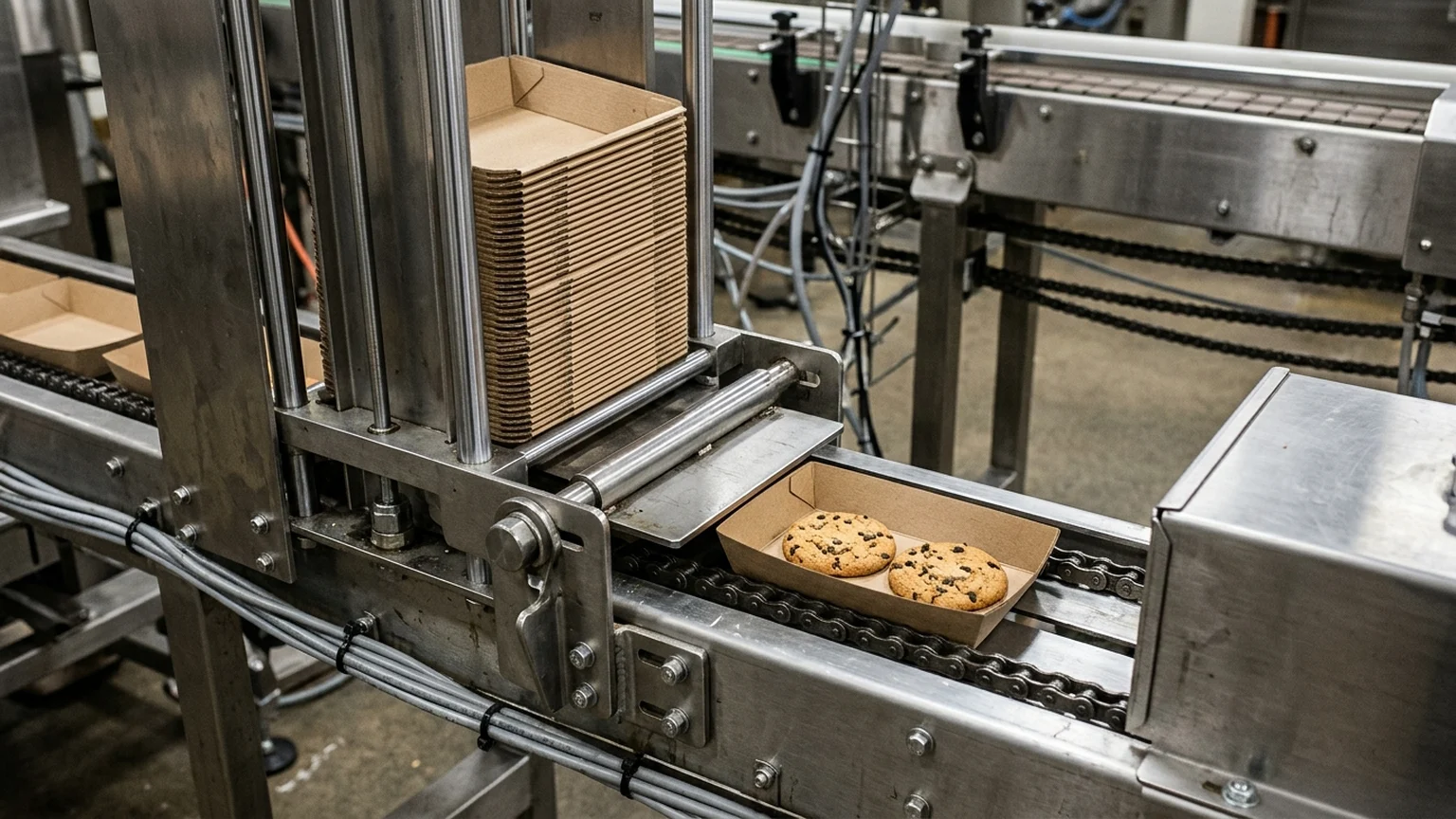
Semi-Automatic Bulk Loading, 80–220 ppm): Instead of placing individual pieces into moving chain flights, one operator loads stacks of50 to 200rigid items (flat biscuits, wafers, thermoformed trays, paperboard U-cards, or hotel soaps) into vertical or inclined stainless-steel magazine chutes. A servo-driven reciprocating pusher blade or rotary vacuum drum indexes the bottom piece into every passing chain lug. Magazine feeders bridge the gap between manual and inline automation—allowing one operator to tend2 to 3machines (up to 400–600 pieces/min total)—provided product thickness variation stays within±10%and pieces do not stick together or warp. - Cascaded servo smart-belt phase feeders (
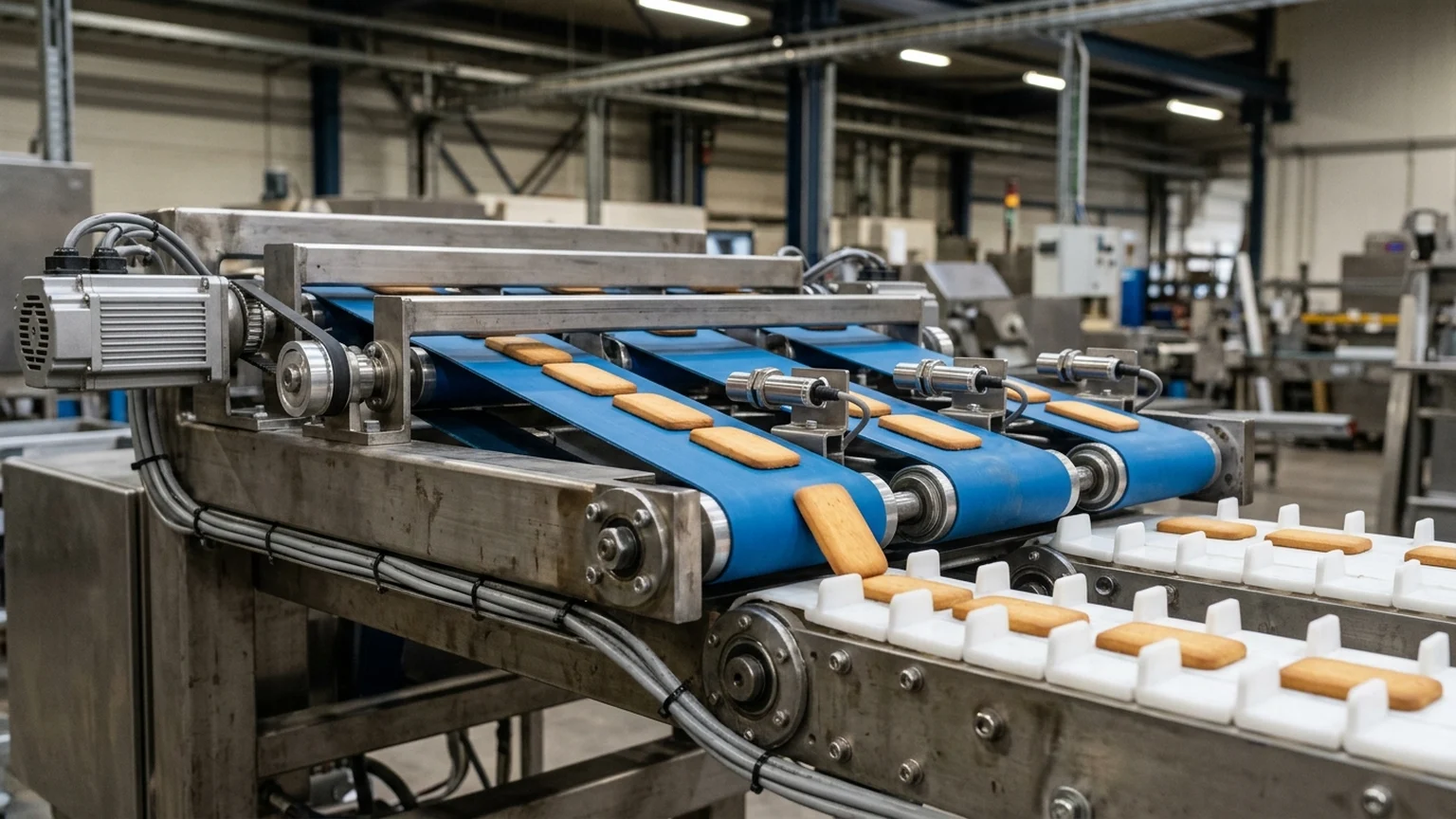
Syntegon PF5 Architecture, 100–500+ ppm): When products arrive in a continuous single-file stream from a cooling tunnel, fryer, or depositor with irregular gaps, a smart-belt phase feeder (consisting of 3 to 6 short, high-friction food-grade polyurethane belts driven by independent brushless servos) measures the leading and trailing edge of every item via high-speed fiber-optic sensors. As analyzed in Syntegon's sealing and cutting engineering guide, the belts dynamically modulate velocity to close gaps, build a micro-queue, and launch each product into the wrapper's flighted chain (or directly onto a bottom-fed film web) in exact phase with the rotary cross-sealing jaws. - Row Distribution Systems (
RDS) and Vision-Guided Pick-and-Place (Syntegon RPP & IDH, 120–800 ppm): For wide multi-row bakery ovens or chocolate enrobers, pullnose row distributors deflect individual rows onto cross-belts feeding multiple wrappers. Where fragile or randomly oriented cookies and crackers require on-edge stacking or slug grouping without long mechanical chicanes, linear-motor vision pick-and-place systems (such as the Syntegon IDH with up to 40 independent vacuum pickers) pick directly from the wide process belt at up to800 products/minwhile an integrated mini-buffer automatically backfills incomplete rows.
Step 4 — How Must Stop/Restart Handshakes and Fault Sensors Be Engineered?
Connecting an upstream processing line or multi-operator team to a flow wrapper without automated fault handshakes creates catastrophic film and product waste whenever either side pauses. Both manual and automatic infeeds must specify four closed-loop control responses in the Request for Quotation (RFQ):
| Line disturbance or product fault | Uncontrolled wrapper behavior (no interlocks) | Engineered servo & sensor response | Dominant Failure Mode & Mechanical Prevention |
|---|---|---|---|
| Empty chain lug (operator miss or upstream gap) | Wrapper continues feeding film and crimping empty pillow bags at full line speed | Optical No-Product-No-Bag (NPNB) sensor pauses film unwind, fin wheels, and cross-jaws while lug chain advances | 3–8% rollstock wasted as sealed empty bags ($8k–$18k/yr) -> Mandate servo NPNB phase-hold with automatic print-mark re-registration |
| Misplaced or tail-lagging product across lug finger | Rotating cross-sealing jaws guillotine the product body, smearing chocolate/jam into serrations | Optical Misplaced Product Detection (MPD) inhibits cross-jaw closure (produces 1 double-length twin bag) and triggers reject gate | 20–45 min line stop to scrape carbonized product from jaw serrations -> Specify dual-beam MPD + electronic jaw torque overload release |
| Wrapper stops for film-roll splice (45–90 sec) or jam | Continuous oven or cooling tunnel keeps discharging onto stalled infeed, piling up products on the floor | OPC UA / hardwired upstream handshake diverts rows to FIFO gondola buffer or automatic bypass conveyor; auto-splicer cuts stop to <2 sec | Thermal dwell scorches stationary web in fin assembly -> Specify auto-opening pneumatic heated finwheels on stop + automatic reel splicer |
| Speed modulation during smart-belt catch-up or starvation | Cross-jaw dwell time drops at high speed (cold weak seals) or spikes at low speed (film burn-through) | Master-slave servo axis scales jaw orbital velocity profile and PID heater compensation across 50–350+ ppm speed ramps | Molten end-seal splitting under ASTM F1921 hot-tack stress or ASTM F88 micro-leaks -> Use D-cam/box-motion or speed-compensated rotary dwell |
For sticky, soft, or trayless items that deform against pusher lugs, review sticky bar flow wrapping, individual vs multipack cookie packaging, and flow wrap film and sealing guide.
Physical-Threshold Engineering Rules for Manual vs Automatic Feeding Selection
Apply these four quantitative rules of thumb during line layout to decide whether manual loading, semi-automatic magazine feeding, or full servo phase feeding is required:
- Ergonomic Pitch-Rate & Multi-Shift Staffing Threshold (
> 60–80 ppm per Operator): If sustained net line throughputQ_lineexceeds60 to 80 packs/minfor simple rigid single pieces (or > 35 to 45 packs/minfor multi-piece stacks, tray insertions, or fragile baked goods), or if multi-shift operation requiresN_op >= 2 to 3 manual loaders per shift-> prioritize a cascaded servo smart-belt phase feeder (or vertical magazine feeder for stackable formats) over extending a manual lug chain to3 or 4operators because visual slot-hunting across a moving chain degrades operator efficiency toeta_sync = 0.80and drives labor payback below6 to 14 months. - Empty-Bag Inhibit & Jaw-Protection Threshold (
Missed Lugs > 1.5%): If operating any manual lug-chain infeed (1 to 4 operators) or an intermittent upstream transfer where empty chain flights exceed1.5% to 2.0%of machine cycles -> prioritize servo No-Product-No-Bag (NPNB) phase inhibit paired with optical Misplaced Product Detection (MPD) and auto-opening heated finwheels because stopping the film tube during empty flights eliminates$8,000 to $18,000/yearin empty-bag film waste and prevents out-of-phase products from being crushed in the cross-sealing jaws. - Continuous Thermal Process Buffering Threshold (
Upstream Oven/Cooler > 150–250 ppm): If the flow wrapper is coupled to a continuous thermal process (bakery tunnel oven, wafer cooling arch, or chocolate enrober cooling tunnel) discharging> 150 to 250 pieces/minthat cannot pause without burning or over-chilling product -> prioritize an automatic dual-reel film splicer (reducing roll-change stops to < 2 seconds) plus a60 to 180 secondFIFO accumulation buffer and pullnose Row Distribution System (RDS) over direct unbuffered coupling so routine wrapper micro-stops never force upstream batch dumping. - Product Fragility & Surface Tackiness Threshold (
Lug Push vs Belt/Bottom-Film/Robotic Transfer): If the product has a sticky coating (chocolate, caramel, glaze), low compressive stiffness (soft cakes, un-trayed multipack stacks), or a high friction coefficient that causes pieces to tip, buckle, or smear when pushed from behind by a10 to 15 mmchain lug finger -> prioritize carrier flat-top lug attachments, a bottom-reel inverted flow wrapper (ULMA FR 305style where the product rides directly on the unwinding film web), or vision-guided vacuum pick-and-place (Syntegon RPP / IDH) over standard top-reel lugged chain feeding.
Quantitative Feeding Equations and Worked Arithmetic Examples
Use these four engineering equations to calculate exact manual staffing requirements, uninhibited empty-bag film waste, smart-belt speed ratios, and automation capital payback. For rollstock width and bag-length inputs used in these equations, see flow wrap film width and bag length calculation.
1. Ergonomic Manual Operator Count (N_op) With Multi-Operator Synchronization Loss
N_op = ceil( Q_line / (r_ergo * eta_sync) )
- Variables:
Q_line= required sustained net line output (packs/min);r_ergo= sustainable single-operator hand-loading rate (60 ppmfor rigid single bars;40 ppmfor fragile or multi-piece groups);eta_sync= multi-operator visual slot-finding efficiency (1.00for 1 operator;0.88for 2 operators;0.80for 3 to 4 operators sharing one moving lug chain). - Worked example: Wrapping
Q_line = 140 packs/minof single protein bars (r_ergo = 60 ppm) on an extended4.0 mmanual lugged chain conveyor (eta_sync = 0.80) requiresN_op = ceil(140 / (60 * 0.80)) = ceil(140 / 48.0) = ceil(2.92) = 3 operators per shift(6 full-time operators across a two-shift schedule, plus relief coverage for breaks).
2. Annual Empty-Bag Film Scrap (S_empty_yr) on Uninhibited Manual Infeeds
S_empty_yr ($/year) = Q_line * 60 * H_yr * s_miss * (L_cut / 1000) * (W_web / 1000) * (GSM / 1000) * C_film
- Variables:
H_yr= annual scheduled production hours (hours/year);s_miss= fraction of moving chain lugs missed by manual operators (0.03 to 0.08);L_cut= bag cut pitch (mm);W_web= flat film reel width (mm);GSM= film basis weight (g/m²);C_film= rollstock price ($/kg). - Worked example: A
Q_line = 120 packs/minmanual line operatingH_yr = 4,000 hours/year(28,800,000 machine cycles/yr) with as_miss = 4.5%missed-lug rate (1,296,000 empty bags/yr) usingL_cut = 240 mm,W_web = 320 mm, andGSM = 38 g/m²BOPP laminate atC_film = $3.60/kgwastes1,296,000 * 0.240 * 0.320 * 0.038 = 3,782.2 kg/yearof film—costing$13,616/yearin sealed empty bags (plus manual downstream culling labor), which pays back a$3,200servoNPNBsensor option in11 weeks.
3. Smart-Belt Phase Feeder Velocity Scaling (V_infeed_chain) & Gap Conversion
V_infeed_chain (m/min) = V_arrival * (P_lug / P_arrival)
- Variables:
V_arrival= linear belt speed of the upstream cooling tunnel or discharge conveyor (m/min);P_arrival= average center-to-center product spacing arriving on the upstream belt (mm);P_lug= center-to-center flighted lug spacing on the flow wrapper infeed chain (mm). - Worked example: When enrobed bars exit a cooling tunnel nosebar at
V_arrival = 12.0 m/minwith an average center-to-center spacing ofP_arrival = 105 mm(114.3 bars/min) and transfer into a flow wrapper with chain lug spacingP_lug = 175 mm, the 4-stage servo smart-belt feeder accelerates the product stream toV_infeed_chain = 12.0 * (175 / 105) = 20.0 m/minwhile compressing up to±35 mmof random arrival position jitter down to±1.0 mmat the lug handoff.
4. Automation Capital Payback Crossover (T_payback)
T_payback (years) = Delta_CapEx / ( (Delta_N_op * N_shifts * W_annual) + S_scrap_saved - Delta_C_maint )
- Variables:
Delta_CapEx= incremental capital cost of the automatic feeding module ($);Delta_N_op= operator headcount reduced per shift;N_shifts= active shifts per day;W_annual= fully burdened annual wage per operator ($/year);S_scrap_saved= annual film and crushed-product scrap savings ($/year);Delta_C_maint= incremental annual feeder belt/sensor maintenance ($/year). - Worked example: Upgrading a two-shift (
N_shifts = 2),140 packs/minbar line from3 manual loaders/shift(6 FTEs) to a cascaded servo smart-belt phase feeder (0.5 operator/shiftsupervisory tender =1 FTE, savingDelta_N_op * N_shifts = 5 FTEsatW_annual = $42,000/yr=$210,000/yrlabor savings, plus$11,500/yrin eliminated jaw-crush and empty-bag scrap, minus$4,500/yrfeeder maintenance =$217,000/yrnet annual savings) against an incremental feeder investment ofDelta_CapEx = $115,000achieves full capital payback inT_payback = 115,000 / 217,000 = 0.53 years(6.4 months).
3-Year Labor, Film Scrap & OEE Total Cost of Ownership (TCO) Ledger
Comparing purchase prices between a base hand-fed flow wrapper and an automated smart-belt or magazine-fed line without modeling 3-year shift labor, empty-bag film waste, and jaw-crush cleanout downtime misleads procurement teams. Compare machine capital tiers in flow wrapper price guide, vertical vs horizontal baggers in HFFS vs VFFS, and our flow wrapper requirements checklist.
| TCO cost category (3-year horizon) | Option A: Manual 3-Operator Lug Chain (No NPNB) | Option B: Semi-Auto Magazine Feeder + NPNB/MPD | Option C: Servo Smart-Belt Phase Feeder (PF5 Baseline) |
|---|---|---|---|
| Direct infeed staffing labor (2 shifts @ $42,000/FTE/yr) | 3 operators/shift (6 FTEs) = $252,000/yr ($756,000 over 3 yrs) | 1 operator/shift bulk-loading hoppers (2 FTEs) = $84,000/yr ($252,000 over 3 yrs) | 0.5 operator/shift line supervision (1 FTE) = $42,000/yr ($126,000 over 3 yrs) |
| Empty-bag film scrap & misplaced jaw-crush product waste | 4.5% empty bags + 1.2% jaw crushes = $18,400/yr ($55,200 over 3 yrs) | 0.3% empty bags (NPNB active) + 0.4% magazine jams = $2,600/yr ($7,800 over 3 yrs) | <0.1% empty bags (NPNB + ±1 mm servo phase) = $900/yr ($2,700 over 3 yrs) |
| Unplanned jaw-cleanout downtime & OEE availability | 68–74% net OEE (frequent operator pace dips & jaw-crush cleanouts) | 78–83% net OEE (steady hopper discharge; 8–12 min rail changeover) | 85–92% net OEE (continuous servo gap closing + auto-open finwheels) |
| Incremental feeder CapEx & 3-year maintenance | Baseline 4.0 m hand-fed lug conveyor (+$4,500 3-yr chain/lug wear) | +$28,000–$45,000 magazine/card feeder (+$6,000 3-yr pusher/belt wear) | +$85,000–$135,000 4-to-5 belt servo phase feeder (+$13,500 3-yr PU belt/sensor wear) |
What to Send Us for a Manual vs Automatic Feeding Engineering Assessment
| Item to provide | Why our engineers need it | Acceptable engineering format |
|---|---|---|
| Upstream discharge video (30–60 sec normal flow + pauses) | Verifies arrival orientation, row alignment, belt speed (V_arrival), spacing jitter, and surface tackiness | Smartphone video showing where products exit the oven, cooling tunnel, depositor, or manual packing table |
| Product & carrier dimension range (L_prod x W_prod x H_prod & weight) | Sets chain lug pitch (P_lug), magazine stack clearances, or smart-belt transfer roller diameters | Min/nominal/max dimensions in mm (e.g., 115x38x20 mm enrobed bar, 45 g; or 2-high biscuit stack in U-card) |
| Sustained upstream arrival rate vs target wrapper speed (packs/min) | Calculates required operator count (N_op), smart-belt acceleration ratio, and FIFO buffer seconds | 140 bars/min continuous exit from cooling tunnel across 2 shifts (4,000 hrs/yr), 1 piece per pillow pack |
| Stop/restart constraint & film splicing requirement | Determines whether upstream equipment can pause or requires a 60–180 sec FIFO buffer and auto-splicer | Cooling tunnel cannot stop for >15 sec; require dual-reel automatic film splicer and pneumatic auto-open finwheels |
| Available floor length, elevation & changeover schedule | Matches modular infeed length (2.0–10.0 m), transfer height (650–930 mm), and fixed vs recipe-adjusted rails | 6.5 m x 2.2 m floor envelope, 850 mm upstream belt discharge height, 3 SKU format changes per 8-hour shift |
Send Your Upstream Infeed Video & Rate Target on WhatsApp for a Feeding Layout Review
Common Questions on Manual vs Automatic Flow Wrapper Feeding
Why does an "automatic horizontal flow wrapper" still require manual product loading in its base configuration?
In packaging machinery terminology, an "automatic flow wrapper" (such as a standard ULMA FR 100 or Syntegon Pack 103/202) means the machine automatically unwinds film, forms the tube, and seals and cuts each pack. Standard baseline machines ship with a 2.0 m hand-fed lugged chain conveyor where operators orient and place products between the moving flights. Automating product placement requires adding a magazine feeder, a cascaded servo smart-belt phase feeder, or a robotic pick-and-place module upstream of the lug chain.
How many packs per minute can one human operator realistically hand-feed into a flow wrapper over an 8-hour shift?
A single standing operator hand-placing rigid, uniform single items (such as granola bars or soap bars) from an ergonomic picking tray into moving chain lugs sustains 50 to 65 packs/min over an 8-hour shift, with an absolute ergonomic ceiling of 60 to 80 packs/min. When the operator must assemble a multi-piece group, load a U-card tray, or handle soft/fragile baked goods, sustainable output drops to 30 to 45 packs/min per person.
When should I choose a vertical magazine feeder instead of a multi-belt servo smart feeder?
Choose a vertical or inclined magazine feeder (80 to 220 packs/min) when your products are flat, rigid, and stackable with consistent thickness (±10%)—such as molded biscuits, wafers, blister cards, thermoformed trays, or paperboard U-cards—and arrive in batch totes rather than on a continuous conveyor. Choose a cascaded 3-to-6 stage servo smart-belt phase feeder (100 to 500+ packs/min) when products arrive continuously in single file from an upstream cooling tunnel, oven, or depositor with random spacing that must be dynamically closed and phased into the wrapper lugs.
How do No-Product-No-Bag (NPNB) and Misplaced Product Detection (MPD) protect manual and automatic lines?
An optical No-Product-No-Bag (NPNB) sensor monitors each infeed chain flight just ahead of the forming box; when a flight is empty, the servo drive momentarily pauses film unwind and cross-jaw rotation while the chain continues, eliminating 3% to 8% empty-bag film waste. Misplaced Product Detection (MPD) senses any product riding out of phase across a lug finger and inhibits the cross-sealing jaws for one cycle (creating an uncut twin bag diverted downstream) so the heated knives never crush product or foul the serrations.
Related guides
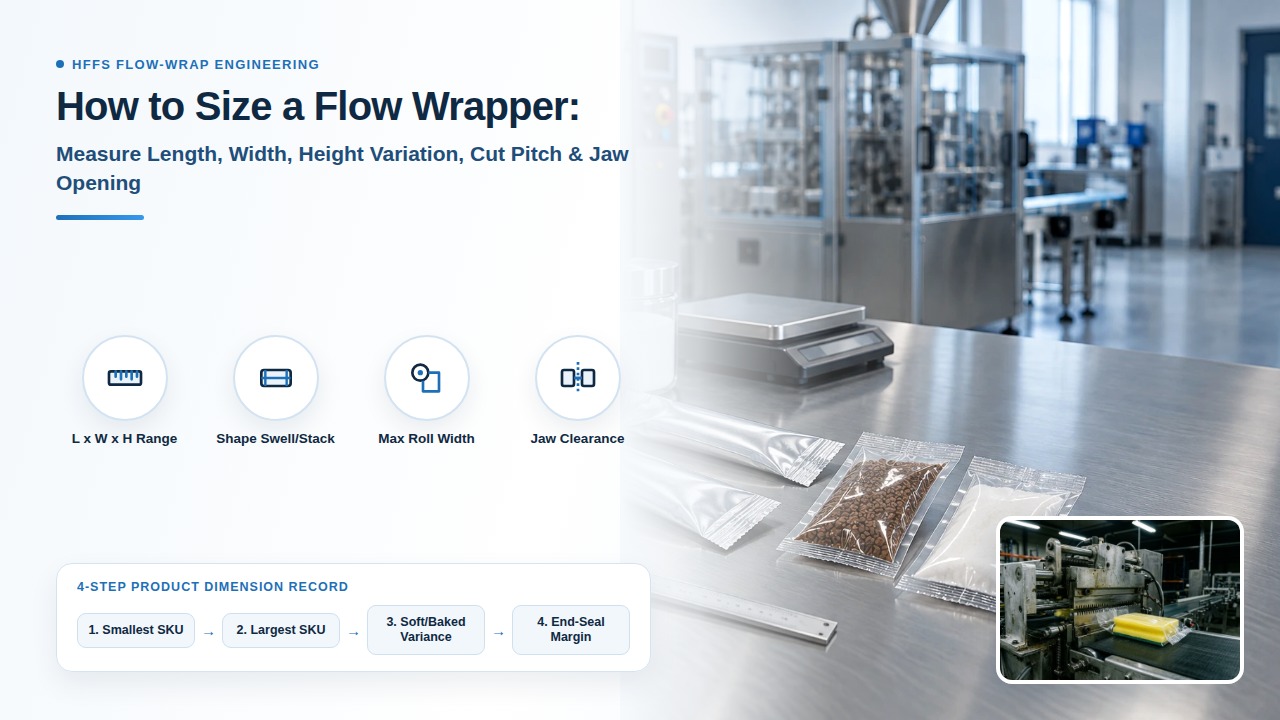
How to Size a Flow Wrapper for Your Product
Size a horizontal flow wrapper from real product length, width, and height tolerances: flat web width (W_web), cut pitch (L_cut), forming box, and jaw clearance.
Read more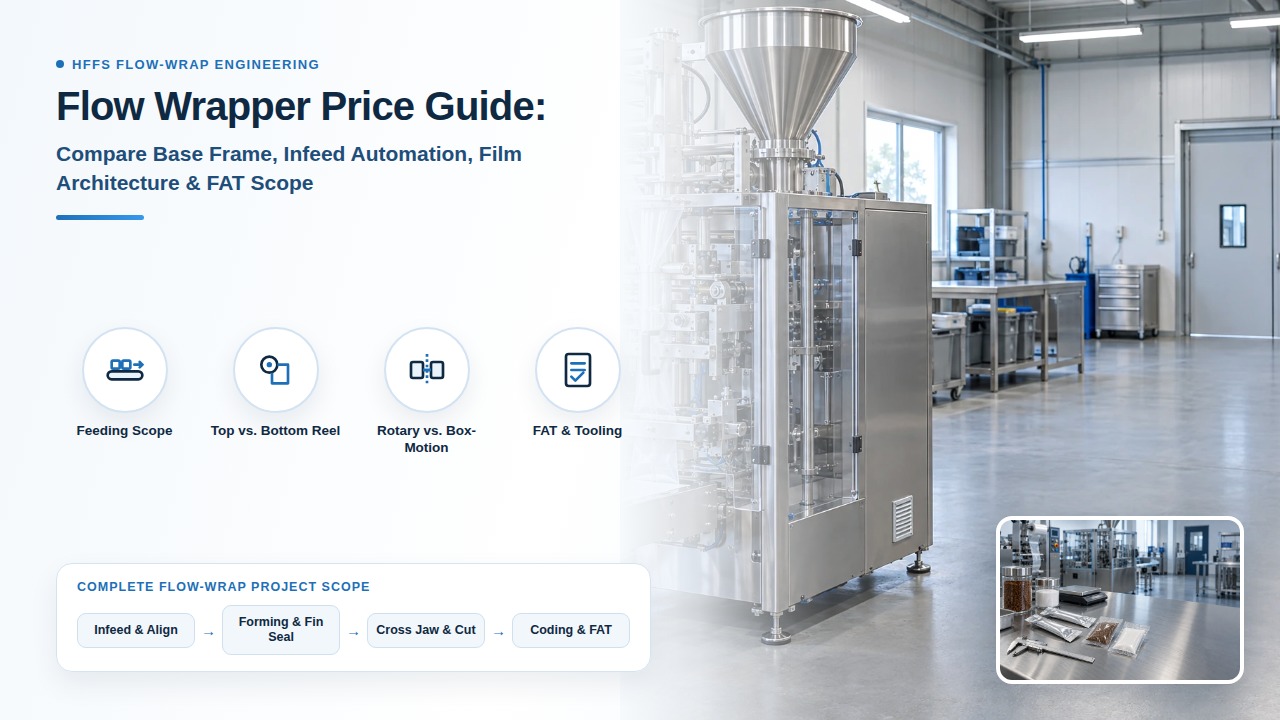
Flow Wrapper Price: What Determines Your Project Cost?
What is included in a flow wrapper quote? Check feeding equipment, options, freight and installation before comparing prices.
Read more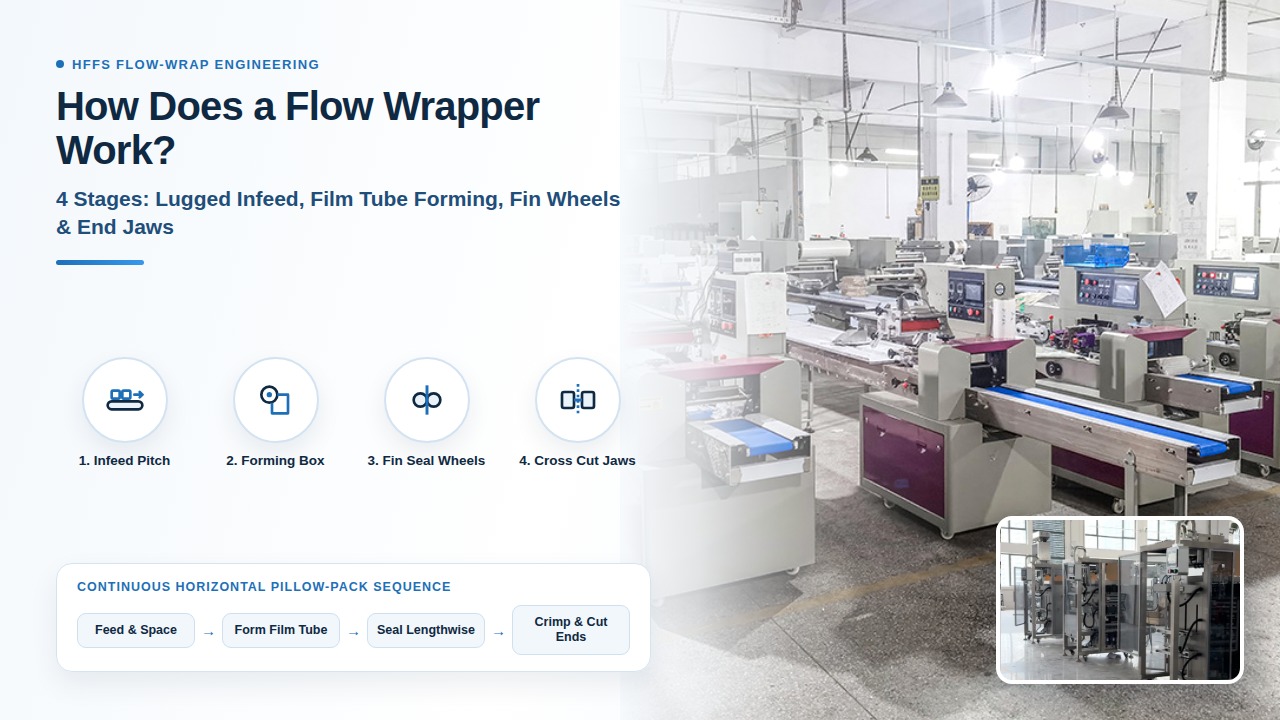
How Does a Flow Wrapper Work? Step-by-Step Process
Learn how a horizontal flow wrapper works across 5 stages: pitch infeed, tube forming, fin-wheel sealing, cross-sealing jaws, and discharge calculations.
Read more