
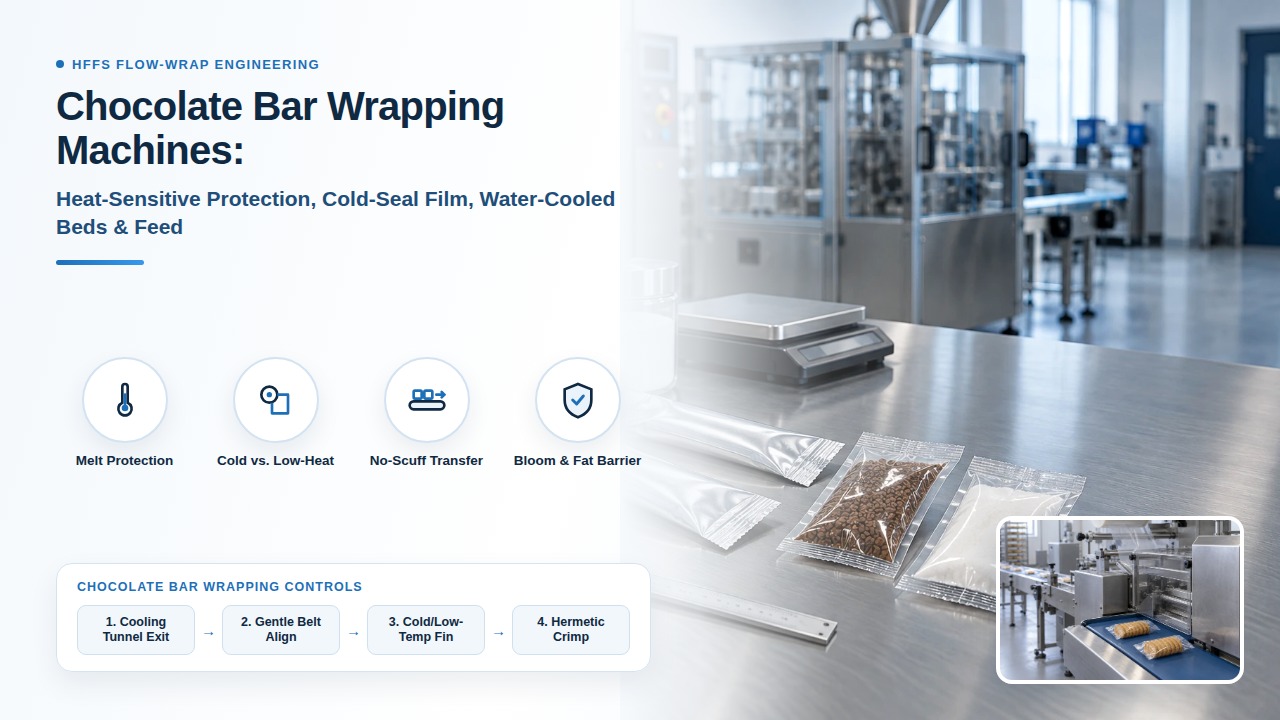
Chocolate Bars vs Other Confectionery
A chocolate bar wrapping machine needs assessment with the bar in its actual packing condition, the intended film and the required finished package. Temperature, surface smear and the way the bar enters the wrapper can change the trial. Start with those inputs before choosing a machine configuration.
This page covers chocolate bars, tablets and similar solid chocolate products presented as individual pieces or a defined group. Use the candy packaging page for other solid confectionery and the cereal and protein bar page for nutrition bars, including those with a chocolate coating. A coating alone does not make the handling problem the same. The bakery product selector helps separate requirements for wafer and baked products.
Flow Wrap or Foil Folding?
Open an example of the package you want. Conventional flow wrapping forms reel film around a bar and makes a longitudinal seam and sealed ends. Fold wrapping creates folded flaps around the product, sometimes with a separate paper band. Theegarten-Pactec's chocolate wrapping brochure describes this latter route with foil and laminate materials. It is a different equipment requirement.
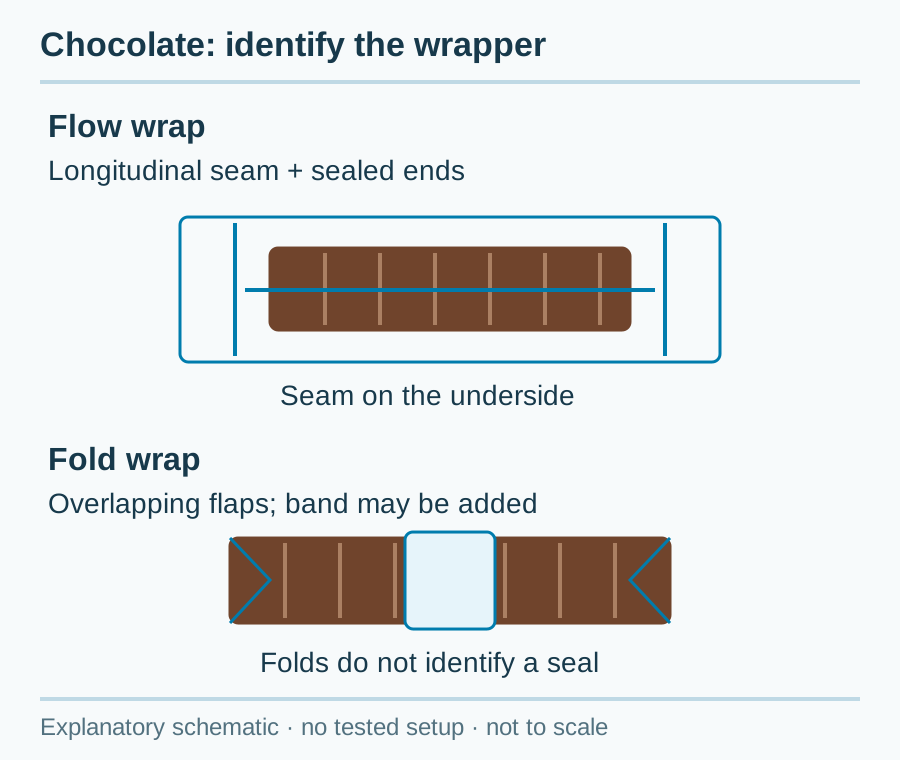
A metallic appearance does not identify the process: a metallized film pack can still be flow-wrapped. Send photographs of the unopened and opened package, including its underside and ends. State whether the bar needs one wrapper, an inner wrap plus an outer sleeve, or a retail multipack. Do not assume a flow wrapper also applies sleeves or cartons. Tempering, moulding and cooling chocolate are separate upstream operations.
Protecting Heat-Sensitive Surfaces
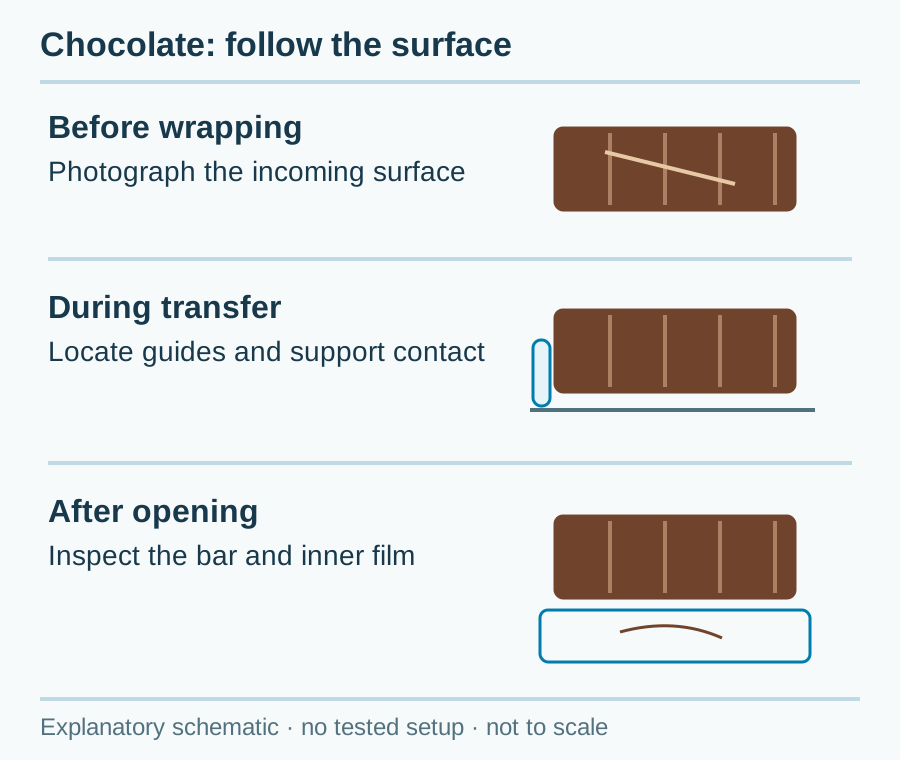
Record the bar temperature at the intended packing point, the room conditions and the time since cooling. Include the condition after a normal production hold. Show any existing scuffs, softened edges, coating cracks or smear before wrapping so the trial can distinguish incoming defects from handling damage.
Ask the supplier to identify contact at conveyor transfers, side guides, pushers, the former and the film. Agree how the bar will be photographed before packing and after opening. Inspect the film's inside surface for transferred chocolate as well as the bar itself; an attractive unopened pack can conceal surface damage.
Syntegon describes both heat sealing and cold sealing for chocolate packaging. That establishes possible process routes, not cold-seal availability here. Cold sealing requires a compatible material and machine arrangement; it does not establish that the bar will release cleanly from the film. Ask for the proposed sealing method and its assessment conditions in writing. No universal cooling temperature or smear-free result is specified here.
Feeding, Size and Pack Format
Measure actual length, width and highest point, including moulded features or inclusions. Record the size extremes that occur together. Photograph the bar from above and from the side. If there is a tray or support card, measure the complete assembly and include it in the sample.
| Pack requirement | What changes the assessment | Input to provide |
|---|---|---|
| One bar per pack | Orientation, contact and spacing | Actual bars and a short incoming-conveyor video |
| Several bars in one outer wrap | Group formation and stability | Count, arrangement and any support material |
| Bar on a tray or card | Transfer and clearance for the whole assembly | Tray or card sample with the bar in place |
| Folded foil with a band or sleeve | A separate folding or secondary-packaging operation | Opened and unopened reference packages |
Describe whether bars arrive aligned, in rows or in an irregular stream. Manual placement, automatic spacing and assembling a group are different tasks. Use the flow wrapper configuration guide to discuss film path and feeding against the same product samples. Ask what happens during missing-product gaps, stops and restarts, and which handling tasks remain outside the quoted scope.
Film and Seal Testing
Provide the film supplier's specification, sealable-face identification, reel details and any printed repeat information. Describe the required opening behavior, pack appearance and storage conditions. The flow-wrap film guide explains which material information belongs in the assessment.
Keep product clearance and seal formation as separate checks. Ask the supplier to inspect whether chocolate or crumbs enter the sealing area, whether the film forms consistently, and whether the finished seals meet the agreed inspection method. Syntegon's sealing guidance treats product, film and sealing conditions together; a temperature setting alone is not a validated seal recipe.
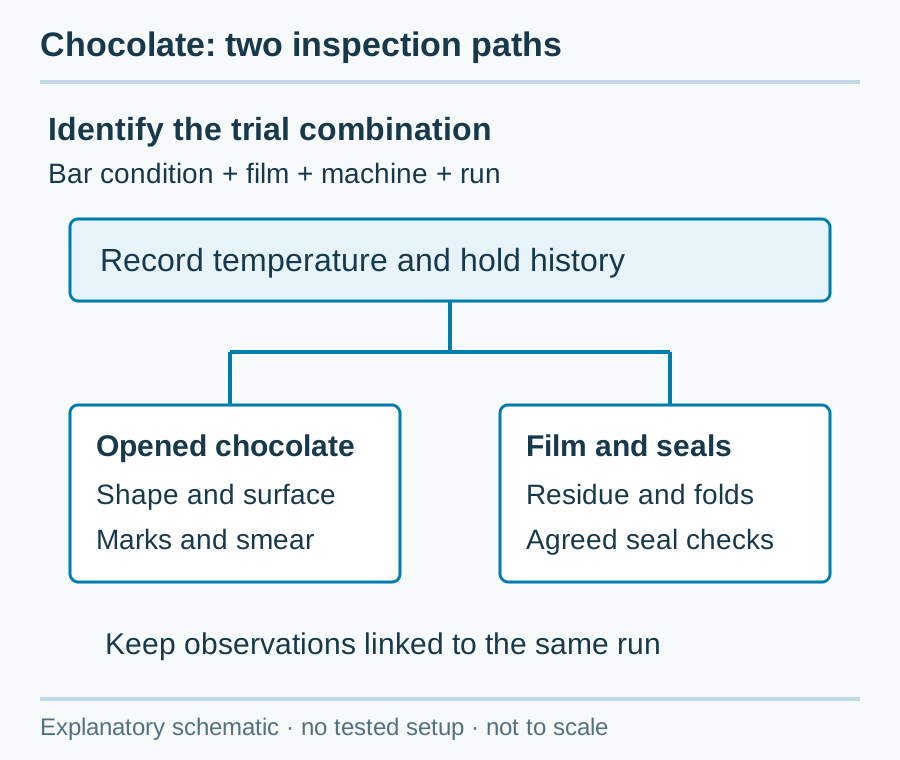
Agree pack-integrity checks with the supplier and shelf-life validation with the relevant product and packaging specialists. A sealed pack, a particular film structure or an undamaged bar does not by itself establish shelf life. Treat a film substitution or a different bar surface as a change needing review.
Your Sample-Test and Quote Inputs
Discuss your chocolate bar package on WhatsApp. Send bar and package photographs, actual size extremes, packing temperature and cooling notes, pieces per pack, film information, surface acceptance requirements and an infeed video. State the required output as a target for assessment. Ask which samples are needed and which feeding, sealing and changeover items remain to be tested before a quotation is agreed.
Before you request a quote
Cereal, Granola and Protein Bar Packaging Machines
For cereal and protein bars, describe stickiness, coating and size variation. Use those details to plan feeding and film trials for a flow wrapper.
Read more
Compare Flow Wrapper Types and Configurations
Rotary or box motion? Top film or bottom film? Compare the feeding, film path and end-seal choices in a flow wrapper proposal.
Read more
Choosing Flow Wrap Film for Your Product and Machine
Choosing flow wrap film starts with the product and required seal. Gather the film specification, reel dimensions and samples for compatibility testing.
Read more