
Updated 2026-10-17
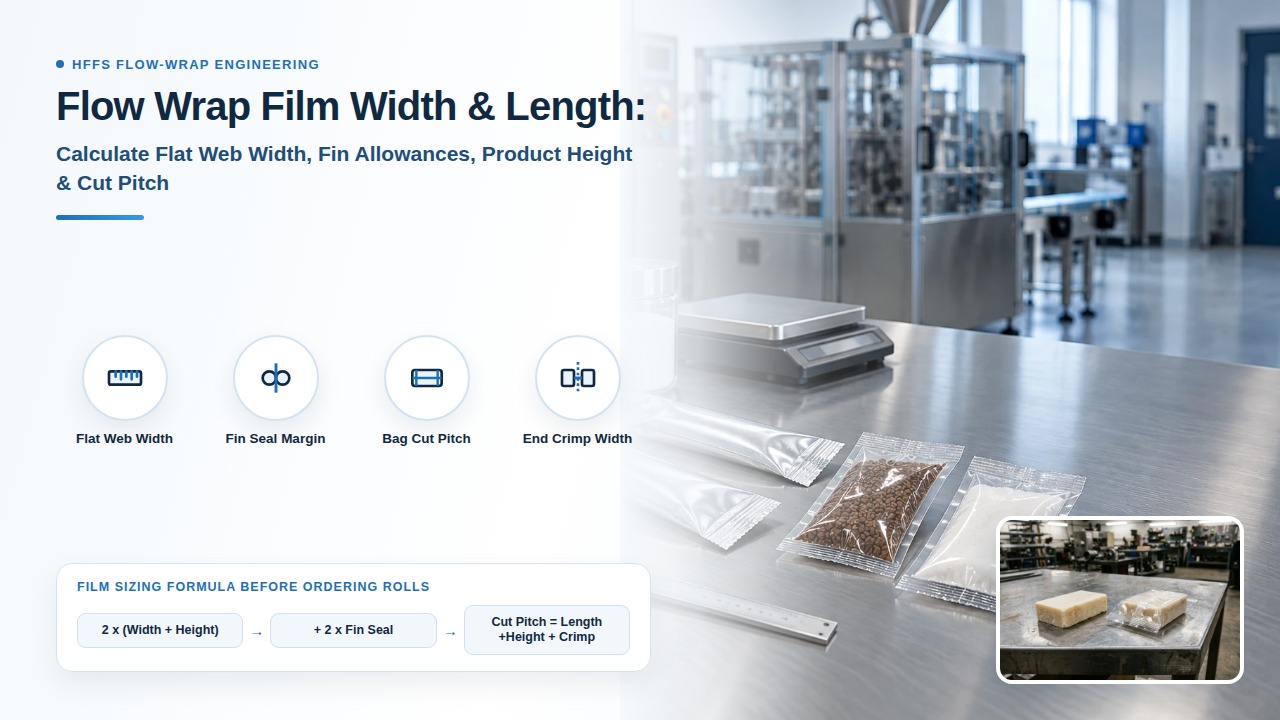
Ordering slitted rollstock or locking printed artwork cylinders from product dimensions alone—without accounting for vertical product height drape, forming-box tracking clearance, longitudinal fin-seal vs lap-seal geometry, and transverse jaw crimp margins—causes edge starvation at the fin wheels, crushed product ends inside rotary jaws, and 8% to 18% avoidable film waste, rework, and seal leakage. Accurate flow wrap film width and bag length calculation requires converting the conditioned three-axis product envelope (L_prod x W_prod x H_prod, including trays, U-cards, and thermal swell) into two coupled rollstock coordinates: flat film web width across travel (W_web) and cut-to-cut bag pitch along travel (L_cut). Because both product width and product height consume flat web perimeter while product height and end-seal geometry consume longitudinal repeat length, every rollstock specification must be calculated from explicit folding equations, checked against each format's dominant failure mode and root cause (such as web misalignment, seal contamination, and center-fin leakage), and verified under ASTM F88, ASTM F1921, and ASTM D1894 test baselines before committing to commercial print runs.
Engineering summary: Calculate horizontal flow wrap film width using W_web = 2(W_prod + H_prod) + 2F_fin + C_forming for a longitudinal fin seal (where 2F_fin = 20 to 30 mm and C_forming = 6 to 18 mm) or W_web = 2(W_prod + H_prod) + O_lap + C_forming for a flat lap seal (O_lap = 12 to 18 mm), and calculate cut-to-cut bag length using L_cut = L_prod + k_H * H_prod + 2W_crimp + C_jaw (where 2W_crimp = 20 to 36 mm and C_jaw = 16 to 28 mm), matching printed eye-mark repeat pitch within ±0.5 to ±1.0 mm across a 450 to 700 mm HFFS reel mandrel (300 mm max OD on a 76 mm core).
| Rollstock parameter or subsystem | Standard engineering baseline or formula | Why it governs rollstock slitting & artwork dielines |
|---|---|---|
| Flat film web width — Fin seal (W_web_fin) | W_web = 2(W_prod + H_prod) + 2F_fin + C_forming; 2F_fin = 20–30 mm (2 x 10–15 mm fin), C_forming = 6–10 mm fixed / 12–18 mm adjustable former | Seals inside-to-inside sealant layers; under-sizing starves fin wheels and splits seams under ASTM F1921 hot-tack load |
| Flat film web width — Lap seal (W_web_lap) | W_web = 2(W_prod + H_prod) + O_lap + C_forming; O_lap = 12–18 mm flat overlap (requires AB/ABA two-side heat-sealable film) | Saves 10–18 mm of flat web width per pack (3–6% film reduction) but requires inner-to-outer sealant compatibility |
| Cut-to-cut bag length / pitch (L_cut) | L_cut = L_prod + k_H * H_prod + 2W_crimp + C_jaw; k_H = 1.0–1.3 height drape factor, 2W_crimp = 20–36 mm, C_jaw = 16–28 mm | Defines rotary cross-jaw cut pitch, converter print repeat length (P_repeat), and linear film consumption per pack |
| Side-gusseted pack geometry (G_gusset) | Tuck depth G_gusset <= 0.45 * H_prod; adds 4-layer film folds at outer zones of transverse end crimp (+4 to +8 mm C_gusset on stiff webs) | Squares bag ends on tall loaves, cookies, and cartons (>45–55 mm height) to eliminate protruding corner dog-ears |
| Printed eye-mark & registration repeat | 3–5 mm (travel) x 8–10 mm (cross-web) solid contrast mark inside >=5–10 mm graphic-free quiet zone; repeat pitch tolerance ±0.5 mm | Optical photocell triggers rotary cross-jaws; +0.5 mm cumulative print error without registration walks cuts into logos |
| Reel mandrel, COF & polymer standards | Up to 450 mm (Syntegon Pack 403/202) or 650–700 mm web width (ULMA FR 100/200), 300 mm OD, 76 mm core; ASTM D1894 kinetic COF 0.18–0.30; ASTM F88 / F1921; FDA 21 CFR 177.1520 | Controls forming-shoulder drag elongation, fin-wheel traction, hermetic seal peel strength, and food-contact compliance |
How Do You Calculate Flat Film Web Width (W_web) for Fin-Seal, Lap-Seal, and Side-Gusseted Packs?
On a horizontal Form-Fill-Seal (HFFS) flow wrapper, flat film web width (W_web) is the edge-to-edge width of the unstretched rollstock measured perpendicular to machine travel. As the web unwinds from the backstand and passes over the forming shoulder (forming box), it wraps completely around the cross-sectional perimeter of the product or carrier tray—meaning both maximum product width (W_prod_max) and maximum product height (H_prod_max) draw directly from the flat web width. Review our flow wrap film guide and flow wrapper size selection guide for how web width interacts with machine frame tiers and barrier laminates.
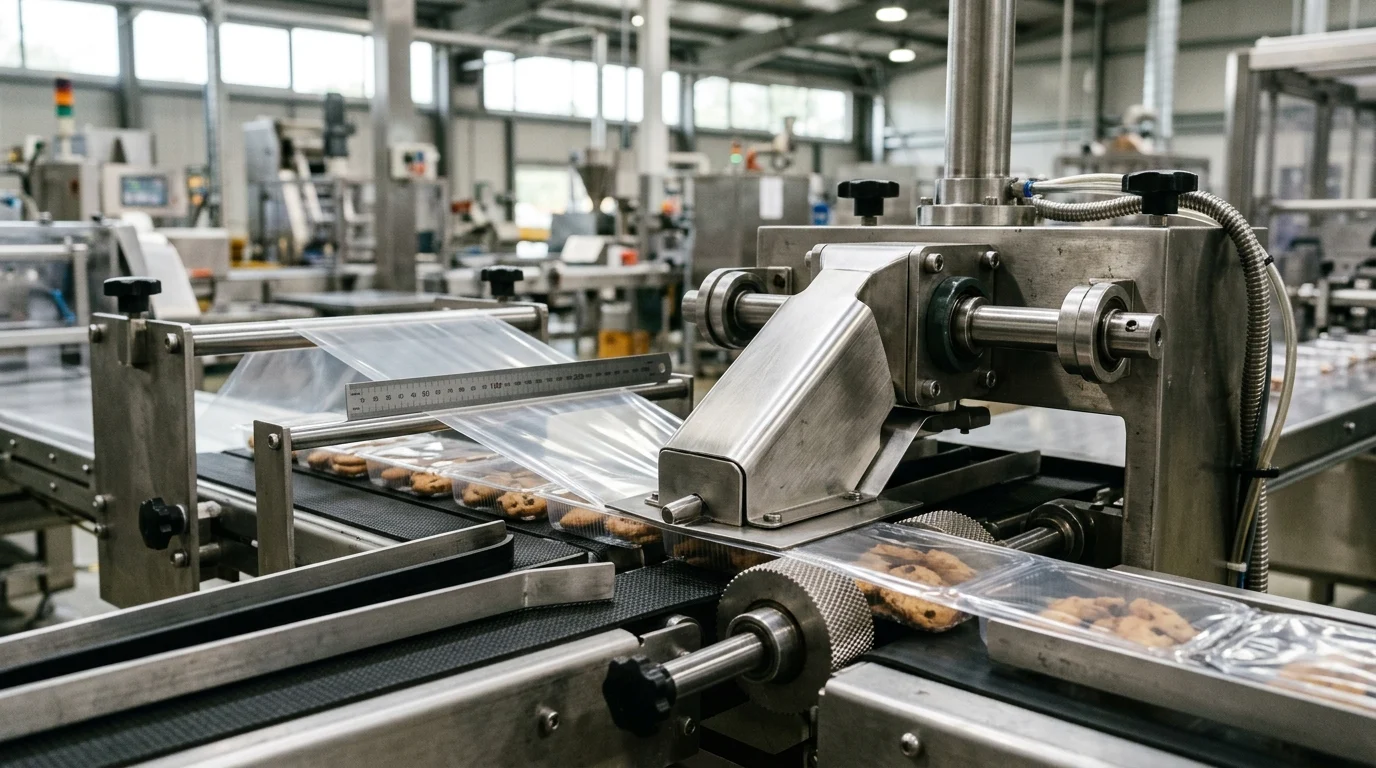
Depending on your longitudinal seam architecture and corner presentation, engineers select among three web-width configurations documented across ULMA Packaging's Flow Pack HFFS series and Syntegon's horizontal flow wrapper sealing guidelines:
- Longitudinal Fin Seal (
Inside-to-Inside Seal): The forming box brings the two inner edges of the film face-to-face underneath (or on top of, on inverted bottom-reel machines) the product, where knurled fin-seal rollers pull and weld a vertical fin of widthF_fin = 10 to 15 mm(consuming 2 * F_fin = 20 to 30 mm of total flat web width) before folding the fin flat against the pack. Because the inner sealant surface welds to itself, a standardABtwo-layer laminate (such as 20 um printed BOPP laminated to 25 um heat-sealable CPP or PE) runs without special outer coatings. - Longitudinal Lap Seal (
Inside-to-Outside Flat Overlap): The forming shoe overlaps the inner face of one film edge directly onto the outer face of the opposite film edge across a flat zone ofO_lap = 12 to 18 mm, sealed by a heated drag shoe or flat roller against the product support bed. A lap seal eliminates one folded flange—reducingW_webby10 to 18 mm(3% to 6%material savings on narrow bars and biscuit packs)—but requires anABAco-extruded film or dual-side heat-sealable coating so the inner layer bonds to the outer layer, plus a rigid product spine (such as a carton, biscuit tray, or firm chocolate bar) to resist sealing shoe pressure. - Side-Gusseted Pillow Pack (
Tuck-In Side Folds): On tall or boxy products (H_prod > 45 to 55 mm, such as sliced bread loaves, stacked cookies, or multipack cartons; see cookie packaging machines and bread packaging machines), pneumatic or cam-driven gusset tucking fingers mounted immediately upstream of the cross-sealing jaws push the vertical side walls inward by a gusset depthG_gussetbefore the transverse jaws close. Geometrically, the side fold redirects the existing2 * H_prodvertical side wall inward without adding theoretical perimeter, providedG_gusset <= 0.45 * H_prodso the two opposing tucks do not collide at the pack centerline. In practice, stiff laminates (> 40 to 50 um) require an extraC_gusset = 4 to 8 mmweb-width tension allowance so the tucking stroke does not pull the molten longitudinal fin seam open underASTM F1921hot-tack stress.
| Seam & fold architecture | Web-width allowance & film structure requirement | Transverse cross-seal layer profile | Dominant Failure Mode & Mechanical Prevention |
|---|---|---|---|
| Standard Fin Seal (Folded bottom or top fin) | 2 * F_fin = 20–30 mm total (10–15 mm folded fin) + C_forming = 6–10 mm (fixed former) or 12–18 mm (adjustable former); standard AB one-side sealable film | 2 film layers across pack width; 4 film layers at center folded fin-seal intersection | Center-fin micro-channel leaker at 2-to-4 layer step or fin pull-out from narrow allowance -> Size F_fin >= 12 mm, verify >= 0.5 mm 60-deg V-groove fin wheels, and Relief-grind or carbon-check cross jaws for 4-layer step under ASTM F88 |
| Flat Lap Seal (Inside-to-outside overlap) | O_lap = 12–18 mm single flat overlap + C_forming = 6–10 mm (fixed former); requires ABA co-extruded dual-side heat-sealable film or registered cold seal | 2 film layers across width; 3 film layers across the 12–18 mm lap-seal overlap zone | Delamination of lap seam on standard AB film or heat scorching of soft product under lap shoe -> Specify verified ABA dual-side sealant web (FDA 21 CFR 177.1520) and use a water-cooled deadplate or tray carrier under the lap heater |
| Side-Gusseted Fin-Seal Pack (Mechanical or pneumatic tuckers) | 2 * F_fin = 24–30 mm + C_forming = 10–14 mm + C_gusset = 4–8 mm on stiff laminates (>40 um); gusset depth G_gusset <= 0.40–0.45 * H_prod | 4 film layers at both left/right side-gusset tucks + 4 film layers at center fin fold (2 layers in intermediate bridges) | Corner pinhole leaks at 4-layer gusset transitions or tearing during tucker stroke -> Match cross-jaw serration profile to 4-layer gauge, set dwell >= 180–250 ms (box-motion or D-cam), and synchronize tucker finger phase with jaw closure |
| Cold-Seal Fin-Seal Pack (Pressure-sensitive cohesive) | 2 * F_fin = 24–30 mm pattern-coated cohesive stripes along both web margins and transverse seal bands; zero thermal shrinkage | 2 layers across body; 4 layers at folded fin (sealed purely by knurled roller nip pressure at ambient temperature) | Cohesive blocking on unwind roll or incomplete edge bond from web wander -> Maintain fixed forming box within ±1 mm of web width and verify cohesive release lacquer COF per ASTM D1894 |
How Do Bag Length (L_cut), Product Pitch (P_lug), and Eye-Mark Registration Interact?
In flow wrapping, product length (L_prod), cut-to-cut bag length (L_cut), infeed lug pitch (P_lug), and printed eye-mark repeat pitch (P_repeat) are four distinct longitudinal measurements along machine travel (see flow wrap packaging and how a flow wrapper works):
- Product length (
L_prod): The physical front-to-back length of the conditioned item, group, or loaded tray along conveyor travel (including any flared tray lip, chocolate tail, or multipack shingle slip). - Cut-to-cut bag length (
L_cut): The flat distance of film consumed between one transverse knife cut and the next. As the film tube collapses from vertical heightH_proddown to the horizontal cross-jaw pinch line at both the leading and trailing ends of the product, the slope consumes0.5 * H_prodto0.65 * H_prodper end (a total height drape allowance of k_H * H_prod, where k_H = 1.0 to 1.3). Adding the two serrated end crimps (2 * W_crimp = 20 to 36 mm) and the front/rear jaw-to-product safety clearance (C_jaw = 16 to 28 mm total) yields the required cut pitchL_cut. - Infeed chain lug pitch (
P_lug): The center-to-center spacing between pusher fingers on the infeed chain (seemanual vs automatic feeding). Because the products must enter the forming tube slightly faster or in phase with the film web without crowding the cross jaws,P_lugis sized20 to 45 mmlonger thanL_cut.
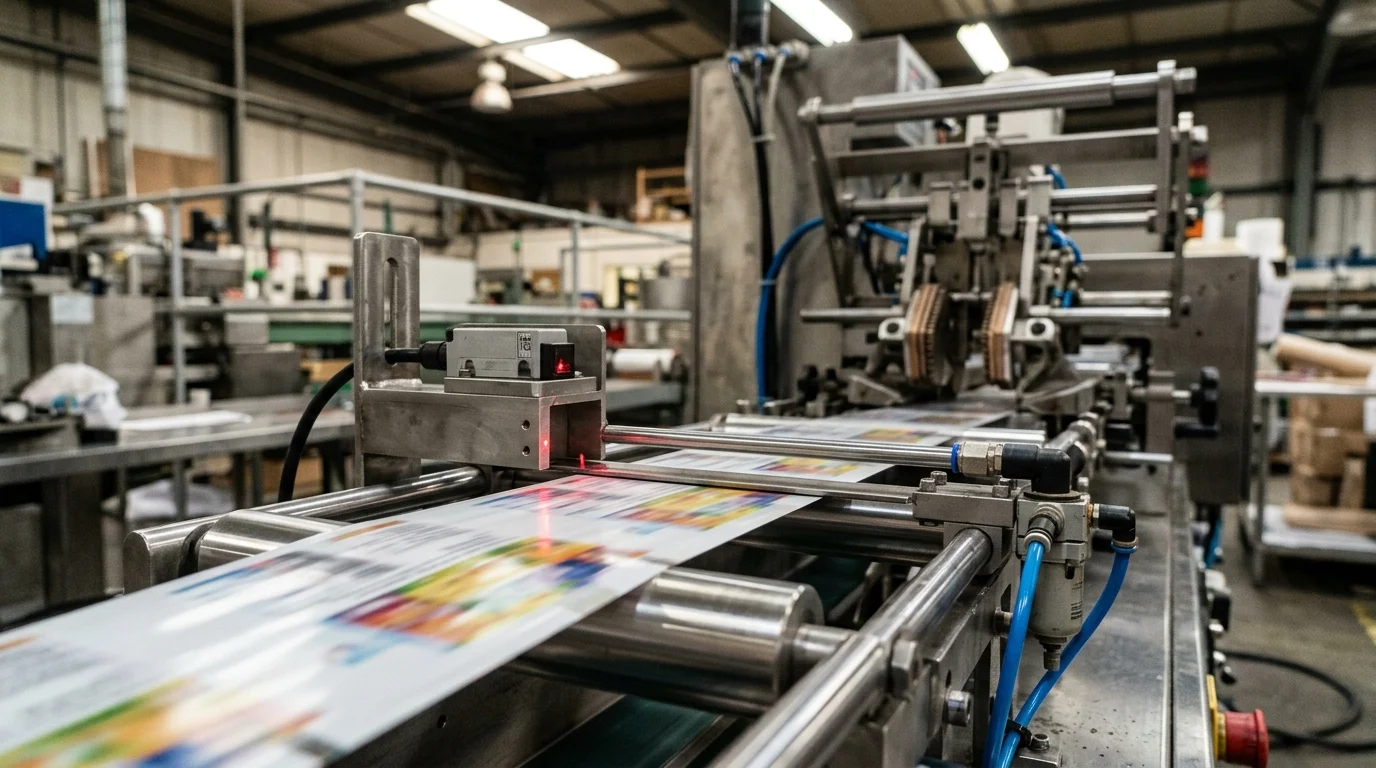
As detailed in ULMA Packaging's Flow Pack HFFS technical specifications (covering the FR 100 and FR 200 series) and Pacmatix's print-registration photocell engineering guide, horizontal flow wrappers control L_cut through one of three operating modes, each with a specific root cause of cut misalignment or seal leakage and a corresponding mechanical prevention:
| Longitudinal cut-control mode | Target film & product application | Repeat pitch & optical sensor specification | Dominant Failure Mode & Mechanical Prevention |
|---|---|---|---|
| Fixed-Length Encoder Mode (Unprinted / Continuous Print) | Clear BOPP/CPP, plain metallized film, or random repeat wallpaper print across uniform bars, cookies, or hardware | Servo cross-jaw and fin-wheel ratio sets fixed L_cut (e.g., 25–457 mm on Syntegon Pack 103; 90–625 mm on ULMA FR 100) | Gradual bag-length shrinkage from fin-wheel slip -> Maintain >= 0.5 mm knurl depth on pull wheels and keep film-to-metal kinetic COF within 0.18–0.30 (ASTM D1894) |
| Eye-Mark Print Registration Mode (Registered Artwork) | Retail branded packs requiring centered front/back graphics, nutrition panels, and scannable barcodes | 3–5 mm (travel) x 8–10 mm (width) solid high-contrast mark in >= 5–10 mm quiet zone; converter repeat P_repeat matched within ±0.5 mm | Cumulative cut drift slicing through artwork or false triggers on metallic ink -> Teach contrast sensor (e.g., Wenglor WM03PCT2 / Sick) on mark leading edge, print opaque white backing under mark on clear/foil webs, and size P_repeat 0.2–0.4% shorter than L_cut for web tension stretch |
| Photoelectric Product-Length Sensing Mode (Variable Bag Length) | Artisan bakery loaves, fresh produce trays, or bunched vegetables with piece-to-piece length variation > ±8–12 mm (unprinted film) | Inline infeed photo-eye measures each item length (100 mm to infinity on ULMA FR 200) and scales L_cut dynamically per pack | Trailing product end guillotined by cross jaws when product slips on belt -> Pair dual-beam length photo-eyes with high-friction food-grade infeed belt and Misplaced Product Detection (MPD) jaw inhibit |
Physical-Threshold Engineering Rules for Film Width and Bag Length Sizing
Use these four physical-threshold rules to lock rollstock width, seam geometry, and print-repeat specifications before ordering slitted trials or engraving print cylinders:
- Fin-Seal vs Lap-Seal Selection (
Web-Width Savings vs Film Structure): If annual volume on a single SKU exceeds3,000,000 to 5,000,000 packs/year, the product has a flat rigid base (such as a paperboard tray, carton, or solid chocolate bar), and your film converter supplies anABAdual-side heat-sealable film -> prioritize a12 to 18 mmflat lap seal (W_web_lap) over a folded fin seal because eliminating the double-folded2 x 12 to 15 mmfin flange reduces flat web width by10 to 18 mm(cutting annual rollstock weight by 3.5% to 6.0%); conversely, if the product is heat-sensitive, soft, or irregular (or runs on a standard AB one-side sealable barrier laminate) -> prioritize a12 to 15 mmfolded fin seal (2F_fin = 24 to 30 mm) because fin-seal rollers weld inner-to-inner sealant layers away from the product surface (seechocolate bar packaging machines). - Side-Gusset Activation (
Product Height vs Corner Dog-Ear Flare): If product heightH_prodexceeds45 to 55 mm(and the height-to-width aspect ratio H_prod / W_prod >= 0.40), such as stacked cookies, bakery loaves, or boxed non-food items -> specify mechanical or pneumatic side-gusset tucking fingers sized to a tuck depth ofG_gusset = 0.35 to 0.45 * H_prod(and add +4 to +8 mm of web-width tension allowance on laminates > 40 um) because collapsing a tall rectangular tube into a flat transverse crimp without side tucks forces triangular "dog-ear" wings to protrude beyond the pack width and jams downstream HFFS machines or case-packing lanes. - Printed Eye-Mark Repeat & Knife Clearance (
Registration Stability Thresholds): If running registered printed rollstock at speeds above100 to 250 packs/min-> specify a solid rectangular eye-mark of3 to 5 mmlength (along travel) by8 to 10 mmwidth (across web) inside a>= 5 to 10 mmgraphic-free quiet zone, hold converter cylinder repeat tolerance within±0.5 mm(with P_repeat set 0.2% to 0.4% shorter than nominal L_cut to compensate for unwind tension stretch), and maintain flying cross-knife clearance< 0.02 mmbecause a+0.5 mmuncorrected repeat error drifts50 mmoff-register in100 packs, while a dull knife (> 0.02 mmgap) forces operators to add20%extra end-seal margin (+6 to +10 mmonL_cut) to hide ragged cuts. - Forming-Shoulder COF & Cold-Room Thermal Conditioning (
ASTM D1894 & < 18 °C Shrinkage): If running thin polyolefin webs (20 to 35 umBOPP/CPP or LDPE) at linear film speedsV_film > 25 to 40 m/minor in cooled packaging halls below18 °C(such as enrobed confectionery or fresh bakery rooms) -> specify anASTM D1894film-to-metal kinetic COF between0.18 and 0.30, condition film reels in the packing hall for>= 24 hoursbefore threading, and size flat web width within±1 to ±2 mmof the fixed forming-box throat because unconditioned polyolefin webs stored below18 °Ccontract by up to0.5%(shrinking a 450 mm web by 2.25 mm and shifting eye-mark repeat pitch), while kinetic COF> 0.35stretches the web across the forming collar and causes chronic registration faults.
Quantitative Film Sizing & Rollstock Yield Equations (With Worked Examples)
Before purchasing production rollstock or approving artwork dielines, compute exact flat web width, cut-to-cut bag length, linear meters per reel, and net packs per roll using these four engineering equations.
1. Flat Film Web Width (W_web) — Fin Seal vs Lap Seal
W_web_fin (mm) = 2 * (W_prod_max + H_prod_max) + 2 * F_fin + C_forming
W_web_lap (mm) = 2 * (W_prod_max + H_prod_max) + O_lap + C_forming
- Variables:
W_prod_max= maximum product or tray width across travel (mm);H_prod_max= maximum product or stack height above bed (mm);F_fin= single folded fin-seal width (10 to 15 mm, so2 * F_fin = 20 to 30 mm);O_lap= flat lap-seal overlap (12 to 18 mm);C_forming= forming-box folding and tracking allowance (6 to 10 mmon a dedicated fixed forming box;12 to 18 mmon a handwheel-adjustable forming box). - Worked example: Wrapping a chocolate-coated granola bar on a U-card (
seecereal and protein bar packaging machines) with conditioned maximum dimensionsW_prod_max = 42 mmandH_prod_max = 24 mmon a high-speed wrapper with a dedicated fixed forming box (C_forming = 8 mm) and aF_fin = 13 mmfin seal requiresW_web_fin = 2 * (42 + 24) + 2 * (13) + 8 = 132 + 26 + 8 = 166 mm(order 166 mm or 168 mm slitted rollstock). Switching to anABAco-extruded film with anO_lap = 14 mmlap seal reduces flat web width toW_web_lap = 132 + 14 + 8 = 154 mm—saving12 mmof web width (7.23%material reduction across every pack).
2. Cut-to-Cut Bag Length (L_cut) and Printed Eye-Mark Repeat (P_repeat)
L_cut (mm) = L_prod_max + (k_H * H_prod_max) + (2 * W_crimp) + C_jaw
P_repeat (mm) = L_cut * (1 - epsilon_stretch)
- Variables:
L_prod_max= maximum product length along travel (mm);k_H= longitudinal film end-drape factor (1.0for sloped or rounded products;1.15 to 1.25for vertical square-ended trays or gusseted packs);W_crimp= width of one serrated transverse end seal (10 to 18 mm, so2 * W_crimp = 20 to 36 mm);C_jaw= total front-plus-rear clearance between product ends and inner crimp edge (16 to 28 mm total, or8 to 14 mmper end);epsilon_stretch= web tension elongation factor (0.002 to 0.004, i.e.,0.2% to 0.4%). - Worked example: For the same granola bar with
L_prod_max = 115 mm,H_prod_max = 24 mm, square ends (k_H = 1.15), twoW_crimp = 13 mmserrated end seals (26 mm total), andC_jaw = 18 mm(9 mmclearance per end), cut-to-cut bag length isL_cut = 115 + (1.15 * 24) + 26 + 18 = 115 + 27.6 + 26 + 18 = 186.6 mm(specify L_cut = 187 mm). Allowingepsilon_stretch = 0.0027(0.27%web stretch across the forming collar), the converter prints the eye-mark repeat pitch atP_repeat = 187 * (1 - 0.0027) = 186.5 mm.
3. Linear Footage per Reel (L_roll) and Net Packs per Roll (N_packs_roll)
L_roll (m) = (3.1416 * (D_outer^2 - D_core^2)) / (4000 * t_film)
N_packs_roll = floor((L_roll * 1000 * (1 - f_scrap)) / L_cut)
- Variables:
D_outer= film reel outer diameter (mm, typically300 mmmax on standard ULMA and Syntegon backstands);D_core= outer diameter of the fiber core (90 mmfor a standard76 mm / 3-inchID core);t_film= total film caliper in microns (um);f_scrap= roll-splice, startup, and registration reject fraction (0.015 to 0.025). - Worked example: Loading a
D_outer = 300 mmreel wound on aD_core = 90 mmcore using at_film = 35 umBOPP/metallized-CPP laminate yields a linear reel length ofL_roll = (3.1416 * (300^2 - 90^2)) / (4000 * 35) = (3.1416 * 81,900) / 140,000 = 1,838 mper roll. AtL_cut = 187 mmandf_scrap = 0.02(2%splice/threading waste), each reel producesN_packs_roll = floor((1,838 * 1000 * 0.98) / 187) = 9,632 good packs/roll(running 32.1 minutes between splices at 300 packs/min).
4. Pack Film Weight (M_pack) and Annual Rollstock Tonnage (M_annual)
M_pack (g) = (W_web * L_cut * GSM) / 1,000,000
M_annual (kg/yr) = (N_packs_yr * M_pack) / 1000
- Variables:
W_web= flat web width (mm);L_cut= cut-to-cut bag length (mm);GSM= film basis weight ing/m²(for polyolefin laminates with density ~0.91 g/cm³, a 35 um web equals ~31.8 g/m²; with ink and adhesive, typically 34.0 g/m²). - Worked example: Using
W_web_fin = 166 mm,L_cut = 187 mm, andGSM = 34.0 g/m², each wrapper consumesM_pack = (166 * 187 * 34.0) / 1,000,000 = 1.055 g/pack. Across15,000,000 packs/year, total film consumption isM_annual = 15,000,000 * 1.055 / 1000 = 15,825 kg/year($55,388/yearat$3.50/kg). Trimming12 mmof web width (via lap seal or eliminating an oversized shared reel) saves1,144 kg/year($4,004/yearon a single SKU).
How to Reverse-Engineer Film Width and Bag Length from an Existing Sample Pack
When benchmarking a current commercial pack or preparing a quotation request (see flow wrapper requirements checklist), engineers measure both the sealed pack with the product inside and a slit-open, unstretched flat film cutout. Measuring a creased, folded bag without unfolding the fin seal and side gussets underestimates W_web by 25 to 55 mm.
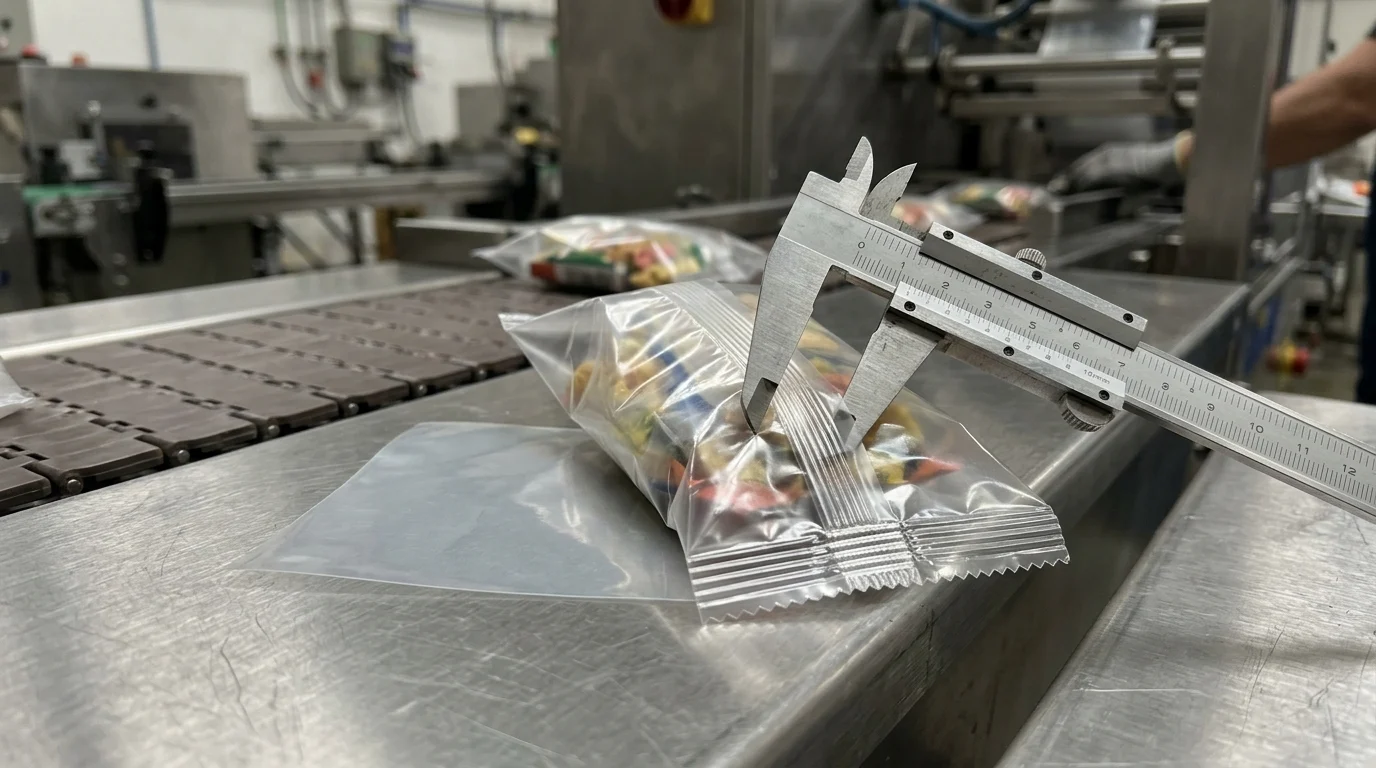
Follow this 5-step physical audit protocol on 5 to 10 conditioned sample packs:
- Record conditioned product envelope (
L_prod x W_prod x H_prod): Before opening the sample pack, measure overall closed bag length, closed bag width, and folded fin-flange width (F_fin) using a vernier caliper. Then remove the product (and any paperboard U-card or tray) and measure its length along travel, width across travel, and height above the conveyor bed across multiple pieces (seeindividual vs multipack cookie packaging and bread flow wrap vs bagging). - Measure transverse end-crimp width (
W_crimp) and side-gusset tuck depth (G_gusset): Measure the width of both serrated end seals (W_crimp, typically10 to 18 mmeach) and unfold the bag ends to check whether mechanical side gussets were tucked in (recording the inward fold depth G_gusset on each side). - Slit and flatten the wrapper to measure true
W_webandL_cut: Carefully peel open the longitudinal fin or lap seam (or slit along one fold line and add 2 * F_fin) and lay the film completely flat on a stainless inspection table without stretching the thin web. Measure edge-to-edge across machine travel (W_web) and cut-edge to cut-edge along travel (L_cut) to the nearest0.5 mm. - Verify printed eye-mark dimensions and repeat pitch (
P_repeat): On printed film, measure the rectangular eye-mark length along travel (3 to 5 mm), mark width across the web (8 to 10 mm), distance from the nearest film edge, surrounding graphic-free quiet zone (>= 5 to 10 mm), and exact leading-edge to leading-edge repeat distance (P_repeat) across at least three consecutive repeats on an unstretched reel sample. - Measure total film caliper (
t_film) and identify layer structure: Use a digital micrometer (0.001 mmresolution) to measure single-layer film thickness (e.g., 35 um) and check the four-layer thickness at the center fin fold (4 * t_film = 140 um), matching the result against the converter's technical datasheet (BOPP/CPP,PET/PE, or cold-seal laminate; compare thermal vs shrink webs in flow wrap vs shrink wrap).
Rollstock Over-Width & Registration Scrap Total Cost of Ownership (TCO) Ledger
Small dimensional errors in W_web or L_cut compound across millions of cycles per year into substantial material and downtime losses. Review equipment budget drivers in our flow wrapper price guide and machine architecture options in flow wrapper types.
| Rollstock sizing or setup error | Physical mechanism on HFFS line | Annual material & downtime penalty | Preventive engineering specification |
|---|---|---|---|
| Over-width shared rollstock (+35 mm excess W_web) | Running a narrow SKU on a wider SKU’s film reel and adjustable forming box folds excess film into wide fins or loose bag ears | At L_cut = 220 mm and 35 g/m² film ($3.50/kg), +35 mm excess width wastes 2,695 kg/yr ($9,432/yr per 10M packs) | Slit dedicated rollstock widths within ±2 mm of calculated W_web for any SKU exceeding 1.5M–2.0M packs/year |
| Worn cross-cut knife (>0.02 mm anvil gap) forcing wider L_cut | Operators add +6 to +8 mm to L_cut and extra jaw shims to mask ragged cuts when flying knives dull | Adding +7 mm to L_cut across 10M packs (W_web = 320 mm, 35 g/m²) wastes 784 kg/yr ($2,744/yr) plus premature jaw wear | Verify < 0.02 mm knife-to-anvil clearance with a feeler gauge at 3 points across the jaw and re-sharpen/replace blades on schedule |
| Eye-mark registration drift & glazed fin wheels | Fin-wheel grooves worn < 0.5 mm or film COF outside 0.18–0.30 cause ±0.5 mm slip per cut, slicing through printed graphics | 1.5% to 3.5% registration reject rate + 15–25 min stoppages per shift ($12,000–$28,000/yr in scrapped film and product) | Teach contrast photocell on mark leading edge, maintain >= 0.5 mm 60-deg V-groove fin wheels, and lock converter COF per ASTM D1894 |
| Cold-room (< 18 °C) unconditioned reel thread-up | Unconditioned polyolefin reels contract ~0.5% in width and pitch, binding on the forming collar and snapping splices | 10–20 min web-break re-threading stops and 50–150 m startup scrap per roll change | Condition rollstock for 24 h at packing-room ambient and reduce unwind brake tension by 10% when floor temperature drops below 18 °C |
What to Send Us for a Rollstock Dieline & Forming-Box Verification
| Engineering item to provide | Why our engineers need it | Acceptable engineering format |
|---|---|---|
| Conditioned product & carrier dimensions (min / nom / max L x W x H) | Establishes true cross-perimeter 2(W_prod + H_prod) and longitudinal height drape k_H * H_prod | Millimeter table for every SKU including tray rim / U-card thickness and post-cooling swell (e.g., 145x65x38 mm ±2 mm) |
| Existing sample pack or target seam & gusset style | Locks fin-seal (2 x 12–15 mm) vs lap-seal (12–18 mm) allowance, crimp width (W_crimp), and side-gusset tuck depth (G_gusset) | Annotated photos of flat slit-open wrapper next to a steel millimeter scale, plus 15–20 physical sample packs for trial |
| Film laminate datasheet & reel mandrel specs | Verifies AB vs ABA sealability, caliper (um), GSM, ASTM D1894 COF (0.18–0.30), roll OD (<=300 mm), and core ID (76 mm) | Converter PDF specification sheet showing layer structure (e.g., 20 um BOPP / 25 um CPP), winding direction chart, and seal window |
| Artwork PDF dieline & eye-mark coordinates (if printed) | Confirms P_repeat matches calculated L_cut and checks 3–5 x 8–10 mm eye-mark contrast and >=5–10 mm quiet zone | 1:1 vector PDF dieline showing repeat pitch, eye-mark track distance from web edge, and opaque white backing layer |
| Target line speed (packs/min) & annual SKU volume | Determines rotary vs box-motion dwell time, rolls consumed per shift, and dedicated slitted reel / fixed former ROI | e.g., 180 packs/min target speed, 6M packs/year on SKU-1 and 2M packs/year on SKU-2 |
Send Your Product Dimensions & Film Dieline on WhatsApp for an Engineering Audit
Common Questions on Flow Wrap Film Width and Bag Length
Why does flat film web width (W_web) require twice the product height in addition to twice the product width?
A horizontal flow wrapper folds a single flat film sheet around all four sides of the product cross-section—top, bottom, left vertical wall, and right vertical wall. That rectangular perimeter equals 2 * W_prod + 2 * H_prod, to which you must add the two folded longitudinal fin-seal flanges (2 * F_fin = 20–30 mm) and forming-box tracking clearance (C_forming = 6–18 mm).
How much film width does switching from a longitudinal fin seal to a lap seal save?
A folded fin seal requires two 10–15 mm flanges welded inside-to-inside (consuming 20–30 mm of flat web width), whereas a flat lap seal overlaps one 12–18 mm edge inner-to-outer. Switching to a lap seal trims 10–18 mm from W_web (saving 3% to 7% of rollstock weight), provided the film is an ABA dual-side sealable structure and the product base can support the sealing shoe.
Why must product height (H_prod) be added when calculating cut-to-cut bag length (L_cut)?
At both ends of the package, the film tube must slope downward from the top of the product (height H_prod) to the flat transverse cross-sealing jaws. That vertical-to-horizontal transition consumes approximately 0.5 * H_prod to 0.65 * H_prod of film length at each end (1.0 * H_prod to 1.3 * H_prod total), in addition to product length (L_prod), both serrated crimps (2 * W_crimp), and jaw clearance (C_jaw).
What eye-mark size and repeat tolerance prevent print registration cut drift on a flow wrapper?
Standard HFFS optical contrast sensors (such as Wenglor, Sick, or Omron mark readers) require a solid high-contrast rectangular eye-mark measuring 3–5 mm along film travel by 8–10 mm across the web, surrounded by a 5–10 mm graphic-free quiet zone and backed by opaque white ink on clear or metallized films. Converter repeat pitch must stay within ±0.5 mm of target L_cut.
Related guides
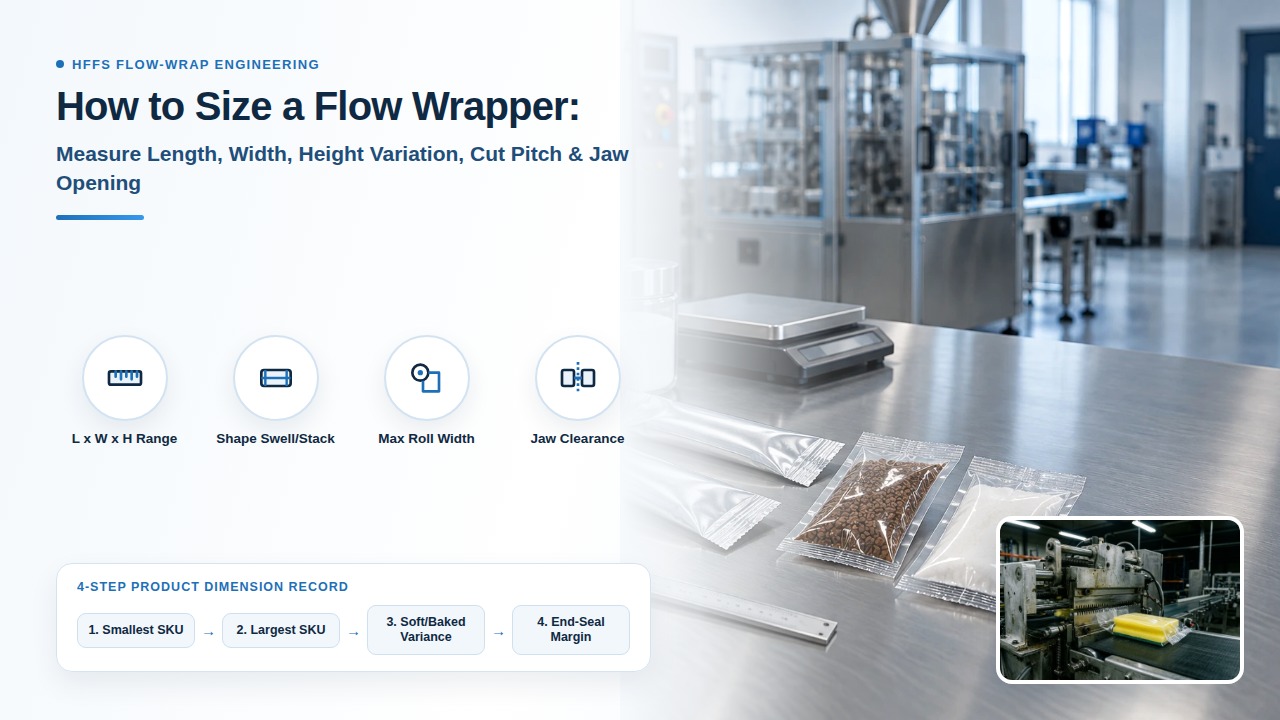
How to Size a Flow Wrapper for Your Product
Size a horizontal flow wrapper from real product length, width, and height tolerances: flat web width (W_web), cut pitch (L_cut), forming box, and jaw clearance.
Read more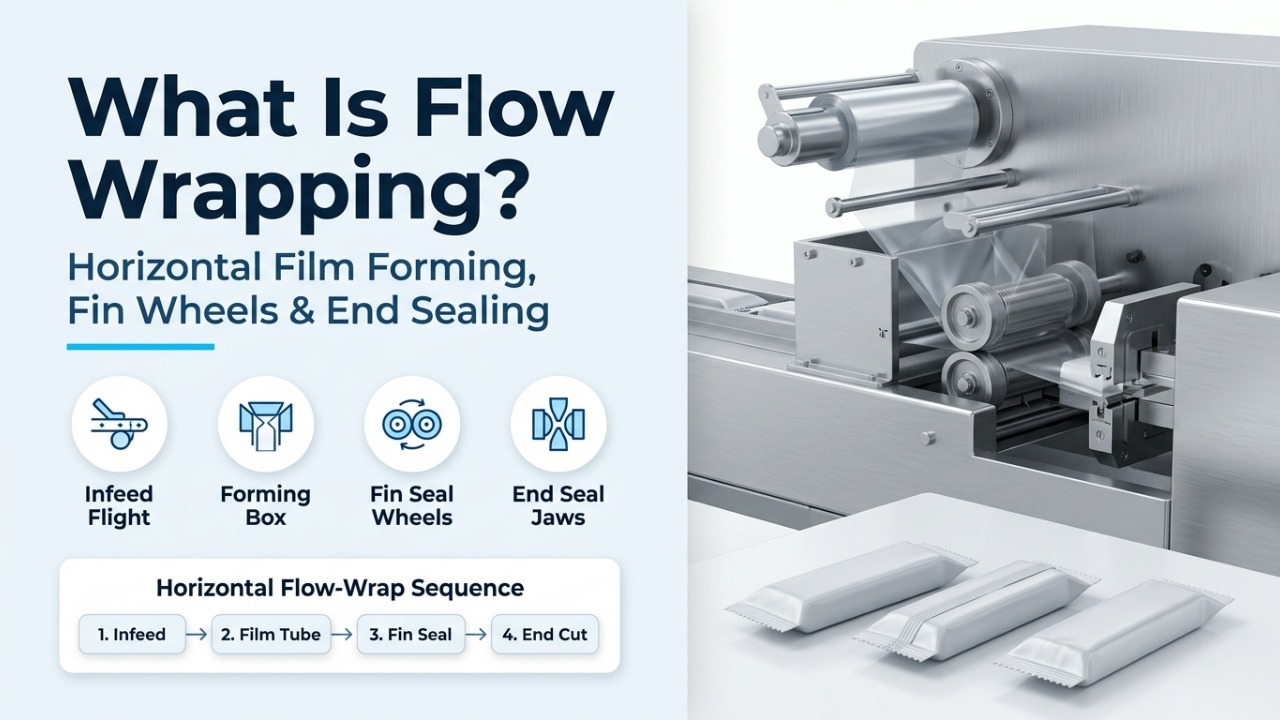
Flow Wrap Packaging: How It Works and When to Use It
Flow wrapping uses reel-fed film to make a pack with a lengthwise seal and two end seals. Check the pack format, product handling and film before choosing a machine.
Read more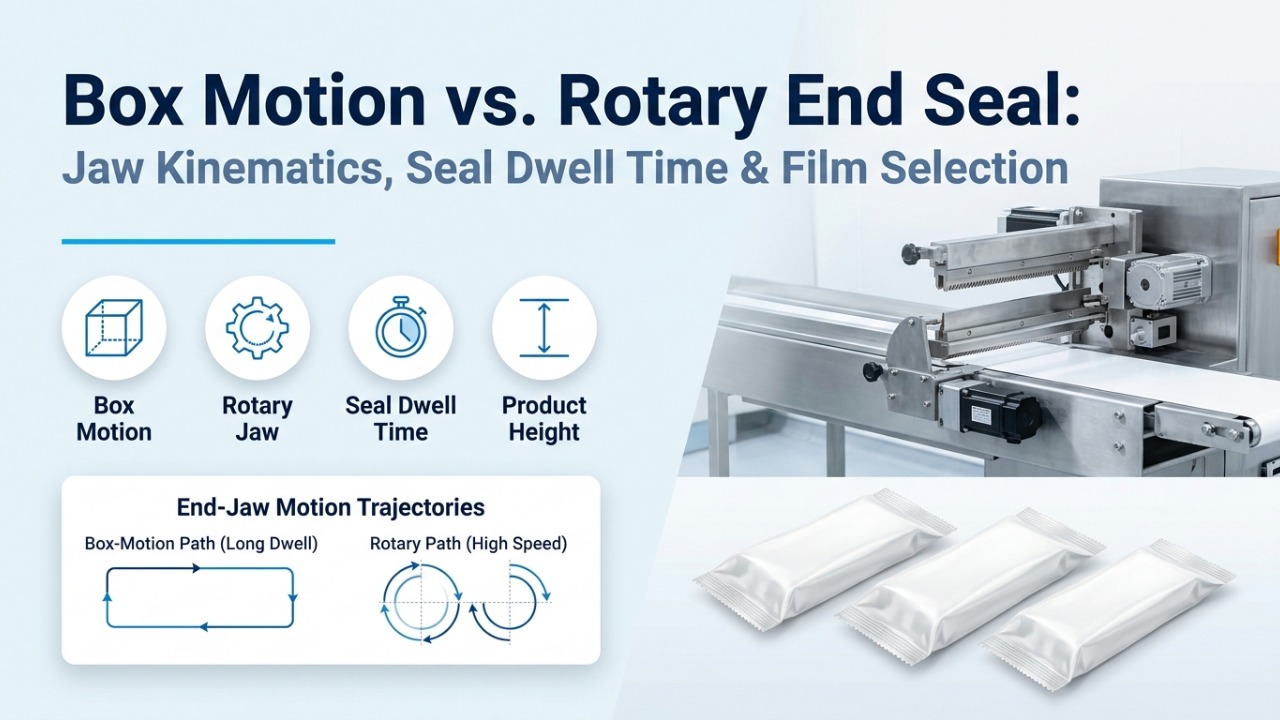
Compare Flow Wrapper Types and Configurations
Rotary or box motion? Top film or bottom film? Compare the feeding, film path and end-seal choices in a flow wrapper proposal.
Read more