
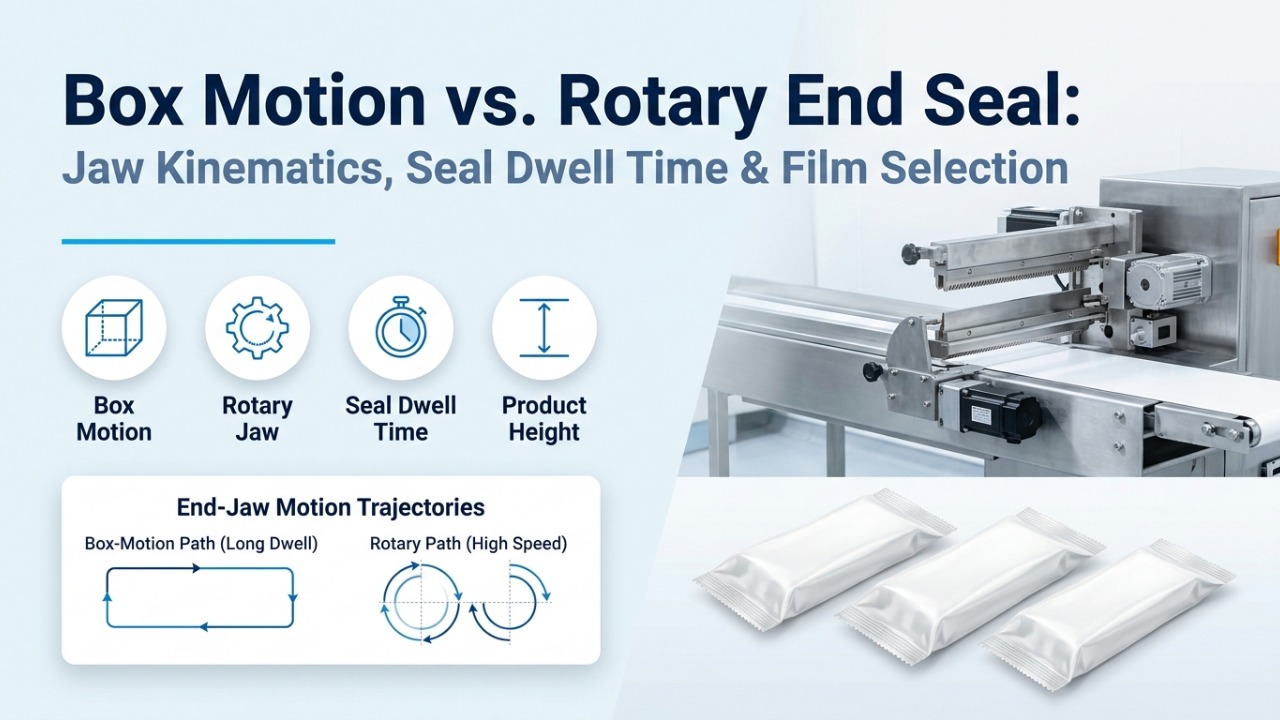
Choose by Product and Process
Compare flow wrapper types by three separate choices: how the product is fed, where the film enters, and how the end-sealing jaws move. A machine can combine choices from all three. A servo drive or an automatic infeed does not, by itself, tell you the sealing arrangement.
Start with the item you need to wrap. Record its size range, condition at packing, pieces per pack and any tray or support card. Then show how it arrives at the wrapper. A stable individual biscuit and a loose group of soft rolls may need different handling even when the finished wrappers look similar. If you need a dose filled into an open pouch, use the HFFS process selector before comparing flow wrappers.
The configurations below are general engineering categories. Their inclusion does not confirm that LINEVO offers a particular arrangement; the proposed supply scope needs confirmation in a quotation.
Rotary and Box-Motion Sealing
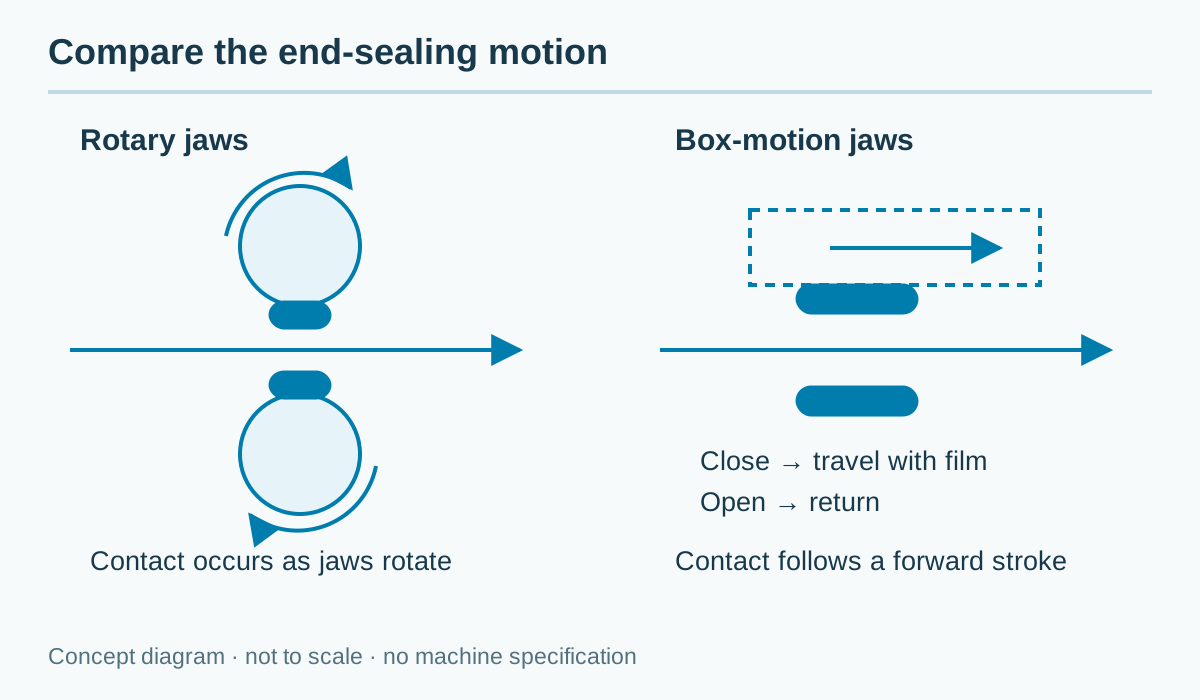
With rotary end sealing, opposed jaws rotate and meet across the moving film tube. Box-motion jaws close on the film, travel forward during contact, open and return. PFM's sealing-system overview describes these distinct motions.
Ask for a diagram or a guarded demonstration video of the proposed sealing head. Identify the product gap, the end-seal area and the point where the cut separates packs. A product must stay clear of that area throughout the cycle; a machine name cannot establish that clearance.
Do not choose solely from a claimed maximum speed. Ask which motion was assessed with your film, pack length and seal checks, and what still requires a sample trial. See the box-motion configuration guide for the questions to carry into a proposal.
Long-Dwell Designs
Dwell is the time the sealing surfaces remain in contact. A long-dwell description addresses that contact time; it is not a universal name for one jaw mechanism. PFM distinguishes long-dwell and box-motion designs in its horizontal sealing range. Have the supplier identify the mechanism rather than treating the terms as interchangeable.
Longer contact alone does not prove a satisfactory seal. Temperature, pressure, jaw alignment and film structure also matter, as Syntegon's sealing and cutting guidance explains. Request the material identification, running conditions and seal inspection method behind any recommendation. Mark an untested film as untested, including when the proposal uses terms such as barrier, mono-material or paper-based.
For a heat-sensitive product, include its temperature and surface condition at packing. The film and sealing guide helps frame the material discussion; there is no general seal-integrity or shelf-life promise attached to a long-dwell label.
Top-Film and Inverted Machines
In a top-film arrangement, film approaches the forming section from above the product path. In an inverted or bottom-film arrangement, the product meets film from below. Ask how the product is supported through the transfer and former, especially if it is soft, sticky, irregular or grouped. ULMA's bottom-film wrapper description is a manufacturer reference for this configuration category.
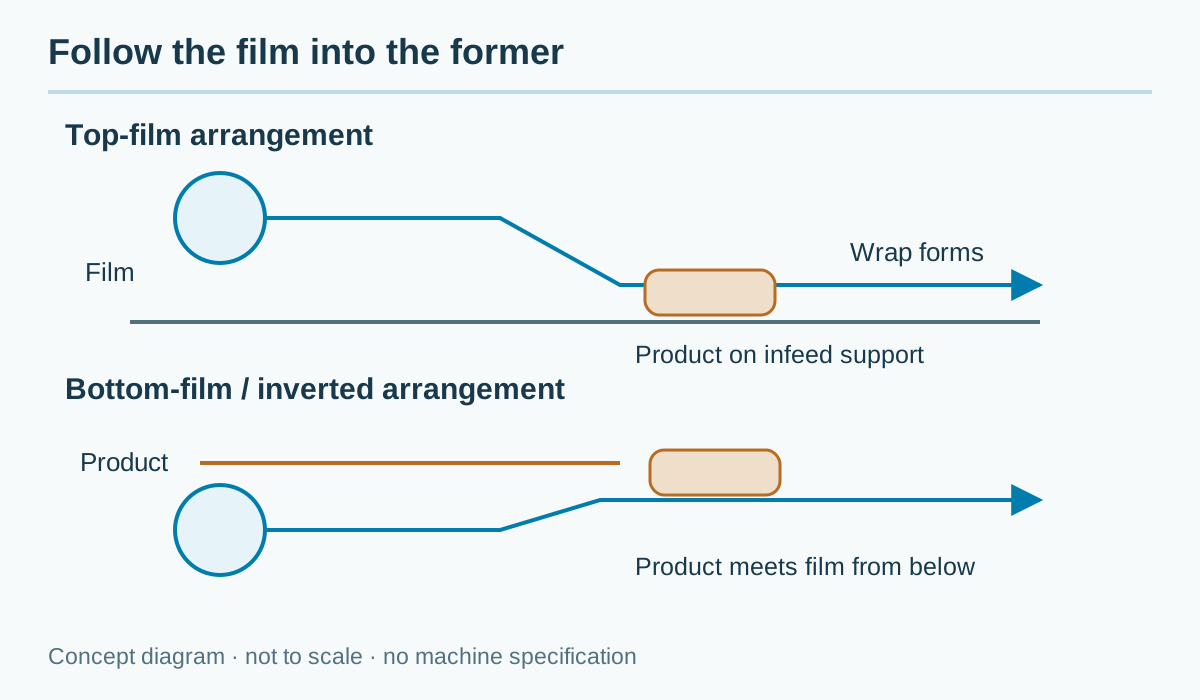
Send a short video showing the product leaving the previous process. Ask whether it can be pushed, needs continuous support, or requires a tray. Confirm the intended seam position on a pack drawing. The words top film and bottom film are not enough to settle transfer behavior or pack appearance.
Manual vs Automated Feeding
Manual loading means an operator places products into the feeding arrangement. An automatic system may also have to distribute, orient, group or space them before the wrapper. Define who or what performs each task. Automatically sealing a pack does not mean the complete line automatically handles the incoming product.
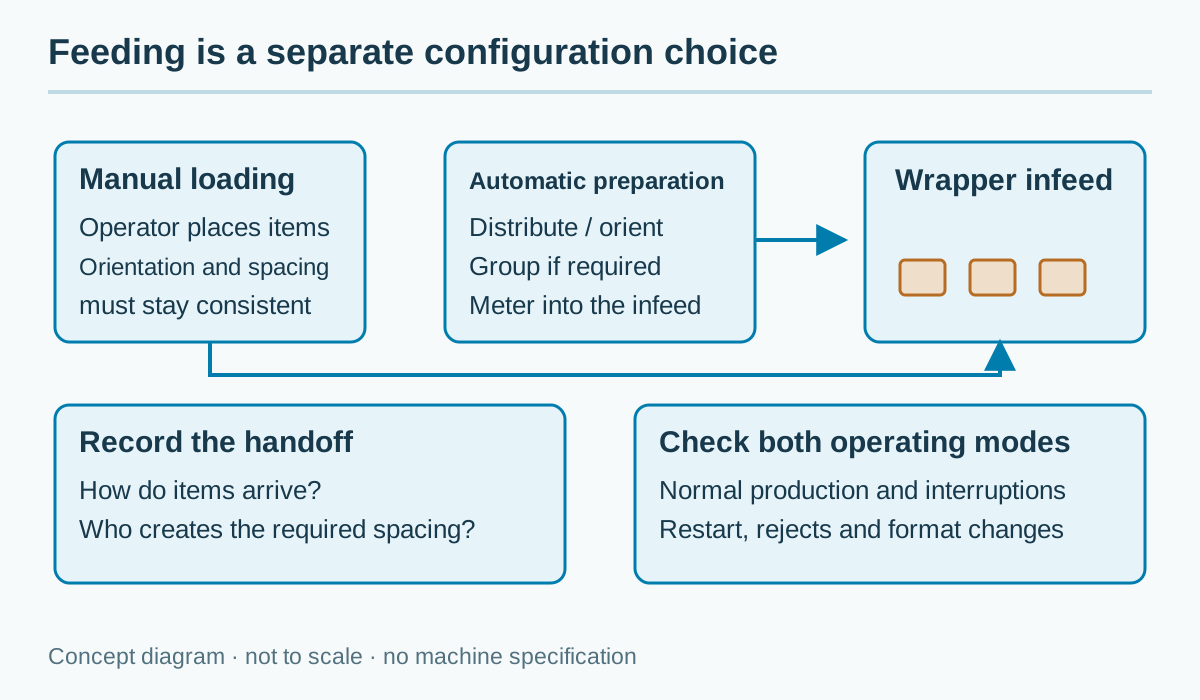
For manual feeding, describe placement, replenishment and the intended working period. For automation, document the incoming arrangement, transfer height, arrival pattern and behavior when either machine stops. Require a clear responsibility for clearing misplaced products and handling rejects under the agreed operating procedure. The manual versus automatic feeding guide develops that comparison.
Output and Size Envelope
Specify target output as accepted packs per minute with a defined product, film and inspection method. Ask the supplier to distinguish the target from a measured result and to state the observation period, interruptions and rejected packs. A video showing motion alone cannot establish sustained accepted output.
Measure the smallest and largest actual products, including height variation and the whole group or tray. Keep product dimensions, finished pack dimensions and reel width as separate fields. Ask which combinations fit the proposed former, infeed and sealing clearance, and which need different tooling or a trial. A maximum film width is not a guarantee that every product below that width fits.
Use the sizing guide to prepare measurements and the output guide to define the comparison conditions. Record changeovers too: parts exchanged, adjustments, film changes and the checks before acceptable production resumes.
Configuration Comparison Table
Use this table to request a written configuration proposal. It compares decision questions, rather than listing confirmed equipment for sale.
| Configuration dimension | Question for the supplier | Evidence to request |
|---|---|---|
| Rotary or box-motion end sealing | Which jaw path fits the pack and sealing conditions? | Head diagram and product-to-seal clearance assessment |
| Long-dwell description | What mechanism provides the contact time? | Mechanism explanation and film-specific seal trial |
| Top-film or inverted path | How is the product supported through the transfer? | Film-path drawing and product handling video |
| Manual or automatic feeding | Who or what orients, groups and spaces the items? | Infeed scope, interfaces and interruption procedure |
| Output and size range | Which product and film combinations have been assessed? | Written conditions, accepted output and unresolved trials |
In the quotation, ask for each proposed feature to be marked standard, optional, not offered or to be tested. A servo control description belongs alongside these details; it does not replace them.
Discuss your configuration on WhatsApp. Send product photos, size extremes, a pack sample and an infeed video. Ask which feeding, film path and sealing arrangement should be assessed, and which inputs are still missing. The requirements checklist keeps those details together.
Common Questions
Is long dwell the same as box motion?
No. Long dwell describes extended sealing contact, while box motion describes a jaw path. Ask which mechanism the supplier means and what sealing conditions have been tested.
Does servo mean the whole feeding line is automatic?
No. Drive and control details do not define who loads, groups or spaces products. Specify feeding and line interfaces separately.
Can one flow wrapper handle all my product sizes?
That requires assessment of the actual size combinations, film, feeding and sealing clearance. Send size extremes and ask which tooling or adjustments each format needs.
Sources and Scope
The PFM, Syntegon and ULMA technical pages cited here support general mechanism and process descriptions. Their product capabilities are not LINEVO specifications. The figures are explanatory schematics, with no customer installation or sample-test result represented.
In this section
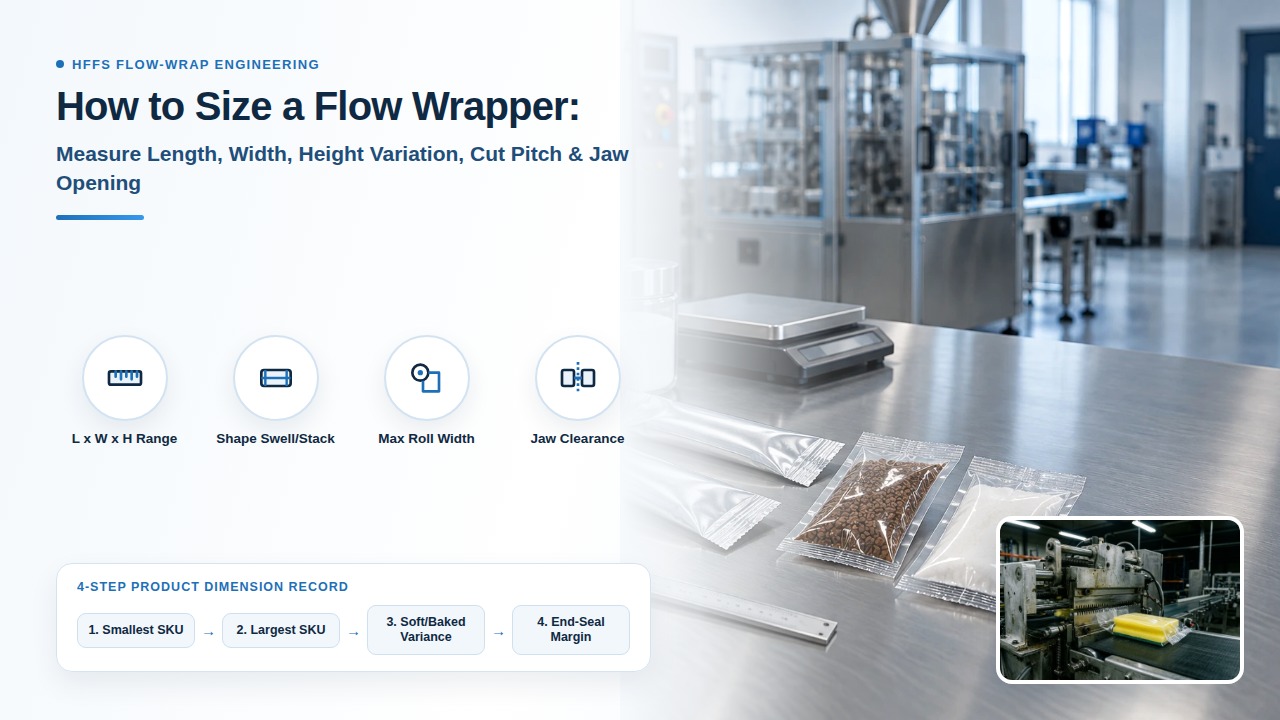
How to Size a Flow Wrapper for Your Product
Size a horizontal flow wrapper from real product length, width, and height tolerances: flat web width (W_web), cut pitch (L_cut), forming box, and jaw clearance.
Read more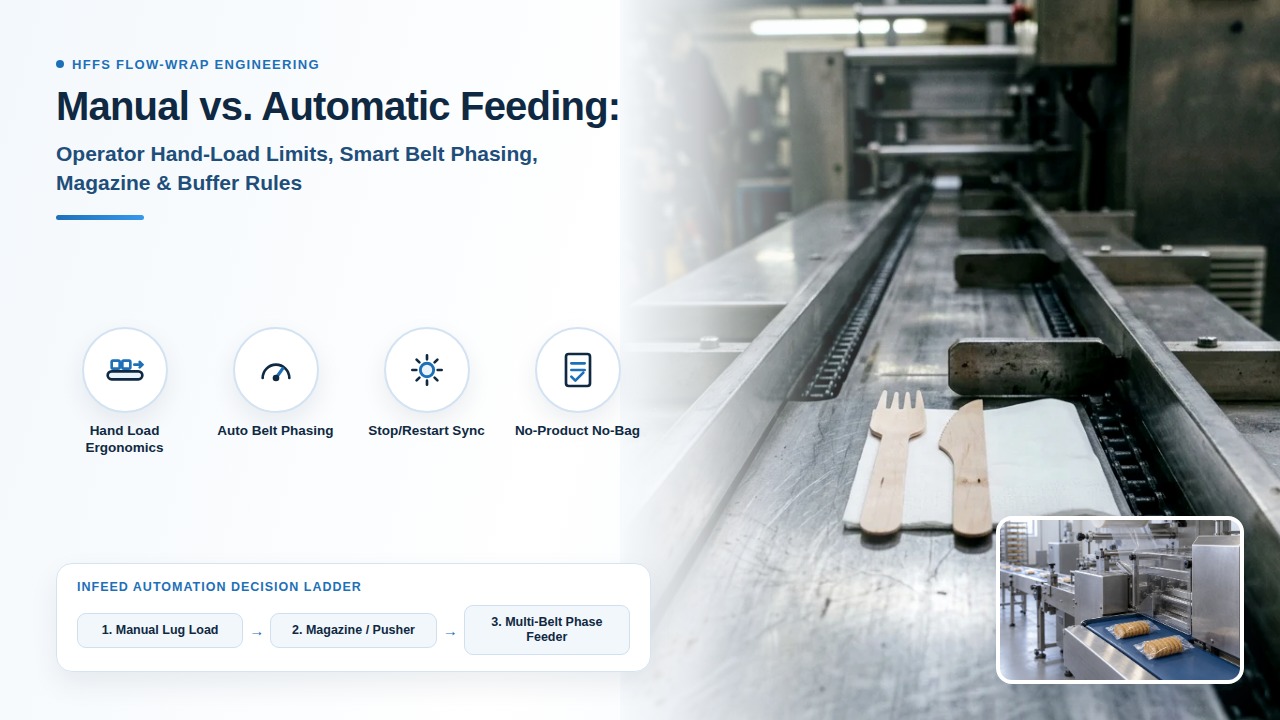
Manual vs Automatic Feeding for Flow Wrappers
Compare manual lug-chain loading (50–80 ppm/operator), magazine feeders, servo smart-belt phase feeders, and robotic HFFS infeeds with ROI & NPNB scrap formulas.
Read more