
Updated 2026-10-17
Specifying a bread packaging line without separating continuous roll-fed horizontal flow wrapping (HFFS) from pre-made wicketed polyethylene bagging causes 3.0% to 7.5% retail mold and staling returns, crushed top loaf crowns, and up to $215,000 per year in avoidable pre-converted bag and closure waste. Accurate bread flow wrap vs bagging selection requires matching your loaf or bun geometry, consumer reclosure frequency, and target shelf life to one of four industrial packaging architectures: top-reel rotary-jaw horizontal flow wrappers (60 to 220+ packs/min), bottom-reel inverted flow wrappers (60 to 180 packs/min for soft trayless roll groups), box-motion hermetic Modified Atmosphere Packaging (MAP) flow wrappers (40 to 150 packs/min with < 0.5% to 1.0% residual $O_2$), and automatic horizontal wicketed poly-baggers paired with Kwik-Lok clip or wire/plastic twist-tie closers (35 to 75 loaves/min). Each architecture imposes a distinct mechanical infeed boundary, film water vapor and oxygen permeability window (ASTM F1249 WVTR and ASTM D3985 OTR), heat-seal or mechanical neck-closure behavior (ASTM F88 and ASTM F1921), and food-contact compliance profile (FDA 21 CFR 177.1520 and OSHA 29 CFR 1910.212 / ISO 12100).
Engineering summary: Select an automatic horizontal wicketed poly-bagger (such as the AMF Mark 75 or GHD Hartmann GBK 420 running 30 to 75 loaves/min with 25 to 38 um LDPE bags and Kwik-Lok clip or twist-tie closures) when packaging soft sliced family sandwich loaves (16 to 24 slices) or bulk burger bun clusters that require 8 to 20 consumer reclosures over 5 to 7 days at ambient room temperature; select a continuous roll-fed horizontal flow wrapper (such as the ULMA FR 200 rotary wrapper, ULMA FR 305 bottom-reel inverted wrapper, Syntegon Pack 202, or ULMA FM 300 Box-Motion MAP wrapper at 60 to 220+ packs/min) when packaging single-serve buns, crusty artisan baguettes (using macro-perforated BOPP with ASTM F1249 WVTR > 150 to 400 g/m²·24h), or extended-shelf-life par-baked loaves requiring hermetic CO2/N2 gas flushing (< 0.5% residual O2 under ASTM D3985 OTR < 2 to 5 cc/m²·24h) and 45% to 55% lower packaging material cost per loaf.
| Bakery packaging parameter or subsystem | Standard engineering baseline or formula | Why it governs HFFS flow wrapper vs wicketed bagger selection |
|---|---|---|
| Rotary & inverted HFFS pillow flow wrap (single buns, baguettes, trayed rolls) | 60–220+ packs/min (ULMA FR 200 / Syntegon Pack 202 top-reel; ULMA FR 305 bottom-reel inverted); web width up to 650–700 mm | Forms continuous rollstock into fin- and end-sealed pillow packs at 2x–3x bagger speed and ~50% lower film cost, but provides no pony-tail neck for twist-tie reclosure |
| Box-motion hermetic MAP flow wrap (par-baked & preservative-free bread) | 40–150 packs/min (ULMA FM 300 Box Motion baseline, 300–600 ms jaw dwell); 30%–60% CO2 / 40%–70% N2 gas flush to <0.5%–1.0% residual O2 | Achieves 21–90 day mold-free ambient shelf life using EVOH barrier laminates (ASTM D3985 OTR < 2–5 cc/m²·24h); impossible on clip/twist-tie wicket bags |
| Automatic horizontal wicketed poly-bagger + clip / twist-tie closer | 35–75 loaves/min (AMF Mark 75 / APEX 60 & GHD Hartmann GBK 220/420 + EC101i baseline); 25–38 um pre-made LDPE bags on dual wicket pins | Pendulum scoop horns hold sliced loaves (16–24 slices) together during insertion and gather a pony-tail neck for 8–20 consumer reclosure cycles |
| Crusty vs soft bread moisture barrier (ASTM F1249 WVTR) | Soft pan bread (crumb aw = 0.95): WVTR < 5–10 g/m²·24h; Crusty baguette (crust aw = 0.35): macro-perforated BOPP WVTR > 150–400 g/m²·24h | Trapping moisture inside unperforated film turns crisp artisan crusts leathery within 2–4 hours, whereas open perforations dry out sliced sandwich crumb |
| Rollstock web width (W_web) vs wicket bag material cost | W_web = 2(W_loaf + H_loaf) + 2F_fin + C_forming; L_cut = L_loaf + k_H*H_loaf + 2W_crimp + C_jaw; saves $0.015–$0.020/loaf vs wicket bag + clip | Rollstock HFFS eliminates pre-converted bag-making markups, 25–38 mm wicket-lip tear-off scrap, and $0.0035–$0.0050/unit clip or twist-tie consumables |
| Thermal cooling limit, seal strength & guarding standards | Infeed core temp <= 28–32 °C; ASTM F88 peel >= 3.0 N/15 mm & ASTM F1921 hot-tack; FDA 21 CFR 177.1520; OSHA 29 CFR 1910.212 / ISO 12100 | Packing bread warmer than 32–35 °C causes headspace condensation and mold spore germination; flour/seed dust requires ASTM F88 seal validation |
How Do Bread Flow Wrapping and Wicketed Poly Bagging Differ in Package Construction and Line Kinematics?
At the retail shelf, both a flow-wrapped loaf and a bagged loaf enclose baked bread inside transparent flexible polymer film. On the bakery packaging floor, however, horizontal Form-Fill-Seal (HFFS) flow wrapping and pre-made wicketed poly-bagging operate on completely different mechanical principles, film supply formats, and closure geometries. As documented across ULMA Packaging's bakery HFFS portfolio (covering the FR 200, FR 305, and FM 300 series), Syntegon's horizontal flow wrapper range (Pack 202 and Pack 301), and industrial bread bagging systems (AMF Bakery Systems Mark 75 / APEX 60 and GHD Hartmann GBK 220 / GBK 420 paired with EC101i clippers), the choice begins with how the film meets the bread and how the consumer interacts with the package after opening. Review our bread packaging machine guide, bakery packaging machine overview, and how flow wrapping works for foundational machinery layouts.
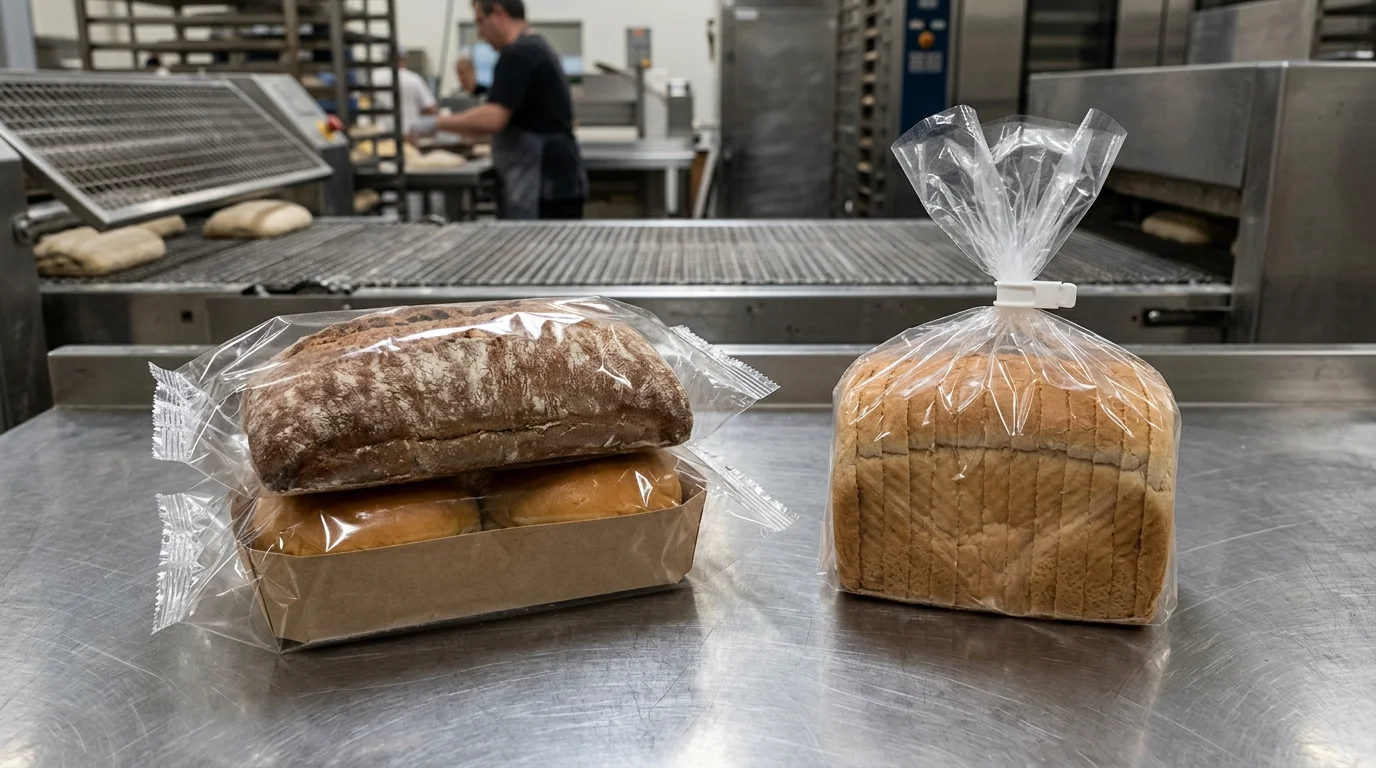
Compare the four core industrial bread packaging architectures before requesting equipment quotations:
- Top-Reel Rotary-Jaw Horizontal Flow Wrapper (
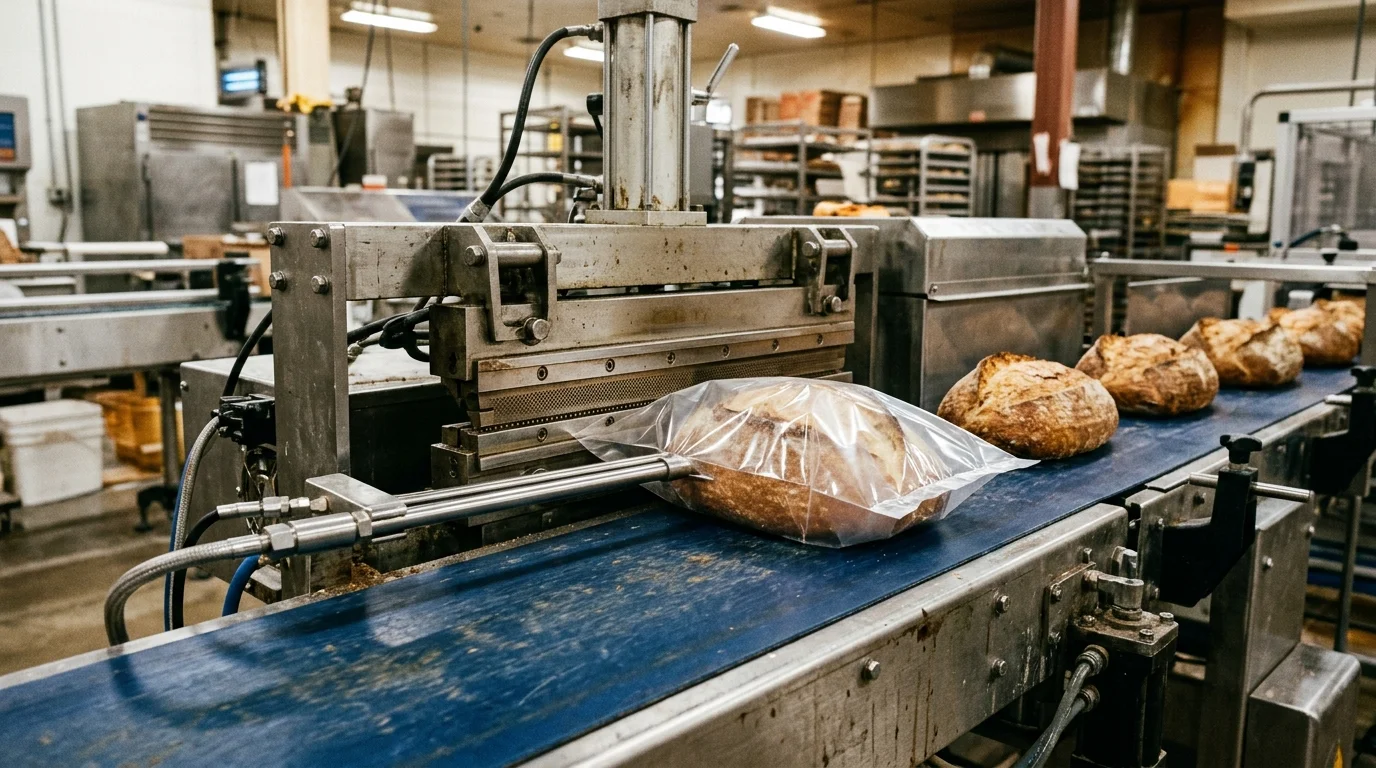
ULMA FR 200 / Syntegon Pack 202 Baseline): Flat printed or unprinted rollstock film (typically 20 to 35 um BOPP, micro-perforated BOPP, or BOPP/CPP laminate, up to650 to 700 mmweb width) unwinds from an overhead spindle, wraps around a fixed or adjustable forming box as products arrive on an infeed lug conveyor, forms a longitudinal bottom fin seal (or lap seal) via three pairs of heated pulling rollers, and is cross-sealed and severed by rotary crimping jaws at60 to 220+ packs/min. Photoelectric product-length sensors (eye-mark or product-trailing-edge detection) automatically adjust cut pitch (L_cut = 100 mm to infinityon theULMA FR 200) to accommodate natural baking length variation in French baguettes, sub rolls, and iced pastries. - Bottom-Reel Inverted Horizontal Flow Wrapper (
ULMA FR 305 Baseline): The film reel unwinds from beneath the product plane (500 to 700 mmweb width) so soft, deformable, or multi-piece ungrouped bakery items (such as 2x2 or 2x3 trayless dinner rolls, slider buns, sliced garlic bread halves, or soft brioche) transfer directly from the cooling conveyor onto the moving flat film web before entering the forming shoulder (producing an upward-facing top longitudinal fin seal). Carrying the bread on the film web eliminates metal pusher lugs and deadplate transfer gaps that squash soft crumb or scatter multi-roll clusters. Compare top-reel and bottom-reel film paths in our flow wrapper types guide. - Box-Motion (
Long-Dwell) Hermetic MAP Flow Wrapper (ULMA FM 300 Baseline): Built on a sanitary cantilevered stainless-steel frame with a two-motor independent reciprocating Box Motion cross-sealing head, the jaws travel horizontally with the film tube for300 to 600 msof constant-pressure heat dwell (6x to 8x longer than rotary jaws) while a stainless-steel lance flushes the film tube with food-gradeCO2 / N2gas at40 to 150 packs/min. This creates a 100% hermetic pillow pack (verified under ASTM F88 and ASTM F1921) capable of holding< 0.5% to 1.0%residual $O_2$ across thicker45 to 85 umlaminated EVOH barrier films for par-baked ciabatta, sourdough, pizza crusts, and preservative-free buns. - Automatic Horizontal Wicketed Poly-Bagger + Clip / Twist-Tie Closer (
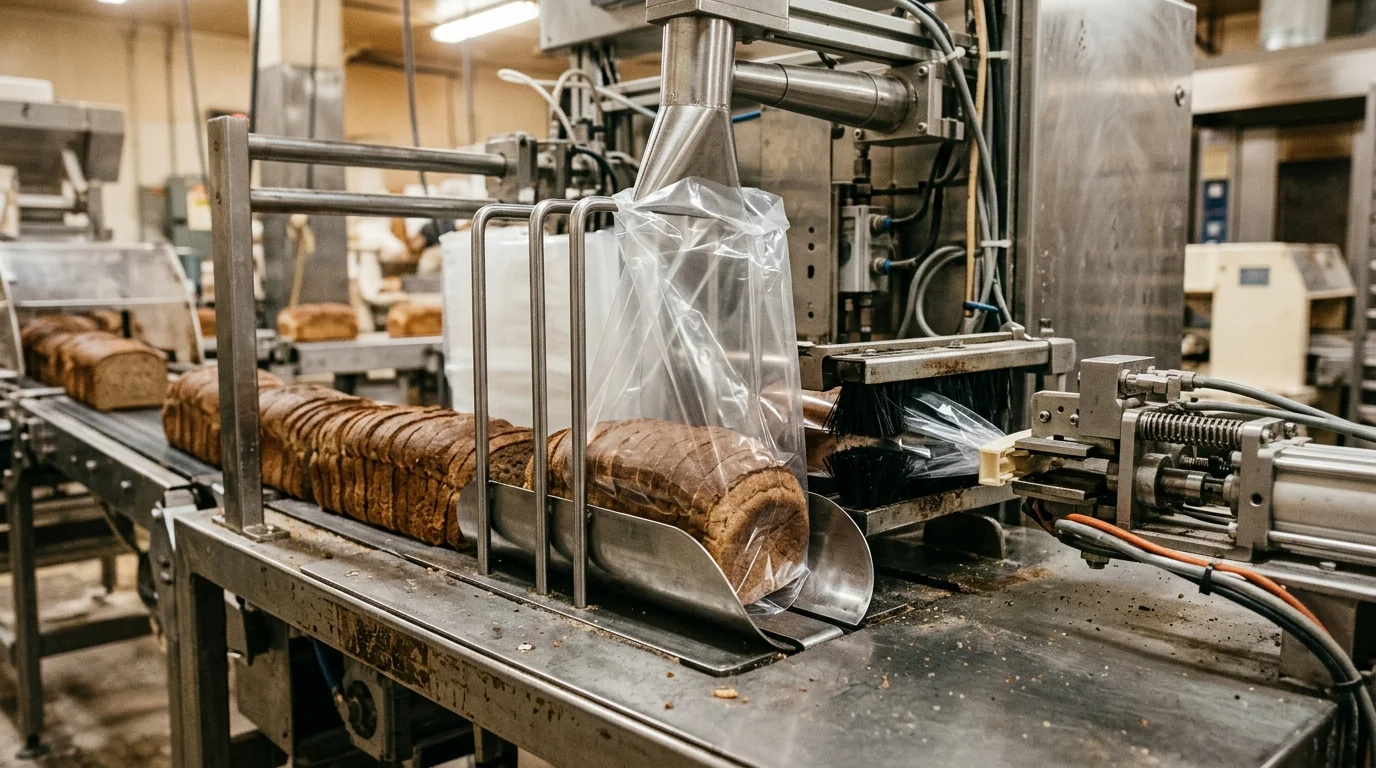
AMF Mark 75 / GHD Hartmann GBK 420 + EC101i Baseline): Pre-made side-gusseted or bottom-gusseted polyethylene (LDPEorCPP,25 to 38 um / 1.0 to 1.5 mil) bags stacked on metal wicket pins (250 to 500 bags per wicket stack) are inflated one by one using an overhead air-jet blower horn. A pair of reciprocating or pendulum-driven stainless-steel scoop horns enters the open bag mouth, expands to tension the film while clamping the sliced loaf (16 to 24 slices exiting an upstream band slicer) so the slices cannot topple, and retracts as the loaf strips the bag off the perforated wicket lip at35 to 75 loaves/min. Downstream rotating brushes evacuate excess air, gather the open bag mouth into a narrow "pony-tail" neck, and apply a reclosableKwik-Lokplastic clip, wire/plastic twist-tie (Burford), or clip-band (GHD Hartmann EC101i).
| Packaging machine architecture & OEM baseline | Primary bread formats & closure geometry | Baseline throughput & material supply | Dominant Failure Mode & Mechanical Prevention |
|---|---|---|---|
| Top-Reel Rotary-Jaw HFFS Flow Wrapper (ULMA FR 200 / Syntegon Pack 202 baseline) | Single burger/hotdog buns, baguettes, rolls on kraft U-trays, iced Danish; 3-seal pillow pack (bottom fin + crimped ends) | 60–220+ packs/min; flat rollstock BOPP or micro-perforated BOPP (20–35 um, W_web = 200–650 mm) | Failure mode: Rotary cross-jaws cutting into variable-length baguettes or tall loaf crowns -> Prevention: Enable photoelectric trailing-edge variable bag length (L_cut) + pneumatic side-gusset tuckers |
| Bottom-Reel Inverted HFFS Flow Wrapper (ULMA FR 305 baseline) | Trayless 2x2 / 2x3 soft dinner rolls, brioche clusters, garlic bread halves, soft morning goods; top fin seal + crimped ends | 60–180 packs/min; bottom-unwound rollstock BOPP/CPP or PE (25–40 um, W_web = 300–700 mm) | Failure mode: Soft roll clusters shifting apart or squashing against chain lugs on top-reel deadplates -> Prevention: Carry ungrouped/grouped rolls directly on the bottom film web with overhead hold-down belt |
| Box-Motion Hermetic MAP Flow Wrapper (ULMA FM 300 baseline) | Par-baked artisan loaves, ciabatta, sourdough, preservative-free pan bread; hermetic 3-seal MAP pillow pack (<0.5%–1.0% O2) | 40–150 packs/min; barrier rollstock BOPP/EVOH/PE or OPET/PE (45–85 um, ASTM D3985 OTR < 2–5 cc/m²·24h) | Failure mode: Flour dust or sesame seeds in cross-seal causing MAP gas leakers (>2% O2) -> Prevention: Specify 300–600 ms box-motion jaw dwell, vacuum flour hood, and ASTM F88 peel verification (>=3.5 N/15 mm) |
| Automatic Horizontal Wicketed Poly-Bagger + Clipper/Tyer (AMF Mark 75 / GHD Hartmann GBK 420 baseline) | Sliced pullman sandwich bread (16–24 slices), family pan loaves, 8-pack bun bags; pre-made LDPE bag + gathered neck w/ clip or twist-tie | 35–75 loaves/min per bagger; pre-made wicketed LDPE bags (25–38 um) + Kwik-Lok clip or wire/plastic twist-tie | Failure mode: End slices tipping during scoop insertion or wicket lip double-bagging tear jams -> Prevention: Synchronize pendulum scoop-horn side pressure, dual auto-switching wicket tables, and air-horn static eliminators |
How Do Hermetic Heat Seals, MAP Gas Flushing, Kwik-Lok Clips, and Twist-Ties Compare for Shelf Life and Reclosure?
A frequent procurement mistake is assuming that a tight-looking bread bag closed with a plastic clip or twist-tie provides an airtight barrier, or conversely, assuming that a standard flow-wrapped pillow pack can be easily reclosed by a household consumer across a week of breakfasts. In bakery food science, microbial mold growth (Aspergillus, Penicillium, Eurotium), crust softening (moisture migration from crumb to crust), and crumb staling (amylopectin starch retrogradation and moisture evaporation) are governed by completely separate seal and film permeability physics. For deeper film selection criteria, see our flow wrap film guide and HFFS machines overview.
Evaluate five closure and barrier mechanisms against your bread's shelf-life and consumer-use profile:
- Hermetic Box-Motion Heat Seal + MAP Gas Flushing (
21 to 90 Days Shelf Life): Preservative-free or par-baked breads have a high internal crumb water activity (aw = 0.94 to 0.97) that supports visible aerobic mold growth within5 to 8 daysin ambient air (20.9% O2). To achieve21 to 90 daysof ambient shelf life without calcium propionate overload, the loaf must be wrapped on a box-motion HFFS wrapper (such as the ULMA FM 300) using high-barrierBOPP/EVOH/PEorOPET/PE-EVOH-PErollstock (ASTM D3985 OTR < 2.0 to 5.0 cc/m²·24h) flushed with30% to 60% CO2(bacteriostatic/fungistatic) and40% to 70% N2(filler gas preventing package collapse whenCO2dissolves into the moist crumb) down to< 0.5% to 1.0%residual $O_2$. Because a wicketed bag closed with a clip or twist-tie leaves folded micro-channels in the gathered neck, it leaks flushed gas back to> 10% O2within hours and cannot be used for true MAP shelf-life extension (unless an inline thermal bag-neck sealer is added upstream of the clip). - Macro-Perforated vs Non-Perforated Rotary HFFS Pillow Pack (
1 to 5 Days Fresh / Foodservice):- Fresh Crusty Artisan Bread (
Baguettes, Ciabatta, Sourdough Boules): Exits the oven with a dry, crisp crust (aw = 0.30 to 0.45,< 6%moisture) over a wet interior crumb (aw = 0.95 to 0.97,45%moisture). Wrapping a crusty loaf inside an unperforated LDPE bag or solid BOPP pillow pack traps migrating water vapor, raising crust $a_w > 0.65$ within2 to 4 hoursand turning the crust rubbery and tough. Rotary flow wrappers solve this by running laser- or needle-perforated BOPP rollstock (0.5 to 1.5 mmholes yielding an effectiveASTM F1249 WVTR > 150 to 400 g/m²·24h), letting steam escape while protecting the loaf from retail handling contamination. - Soft Single-Serve Rolls, Burger Buns & Sweet Brioche: Have a soft crust (
aw = 0.85 to 0.92) that must stay pliable. Rotary HFFS machines wrap them in unperforated25 to 35 umBOPP/CPP or LDPE-blend films (ASTM F1249 WVTR < 5.0 to 8.0 g/m²·24h) with standard heated crimpers.
- Fresh Crusty Artisan Bread (
- Rigid Plastic Closure Clip (
Kwik-Lok Tabon Wicketed LDPE Bag): Snaps over the gathered pony-tail neck of a pre-made LDPE wicket bag at50 to 90 bags/min.Kwik-Loktabs provide a rigid flat billboard (~22 x 24 mm) for inline thermal-transfer or laser printing of price, traceability lot, and "Best By" dates, and are 100% metal-free (allowing the finished loaf to pass through end-of-line metal detectors without false rejects). However, the clip's central slot is non-hermetic (allowing slow air exchange), and matching the clip gate opening to film gauge (1.0 vs 1.5 mil LDPE) is essential to prevent neck slippage. - Wire-Core or Plastic-Core Twist-Tie & Clip-Band (
Burford / Bedford / GHD Hartmann EC101i): Wraps a4 to 8 mmwide ribbon (containing a single/double annealed iron wire or dead-fold plastic core)2.5 to 4 full revolutionsaround the gathered bag neck. Twist-ties cinch tightly against varying film thicknesses and gusset folds, creating a tighter mechanical moisture barrier than a rigid clip slot and surviving15 to 25+ consumer twist/untwist cyclesas a 20-slice sandwich loaf is consumed over a week. Note that ferrous wire-core twist-ties trigger standard metal detectors (requiring either metal detection upstream of the bagger or non-ferrous plastic-core clip-bands). - Flow-Wrap Pillow Pack + Cross-Web Resealable Adhesive Tape / Label: When a bakery wants the high speed and low rollstock cost of an HFFS flow wrapper (
90 to 150 packs/min) for sliced toast halves, tortillas, or 4-pack buns while still giving consumers reclosure, an inline label applicator mounts on the flow wrapper unwind frame to apply a peel-and-reseal pressure-sensitive adhesive tab over a pre-die-cut film flap (or an easy-open tear strip with a fold-over adhesive sticker).
| Closure & barrier system | Hermeticity & gas/moisture barrier (WVTR / OTR) | Consumer reclosure cycles & metal detection | Dominant Failure Mode & Mechanical Prevention |
|---|---|---|---|
| Standard Rotary HFFS Fin + Crimped End Seals (Solid or Perforated BOPP) | Dust-tight mechanical seal (or vented WVTR > 150–400 g/m²·24h on macro-perforated BOPP for crusty loaves) | 0 reclosures (tear-open single use unless fold-over label is added); 100% metal-free | Failure mode: Molten end-seal splitting ("angel hair" or open crimp) on tall loaf crowns (H_loaf > 95 mm) -> Prevention: Tuck side gussets prior to jaw closure and verify ASTM F1921 hot-tack window |
| Box-Motion Long-Dwell Heat Seal + MAP Gas Lance (BOPP/EVOH/PE) | 100% hermetic (ASTM F88 >= 3.5 N/15 mm); ASTM D3985 OTR < 2–5 cc/m²·24h; holds <0.5%–1.0% O2 for 21–90 days | 0 reclosures after consumer opens barrier pack (or pair w/ internal portion packs); 100% metal-free | Failure mode: High residual O2 (>1.5%) or pillow collapse after CO2 absorption into moist crumb -> Prevention: Calibrate lance flow (R_flush = 3.0x) and balance CO2/N2 mix (e.g., 50% CO2 / 50% N2) |
| Wicketed LDPE Bag + Kwik-Lok Rigid Plastic Clip | Non-hermetic (center clip aperture allows slow air exchange); LDPE bag WVTR < 6–10 g/m²·24h retains crumb moisture | 8–15 snap-on/snap-off consumer reclosures; 100% metal-free (passes end-of-line metal detector) | Failure mode: Clip cracking in cold distribution (<4 °C) or slipping off thin (<25 um) LDPE bag necks -> Prevention: Match Kwik-Lok gate opening code to bunched neck thickness and verify impact polymer grade |
| Wicketed LDPE Bag + Wire-Core Twist-Tie or Clip-Band (Burford / GHD Hartmann) | Tight mechanical neck cinch (non-hermetic for MAP unless paired with upstream thermal bag-neck sealer) | 15–25+ twist reclosure cycles across 20-slice loaves; ferrous wire triggers metal detectors (place detector pre-bagger) | Failure mode: Wire-core tie tail puncturing adjacent poly bags in shipping crates or twisting spindle jam -> Prevention: Specify blunt-cut ribbon ends, servo twist-tension control, or plastic-core clip-band |
| HFFS Flow Wrap + Inline Peel-and-Reseal Label / Tape Tab | Hermetic until first consumer peel; maintains low WVTR (<5–8 g/m²·24h) when flap is pressed back down | 5–10 adhesive peel/reseal cycles; 100% metal-free | Failure mode: Bread crumbs or flour adhering to exposed adhesive strip after first opening -> Prevention: Specify food-grade low-tack acrylic dry-edge finger lift and orient opening away from crumb fall |
Physical-Threshold Engineering Rules for Bread Flow Wrap vs Bagging Selection
Use these four physical-threshold rules during bakery line concept engineering to decide between horizontal flow wrapping and pre-made wicketed poly-bagging:
- Consumer Multi-Serving Reclosure & Slice Count Rule (
Wicketed Bagger + Clip/Twist-Tie vs HFFS Flow Wrapper): If the retail unit is a sliced family pan or pullman loaf (>= 14 to 24 slices,400 to 800 g) or a loose bulk bag of6 to 12buns where the household consumer opens and recloses the package>= 5 to 15 timesover4 to 7 days-> prioritize an automatic horizontal wicketed poly-bagger with a gathered pony-tail neck andKwik-Lokclip or twist-tie closure (AMF Mark 75orGHD Hartmann GBK 420) because torn flow-wrap pillow ends cannot be twisted shut without a secondary bag clip, and exposed slice faces lose moisture (falling below aw = 0.85) within12 hoursif left uncinched. Conversely, if the pack is consumed in1 to 2 sittings(single-serve buns, 2-to-4 roll packs, foodservice portions, or take-and-bake loaves), prioritize continuous HFFS flow wrapping to double line speed and cut packaging material spend by45% to 55%. - Crusty Artisan Bread vs Soft Pan Bread
ASTM F1249WVTR Rule (Macro-Perforated Flow Wrap vs Low-WVTR LDPE/BOPP): If baking a fresh crusty artisan bread (French baguette, ciabatta, rustic boule) with an oven-exit crust water activity ofaw = 0.30 to 0.45(< 6%crust moisture) surrounding an interior crumb ofaw = 0.95 to 0.97for24 to 48 hourambient retail sale -> prioritize a rotary HFFS flow wrapper (such as the ULMA FR 200) running macro- or laser-perforated BOPP film with an effectiveASTM F1249 WVTR > 150 to 400 g/m²·24h(or paper-window rollstock) so migrating core water vapor vents continuously instead of softening the crust (which turns leathery once crust aw exceeds 0.65). If packaging soft sliced sandwich bread, brioche, or hamburger buns (crust aw = 0.85 to 0.92), specify unperforated LDPE wicket bags or BOPP/CPP flow-wrap film withASTM F1249 WVTR < 5.0 to 10.0 g/m²·24hto lock moisture inside the crumb. - Extended Shelf Life (
21 to 90 Days) & MAP Residual Oxygen Rule (Box-Motion HFFS vs Wicket Bagger): If distribution requires>= 14 to 90 daysof mold-free ambient shelf life on par-baked bread, bake-off rolls, or preservative-free loaves via Modified Atmosphere Packaging (30% to 60% CO2 / 40% to 70% N2gas flushing) -> prioritize a box-motion (long-dwell) horizontal flow wrapper (such as the ULMA FM 300with300 to 600 mssealing dwell) running high-barrierBOPP/EVOH/PErollstock (ASTM D3985 OTR < 2.0 to 5.0 cc/m²·24h) purged to< 0.5% to 1.0%residual $O_2$. Never rely on a standard rotary-jaw flow wrapper (whose 40 to 80 ms contact time cannot seal reliably through thick EVOH laminates during gas-lance purging) or an unsealed wicket-bag clip/twist-tie (which leaks MAP gas immediately through the gathered neck folds). - Bread Cooling Core Temperature, Slice Stack Cohesion & Crown Variance Rule (
Thermal & Mechanical Infeed Boundary): If loaf core temperature at the cooling-spiral exit exceeds32 to 35 °C(90 to 95 °F) on unperforated barrier film or poly bags -> extend spiral cooling dwell time before either machine because warm water vapor condenses inside the headspace as the pack cools to20 °C, elevating surface water activity toaw > 0.98and triggering mold spore germination within48 to 72 hours. Furthermore, if an unsupported 20-slice loaf (slice thickness 10 to 14 mm) or a loaf with> ±12 to ±18 mmcrown height variation must be packaged without a paperboard U-tray, use a scoop-horn wicketed bagger (which clamps both sides of the sliced stack during insertion); if flow wrapping soft ungrouped rolls or sliced half-loaves without trays, specify a bottom-reel inverted flow wrapper (ULMA FR 305) so the bottom film web supports the stack continuously into the forming box (see flow wrapper sizing and manual vs automatic feeding).
Quantitative Equations and Worked Arithmetic Examples for Bread Packaging
Use these three explicit engineering equations to calculate rollstock film dimensions versus pre-made wicketed bag costs, size a box-motion MAP gas-flushing supply, and balance upstream band-slicer or cooling-tunnel throughput. For complete rollstock slitting calculations, see flow wrap film width and bag length.
1. Rollstock HFFS Film vs Pre-Made Wicketed Bag + Clip Material Cost Crossover (W_web, L_cut, Delta_Cost_mat_yr)
W_web (mm) = 2 * (W_loaf + H_loaf) + 2 * F_fin + C_forming
L_cut (mm) = L_loaf + k_H * H_loaf + 2 * W_crimp + C_jaw
m_roll (g/pack) = (W_web * L_cut * GSM) / 1,000,000
Delta_Cost_mat_yr ($/year) = N_loaves_yr * ((C_wicket_bag + C_clip_unit) - (m_roll / 1000 * P_roll_kg + C_label_unit))
- Variables:
L_loaf,W_loaf,H_loaf= bread loaf or bun-cluster length, width, and maximum crown height (mm);F_fin= longitudinal fin-seal height (typically 15 to 20 mmon bread wrappers);C_forming= forming-box clearance allowance (10 to 16 mm);k_H= end-drape factor (1.0 to 1.15with side-gusset tucking);W_crimp= transverse seal jaw width (15 to 25 mm);C_jaw= jaw clearance to prevent cutting the crust (20 to 30 mm);GSM= film basis weight (g/m²);C_wicket_bag= unit purchase price of a pre-converted wicketed LDPE bag ($/bag, which includes converter side-weld/bottom-gusset labor plus the25 to 38 mmperforated wicket-lip tear-off scrap);C_clip_unit= unit price of aKwik-Lokclip or twist-tie ($/unit). - Worked example: A commercial bakery packages
N_loaves_yr = 12,000,000 units/year(80 packs/min x 2,500 hours/year) of a 4-pack of brioche burger buns (L_loaf = 210 mm,W_loaf = 210 mm,H_loaf = 65 mm).- Route A (
Automatic Wicketed Poly-Bagger + Kwik-Lok Clip): Uses a pre-made32 um(1.25 mil) printed wicketed LDPE bag costingC_wicket_bag = $0.0295/bagplus a printed plastic clip costingC_clip_unit = $0.0042/clip=$0.0337/pack($404,400/year). - Route B (
Horizontal Flow Wrapper on Printed Rollstock): WithF_fin = 15 mm,C_forming = 12 mm,k_H = 1.0,W_crimp = 18 mm, andC_jaw = 24 mm, flat web width isW_web = 2(210 + 65) + 30 + 12 = 592 mmand cut pitch isL_cut = 210 + 65 + 36 + 24 = 335 mm(area = 0.1983 m²/pack). Using30 umprinted BOPP/CPP rollstock (GSM = 27.3 g/m²atP_roll_kg = $3.10/kg) consumesm_roll = 5.41 g/pack, costing$0.0168/pack(or $0.0193/packif adding a$0.0025resealable cross-web tape tab). Switching from wicketed bagging to HFFS rollstock saves12,000,000 * ($0.0337 - $0.0168) =$202,800/year(a 50.1% material cost reduction, or$172,800/yearsaved even with a resealable tape tab).
- Route A (
2. Box-Motion MAP Gas-Flushing Consumption & Crumb Porosity Purge Equation (V_pack_total, Q_gas)
V_loaf_env (L) = (L_loaf * W_loaf * H_loaf) / 1,000,000
V_gas_internal (L/pack) = V_loaf_env * (alpha_crumb + beta_headspace)
Q_gas (L/min) = Q_packs * V_gas_internal * R_flush
- Variables: Because baked bread is an open-cell sponge, purging ambient oxygen from a bread package requires displacing not only the visible headspace around the loaf (
beta_headspace = 0.25 to 0.40of loaf envelope volume) but also the interconnected gas cells inside the baked crumb (alpha_crumb = 0.65 to 0.78porosity fraction for pan bread and ciabatta).R_flush(2.5 to 4.0) is the laminar lance volumetric displacement ratio inside the HFFS film tube required to drive residual $O_2$ from20.9%down to< 0.5% to 1.0%before the box-motion jaws close. - Worked example: A box-motion HFFS wrapper (
such as an ULMA FM 300) packagesQ_packs = 80 loaves/minof par-baked artisan ciabatta (L_loaf = 240 mm,W_loaf = 120 mm,H_loaf = 70 mm->V_loaf_env = 2.016 L). With open-cell crumb porosityalpha_crumb = 0.72and pillow headspace factorbeta_headspace = 0.33, total gas volume per pack isV_gas_internal = 2.016 * (0.72 + 0.33) = 2.117 L/pack. At a lance displacement ratio ofR_flush = 3.0, the gas mixer must deliverQ_gas = 80 * 2.117 * 3.0 = 508.1 L/min(30.5 Nm³/hourof50% CO2 / 50% N2food-grade gas mix). Across2,500 production hours/yearat an industrial bulk gas cost of$0.42/Nm³, annual MAP gas consumption is76,250 Nm³/year = $32,025/year($0.0027/loaf)—reducing retail mold returns from4.8%to< 0.3%.
3. Upstream Slicer / Cooling Conveyor to Wrapper or Bagger Line Balancing (M_machines)
M_machines = ceil(Q_oven_loaves / (Q_cap_machine * OEE))
- Variables:
Q_oven_loaves= continuous discharge rate of cooled loaves or bun clusters from the spiral cooler (units/min);Q_cap_machine= rated continuous speed of a horizontal flow wrapper (60 to 200 ppm) or horizontal wicketed bagger + band slicer (35 to 75 LPM);OEE= effective operational availability accounting for wicket stack reloading (every 4 to 8 minutesunless dual auto-wicket tables are installed) or rollstock film splicing (every 45 to 90 minutes, or0 minuteswith an automatic zero-speed splicer). - Worked example: An industrial bun line discharges
Q_oven_loaves = 130 four-packs/min. Packaging via pre-made wicketed poly-baggers rated atQ_cap_machine = 65 bags/minandOEE = 0.84(54.6 net bags/mindue to wicket-pin transfers and clip spool changes) requiresM_machines = ceil(130 / 54.6) = 3 parallel wicketed baggers + 3 clippers. Packaging the same130 four-packs/minon a continuous horizontal flow wrapper (such as a Syntegon Pack 202 or ULMA FR 200/305rated at180 packs/minwith automatic reel splicing,OEE = 0.90=162 net packs/min) requires onlyM_machines = 1horizontal flow wrapper, cutting packaging line floor space and operator headcount by60%.
3-Year Total Cost of Ownership (TCO) Ledger: Bread Flow Wrapping vs Wicketed Bagging
Comparing a flow wrapper against a bread bagger on machine purchase price alone ignores the four largest 3-year operational cost drivers: pre-converted wicketed bag + clip/twist-tie consumables, multi-machine labor to match oven speed, wicket reload vs rollstock splice downtime, and retail staling/mold return credits. Review equipment capital tiers in our flow wrapper price guide, compare shrink-film alternatives in flow wrap vs shrink wrap and vertical bagging in HFFS vs VFFS, and organize your RFQ inputs with the flow wrapper requirements checklist.
| TCO cost & operational driver | Rotary / Bottom-Reel HFFS Flow Wrapper (1 x ULMA FR 200 / FR 305) | Box-Motion Hermetic MAP Flow Wrapper (1 x ULMA FM 300 + Gas Mixer) | Automatic Wicketed Poly-Bagger + Clipper (2 x 50–65 LPM Baggers) | Rotary HFFS Flow Wrapper + Inline Resealable Tape/Label Applicator |
|---|---|---|---|---|
| Machinery capital & line footprint (80 units/min net output) | 1 HFFS wrapper w/ auto film splicer; 8–11 m line length (1.0x baseline capex) | 1 Box-Motion HFFS + MAP gas mixer/analyzer + O2 check; 10–13 m length (1.45x capex) | 2 parallel slicer-baggers + 2 Kwik-Lok/twist-tie closers + converging conveyors; 14–18 m footprint (1.6x–1.9x capex) | 1 HFFS wrapper + cross-web peel/reseal labeler; 9–12 m line length (1.2x capex) |
| Annual film, bag & closure consumable spend (12M packs/yr) | $201,600/yr ($0.0168/pack for 30 um printed BOPP/CPP or macro-perforated BOPP rollstock) | $420,000/yr ($0.0323/pack for 60 um EVOH barrier rollstock + $0.0027/pack CO2/N2 gas) | $404,400/yr ($0.0295 pre-made wicketed LDPE bag + $0.0042 Kwik-Lok clip or twist-tie) | $231,600/yr ($0.0168/pack rollstock + $0.0025/pack resealable adhesive tab) |
| Consumable reload frequency & format changeover downtime | 4,000 m film roll runs 75–90 min (continuous w/ auto-splicer); 10–15 min recipe & adjustable former changeover; 1 operator/shift | 2,500 m barrier roll runs 45–60 min; 15–20 min changeover including MAP residual O2 verification (<0.5% O2); 1 operator/shift | 350-bag wicket stack depletes every 5.5–7 min per bagger (requires continuous manual pin loading); 15–25 min scoop-horn & slicer width change; 2 operators/shift | 4,000 m film roll + 10,000-label reel; 12–18 min changeover; 1 operator/shift |
| Retail shelf life & staling / mold return rate (% of gross revenue) | 2–5 days ambient (single-serve buns, crusty baguettes); 3.5%–6.0% staling return if unsold after day 4 | 21–90 days mold-free ambient shelf life; reduces retail mold/staling returns to <0.4% (saving $350,000+/yr on national distribution) | 5–7 days ambient w/ 15+ consumer reclosures; industry standard for 20-slice family sandwich bread (2.5%–4.5% route return baseline) | 5–7 days ambient w/ 5–10 consumer peel-and-reseal cycles on 4-pack buns, half-loaves, and flatbreads |
What to Send Us for a Bread Flow Wrapping vs Bagging Engineering Audit
| Engineering input to provide | Why our engineers need it | Acceptable engineering format |
|---|---|---|
| Bread product type, slice count & three-axis dimensions (L_loaf x W_loaf x H_loaf) | Determines scoop-horn wicket bagging vs top-reel rotary or bottom-reel inverted HFFS, and sizes flat film web width (W_web) and jaw clearance | Min / nominal / max length, width, and crown height in mm (e.g., 20-slice pullman loaf 260 x 115 x 120 mm, or 2x2 burger buns on U-tray 210 x 210 x 65 mm) |
| Crust vs crumb texture, toppings & packing core temperature (°C) | Selects macro-perforated BOPP (WVTR > 150 g/m²·24h) vs low-WVTR barrier film, verifies <=28–32 °C condensation limit, and sizes vacuum seed/flour extraction | Internal core temperature at wrapper infeed (°C), crust hardness (crisp baguette vs soft brioche), and loose toppings (sesame, oats, cornmeal dusting) |
| Target shelf life, MAP gas requirement & consumer reclosure count | Chooses between Rotary HFFS (1–5 days), Box-Motion MAP HFFS (<0.5% O2 for 21–90 days), Reseal-Label HFFS, or Wicketed Poly-Bagger w/ clip/twist-tie | Target shelf life (days at °C), required residual O2 (%), and whether consumers consume the pack in 1 sitting or across 10–20 reclosures |
| Upstream cooling conveyor or band-slicer speed (loaves or packs/min) | Balances single high-speed HFFS wrapper (60–200 ppm) vs multi-lane reciprocating wicket baggers (35–75 LPM) and sizes phase feeders | Continuous output rate (units/min), arrival orientation (single file vs multi-row from spiral cooler), and available floor footprint (L x W m) |
| Current bag, clip, or rollstock film specification & reference pack photos | Calculates exact material cost crossover (Delta_Cost_mat_yr) and verifies ASTM F88 seal strength and FDA 21 CFR 177.1520 compliance | Photos of unopened and opened reference packs, film/bag polymer and caliper (um or mil), and current clip/twist-tie or tray dimensions |
Send Your Bread Dimensions, Cooling Temp & Target Shelf Life on WhatsApp for a Bakery Line Engineering Review
Common Questions on Bread Flow Wrapping vs Wicketed Bagging
Can a horizontal flow wrapper put a twist-tie or Kwik-Lok clip on a bread bag?
Standard horizontal flow wrappers (HFFS) form continuous flat rollstock into a tube, seal a longitudinal fin or lap seam, and crimp/cut flat transverse end seals—they do not gather a pony-tail bag neck for a twist-tie or Kwik-Lok clip. If your retail package requires a gathered neck with a clip or twist-tie, specify an automatic horizontal wicketed poly-bagger paired with a mechanical closing head (or specialized hybrid roll-fed bagging/neck-gathering equipment). Conversely, if you want reclosure on a standard HFFS pillow pack, specify an inline cross-web peel-and-reseal adhesive tape tab.
Why does crusty artisan bread turn soggy inside a standard plastic bread bag, and how does flow wrapping fix it?
Freshly baked crusty baguettes, ciabatta, and sourdough exit the oven with a crisp low-moisture crust (water activity aw = 0.30 to 0.45) surrounding a moist interior crumb (aw = 0.95 to 0.97). Sealing that loaf inside an unperforated LDPE wicket bag traps migrating core moisture, raising crust water activity above aw = 0.65 within 2 to 4 hours and turning the crisp crust rubbery. Rotary HFFS flow wrappers solve this by wrapping crusty loaves at high speed in laser- or macro-perforated BOPP rollstock (with effective ASTM F1249 WVTR > 150 to 400 g/m²·24h), allowing water vapor to vent while protecting the bread from handling contamination.
Why is a box-motion flow wrapper required instead of a wicket bagger or rotary wrapper for MAP par-baked bread?
Extending par-baked or preservative-free bread shelf life to 21–90 days requires flushing the package with 30%–60% CO2 and 40%–70% N2 down to <0.5%–1.0% residual oxygen inside an EVOH barrier laminate (ASTM D3985 OTR < 2–5 cc/m²·24h). Wicketed bags closed with clips or twist-ties leak gas immediately through the gathered neck folds. Standard rotary HFFS jaws only contact the film for 40–80 ms, which can leave micro-leaks across thick barrier laminates or flour-dusted seals. A box-motion HFFS wrapper (such as the ULMA FM 300) clamps the film continuously for 300–600 ms of long-dwell heat and pressure, ensuring 100% hermetic ASTM F88 seals.
What is the maximum bread temperature allowed before flow wrapping or poly-bagging?
For any unperforated barrier flow wrap or wicketed polyethylene bread bag, loaves and buns must be cooled in an upstream spiral or ambient cooling system until the internal crumb core temperature reaches 28 to 32 °C (82 to 90 °F). Packaging bread warmer than 35 °C in a sealed film causes warm water vapor to condense into liquid droplets on the inner film surface as the pack cools, creating localized surface water activity above aw = 0.98 that triggers Aspergillus and Penicillium mold growth within 48 to 72 hours.
Related guides
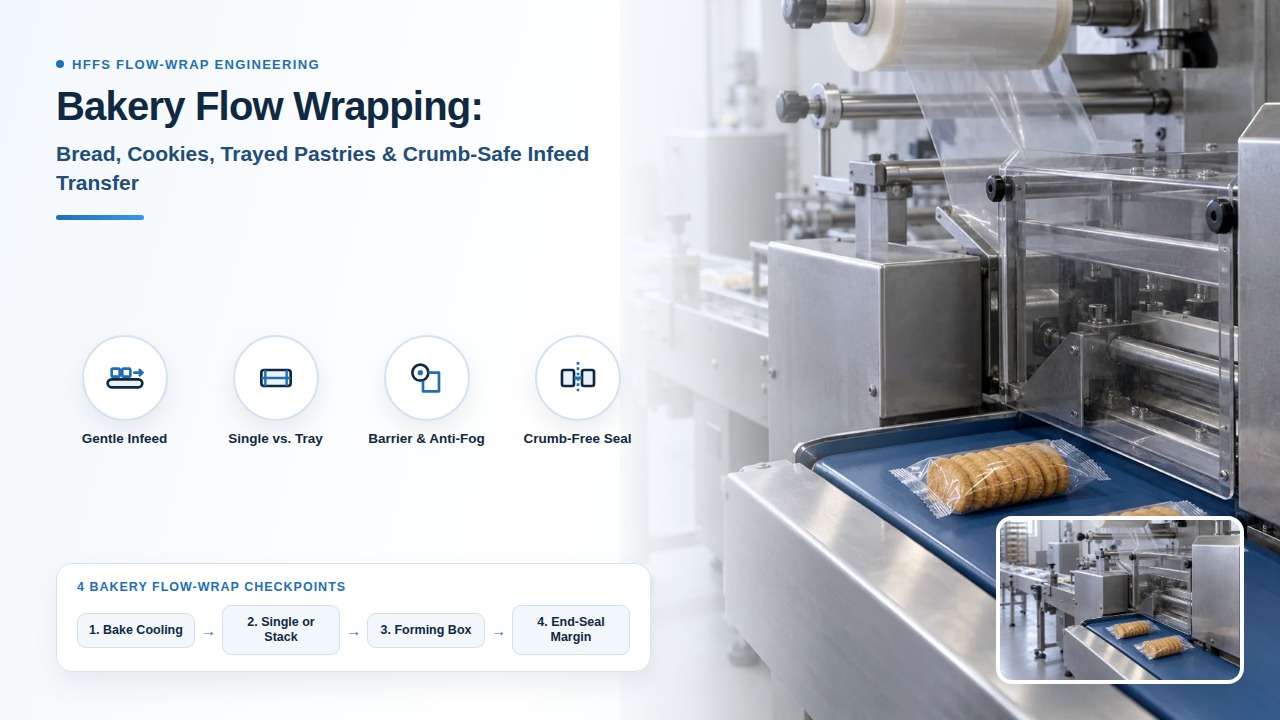
Bakery Packaging Machines for Flow-Wrapped Products
Packing bread, cookies or cakes? Describe the finished pack, product condition and tray use to work out which bakery packaging options need testing.
Read more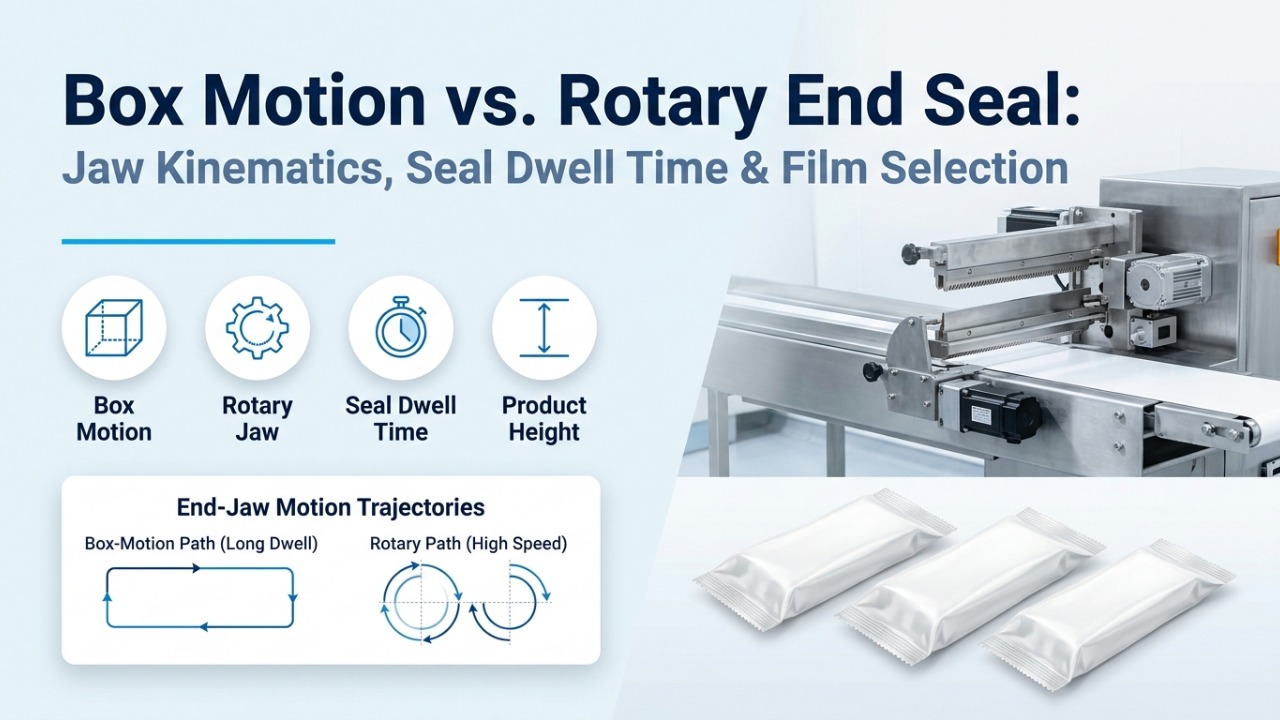
Compare Flow Wrapper Types and Configurations
Rotary or box motion? Top film or bottom film? Compare the feeding, film path and end-seal choices in a flow wrapper proposal.
Read more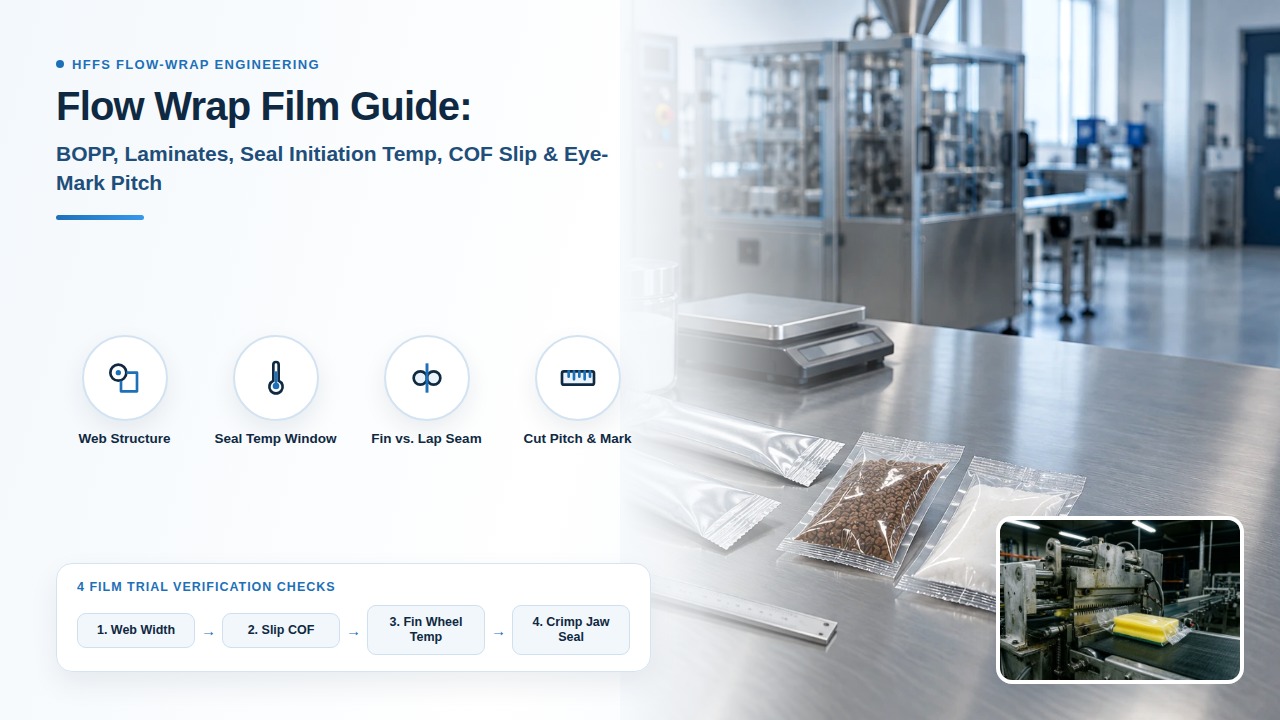
Choosing Flow Wrap Film for Your Product and Machine
Choosing flow wrap film starts with the product and required seal. Gather the film specification, reel dimensions and samples for compatibility testing.
Read more