
Updated 2026-10-17
Forcing high-tack protein, date-paste, caramel, or honey-bound granola bars across a standard top-reel lug-chain deadplate causes 2.5% to 6.8% crushed-bar and tail-smear seal rejects, melted chocolate undersides, and 45 to 90 minutes per shift of unscheduled scraping and belt washdown downtime. Reliable sticky bar flow wrapping requires matching your bar's surface water activity (aw), binder shear tack (ASTM D1894 coefficient of friction), and coating softening temperature to one of three industrial horizontal Form-Fill-Seal (HFFS) configurations: bottom-reel (inverted) belt-to-film flow wrappers (60 to 250 bars/min, where the bar rides directly on the unwinding film web with zero deadplate sliding), chilled-bedplate low-SIT heat-seal flow wrappers (60 to 220 bars/min with 10 to 15 °C glycol/water-cooled carry plates and pneumatic auto-retracting fin wheels), or high-speed pattern-registered cold-seal flow wrappers (200 to 600+ bars/min sealing strictly by mechanical nip pressure at ambient 20 to 24 °C). Each configuration establishes a verifiable mechanical boundary across knife-edge nosebar transfers (R = 3 to 6 mm), FDA 21 CFR 177.1550 PTFE release surfaces, FDA 21 CFR 175.105 cohesive seal registration, and ASTM F88 / F1921 seal integrity.
Engineering summary: Specify a bottom-reel (inverted) horizontal flow wrapper (such as the ULMA FR 305 baseline at 60 to 200+ bars/min) fed by a lugless low-friction polyurethane smart-belt phase feeder (ASTM D1894 kinetic COF mu_k <= 0.20 to 0.28) and a 3 to 6 mm radius knife-edge nosebar whenever wrapping un-enrobed cold-pressed fruit/date bars, soft whey/collagen protein dough bars, or high-syrup granola bars whose bare-steel sliding friction (mu_k >= 0.65 to 1.15) causes compressive buckling on top-reel deadplates; specify a pattern-registered cold-seal flow wrapper (such as the Syntegon Pack 403 or Pack 202 with cold-seal crimpers at 150 to 600+ bars/min) or a 10 to 15 °C water-cooled bedplate wrapper whenever chocolate-enrobed or caramel-topped bars (softening at 27 to 32 °C) cannot tolerate radiant heat from 130 to 165 °C heat-seal jaws.
| Sticky-bar packaging parameter or subsystem | Standard engineering baseline or formula | Why it governs sticky bar HFFS wrapper & film selection |
|---|---|---|
| Bottom-reel (inverted) belt-to-film HFFS architecture | 60–200+ bars/min (ULMA FR 305 baseline); bottom film unwind + overhead top fin-seal wheels; Δv_slide = |v_web − v_belt| ≈ 0 m/min | Carries soft, sticky date, fruit, and un-enrobed protein bars directly on the moving film web, eliminating lug-chain pusher crushing and deadplate syrup drag |
| Knife-edge nosebar & low-COF smart-belt phase feeder | Nosebar roller radius R = 3–6 mm; diamond-embossed / matte PU belt ASTM D1894 kinetic COF μ_k ≤ 0.20–0.28 (vs ≥0.65–1.15 on bare steel) | Closes the conveyor-to-former transfer gap to <4–8 mm and releases high-tack syrup or caramel undersides without tail stringing |
| Chilled bedplate + auto-open fin wheels (Heat-Seal HFFS) | 10–15 °C glycol/water-cooled carry plate; pneumatic fin-wheel retraction <100 ms on stop; low-SIT (85–105 °C) BOPP/CPP film | Prevents conductive/radiant fin-wheel heat from melting chocolate bottoms (T_soft = 27–29 °C) or scorching bars during line stops |
| Pattern-registered cold-seal HFFS (Syntegon Pack 403 / 202 baseline) | 150–600+ bars/min at ambient 20–24 °C jaw temp; 1.5–3.5 MPa nip pressure; FDA 21 CFR 175.105 cohesive in seal margins only | Eliminates thermal jaw heat entirely for chocolate-enrobed and heat-sensitive protein bars while keeping the center bar lane adhesive-free |
| Web width (W_web), cohesive-free lane (W_lane), & cut pitch (L_cut) | W_web = 2(W_bar + H_bar) + 2F_fin + C_forming; W_lane = W_web − 2F_fin − 6 mm; L_cut = L_bar + k_H*H_bar + 2W_crimp + 2C_jaw_side | Prevents bare sticky bars from touching live cold-seal adhesive and keeps viscous caramel/fruit tails out of the rotary cross-jaw path |
| Release coatings, seal peel, & machine safety standards | FDA 21 CFR 177.1550 (PTFE); FDA 21 CFR 177.1520 (polyolefin); ASTM F88 peel ≥ 2.5–4.0 N/15 mm & ASTM F1921 hot-tack; OSHA 29 CFR 1910.212 | Verifies non-stick PTFE jaw/guide compliance, hermetic seal peel strength against oil/crumb migration, and interlocked washdown guarding |
Why Do Sticky Cereal, Fruit, and Protein Bars Jam Standard Top-Reel Flow Wrappers?
A formed nutrition bar that sits firmly on a laboratory table behaves like a viscoelastic adhesive once compressed against metal guides at 100 to 300 bars/min. Across industrial bar production lines—documented in Syntegon's horizontal flow wrapper portfolio (Pack 202, Pack 303 LD, and Pack 403 chocolate and nutrition bar series) and ULMA Packaging's flow pack HFFS range (FR 200 and FR 305 confectionery series)—sticky bar handling failures split into three distinct physical mechanisms: viscous binder shear tack (date paste, brown rice syrup, honey, oligofructose, or glycerol/whey dough), low-melting lipid coatings (real cocoa-butter chocolate softening at 27 to 29 °C or compound coatings at 32 to 36 °C), and particulate shedding (rolled oats, crisped rice, nut pieces, and dried berries). Review our cereal and protein bar packaging machine overview, chocolate bar wrapping machine guide, and how flow wrapping works for complete line context.
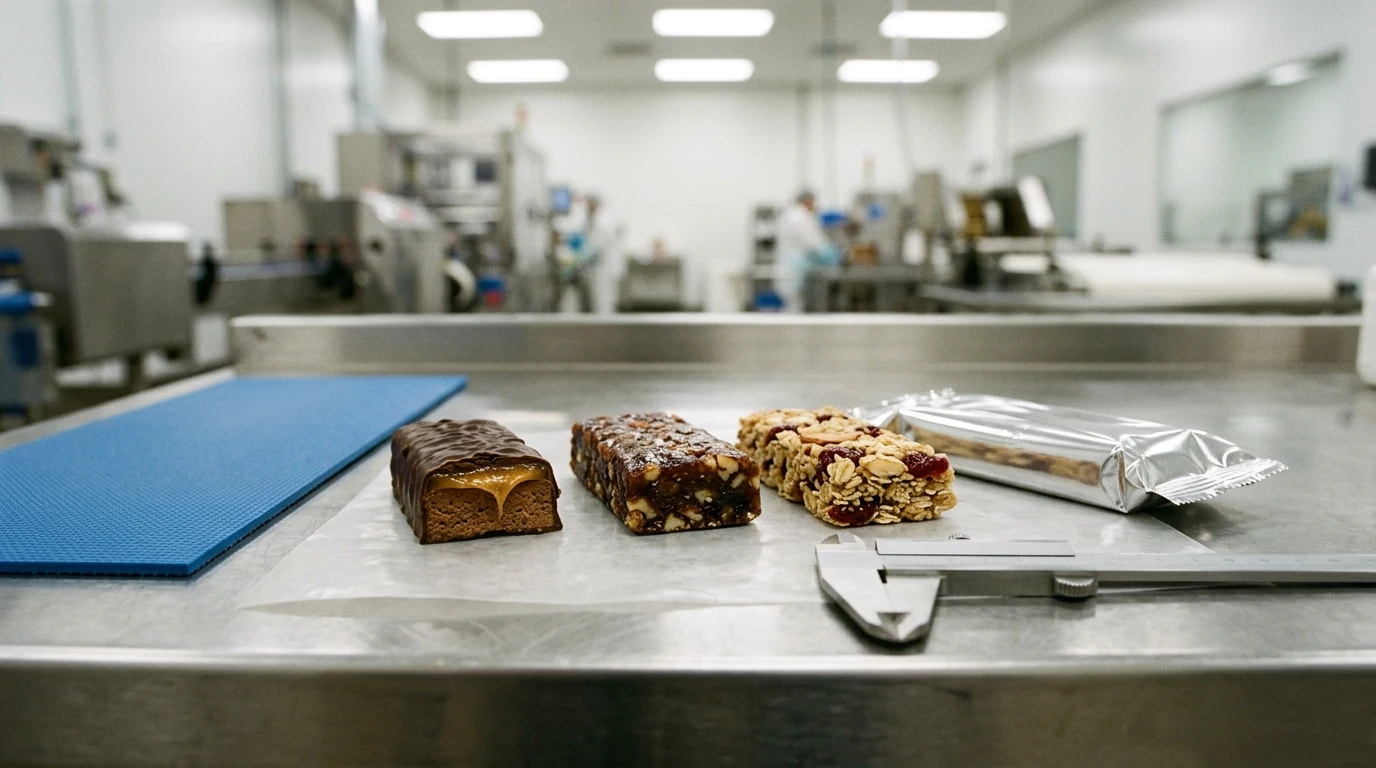
When these bars are fed into an unmodified top-reel flighted lug-chain flow wrapper, four cascading failure modes occur:
- Deadplate Drag & Compressive Accordion Buckling: On a standard top-reel wrapper, the film unwinds from above while a stainless-steel lug chain pushes unwrapped bars along a
1.5 to 2.5 mstationary stainless-steel deadplate into the forming box. High-tack date, fig, or whey-protein bars exhibit a dynamic coefficient of friction (ASTM D1894) ofmu_k = 0.65 to 1.15plus adhesive shear tack (tau_tack = 1.2 to 3.5 kPa) against bare metal. Because the front nose of the bar drags on the deadplate while the rear pusher lug advances at20 to 45 m/min, soft bars (compressive yield < 20 kPa) buckle upward into an "accordion" fold or smear sticky binder across the deadplate within10 to 20 minutesof startup. - Gravity Drop of Sticky Crumbs & Melted Coating into Bottom Fin Seals: Because a top-reel wrapper folds the film tube downward and pulls the two film edges together underneath the bar, loose oat flakes, chia seeds, syrup droplets, and scraped bottom chocolate fall directly by gravity between the mating sealant layers before they enter the heated fin-seal rollers—creating unsealed channels and failed
ASTM F88peel tests. - Conductive Bedplate Heating & Stop-Scorch Melting: Standard heat-seal fin rollers run at
130 to 165 °Cimmediately below the stainless-steel carry plate. Without active water chilling, heat conducts into the carry plate (raising surface temperature to 38 to 52 °C), melting chocolate bottoms (T_soft = 27 to 29 °C), accelerating oil migration out of peanut-butter/protein cores, and baking caramelized sugar onto the forming box. - Trailing-Tail Syrup Stringing & Rotary Cross-Jaw Fouling: If a sticky caramel or fruit-paste bar lags by even
6 to 10 mmduring nosebar transfer—or if its cut end pulls a viscous sugar thread across the transfer gap—the rotary cross-sealing jaws clamp directly through the bar tail. Sticky residue bakes onto the140 °Cserrated crimpers (or gums up unheated cold-seal jaws), tearing subsequent packs until the operator locks out the machine underOSHA 29 CFR 1910.212to scrape the jaws.
| HFFS machine architecture & OEM baseline | Target sticky bar formulations & pack speeds | Film path, belt interface & sealing mechanics | Dominant Failure Mode & Mechanical Prevention |
|---|---|---|---|
| Top-Reel Flighted Lug-Chain HFFS w/ Non-Stick Deadplate (ULMA FR 200 / Syntegon Pack 202 baseline) | Firm baked oat/honey granola bars, crisp rice bars, fully cooled compound-coated bars (60–220 bars/min) | Overhead film reel; polymer snap-on chain lugs; FDA 21 CFR 177.1550 PTFE-coated deadplate & open slag-drop rails; bottom fin seal | Failure mode: Sticky syrup buildup on deadplate causing bar buckling & bottom fin-seal crumb contamination -> Prevention: Restrict to firm low-tack bars (μ_k < 0.35), add PTFE deadplate inserts, and install open 5 mm slag-drop side guides |
| Bottom-Reel Inverted Belt-to-Film HFFS (ULMA FR 305 baseline) | Soft cold-pressed date/fruit paste bars, un-enrobed high-tack whey/collagen protein bars, sticky caramel-nut bars (60–200 bars/min) | Bottom film reel unwinds beneath product; R = 3–6 mm knife-edge nosebar deposits bar directly onto moving film web; upward-facing top fin seal | Failure mode: Bar tail catching at belt-to-film nosebar gap or top fin wheels pinching tall inclusions -> Prevention: Synchronize belt-to-web speed within ±0.5% across a 4 mm knife-edge nosebar and set top fin-guide clearance ≥ H_bar + 4 mm |
| Chilled-Bedplate Low-SIT Heat-Seal HFFS (Modified Top- or Bottom-Reel HFFS) | Chocolate-bottomed granola bars, yogurt-dipped cereal bars, fat-rich keto/protein bars running heat-seal film (60–200 bars/min) | 10–15 °C glycol/water-cooled stainless carry bedplate; pneumatic <100 ms auto-retracting fin wheels; low-SIT (85–105 °C) BOPP/CPP rollstock | Failure mode: Chilled bedplate sweating (condensation at high ambient RH) or radiant jaw heat melting bar tips -> Prevention: Maintain coolant 2 °C above room dew point (or dehumidify packing room <50% RH) and set jaw clearance C_jaw_side ≥ 14–18 mm |
| High-Speed Pattern-Registered Cold-Seal HFFS (Syntegon Pack 403 / Pack 202 Cold-Seal baseline) | Full chocolate-enrobed protein bars, caramel-topped bars, heat-sensitive probiotic/vitamin bars (150–600+ bars/min) | Multi-stage servo pullnose smart belts; ambient 20–24 °C knurled fin wheels & PTFE rotary jaws (1.5–3.5 MPa pressure); FDA 21 CFR 175.105 cold-seal film | Failure mode: Sticky bar shifting laterally into registered cold-seal edge margin and bonding to wrapper -> Prevention: Specify cohesive-free center lane (W_lane) with ±1.5 mm web-edge guiding and high-slip FDA 21 CFR 177.1520 inner film surface |
How Do Bottom-Reel Inverted Film Paths, Knife-Edge Nosebars, and Chilled Bedplates Prevent Sticking?
Eliminating sticky-bar line stops requires engineering every physical contact point from the cooling-tunnel discharge to the rotary cross-sealing jaws. Compare how the five critical machine and film subsystems work together across our flow wrapper types guide, manual vs automatic feeding guide, and flow wrap film guide:
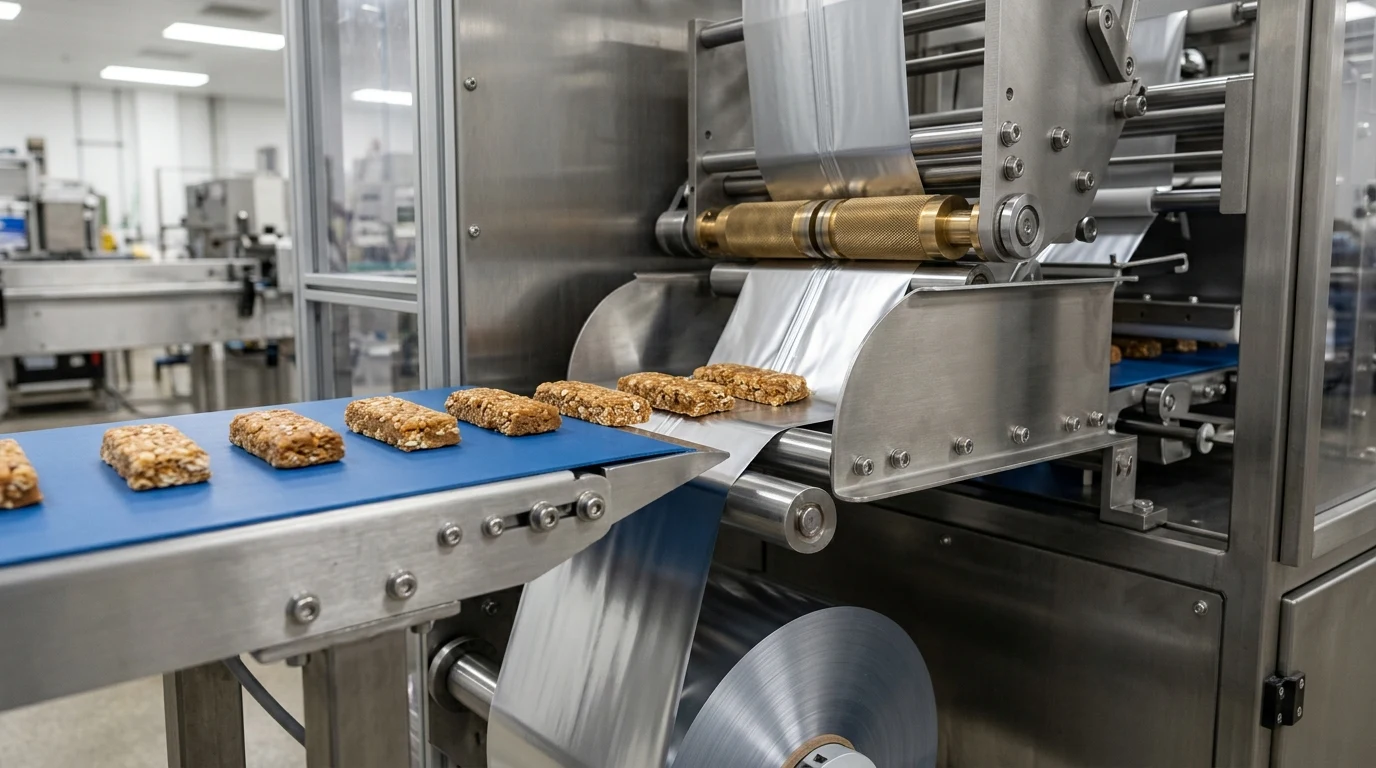
- Bottom-Reel (
Inverted) Film Path (ULMA FR 305Baseline): Instead of pushing the sticky bar over a metal plate, the packaging film unwinds from a bottom spindle below the conveyor level. As the bar exits the infeed belt, it lands directly on the moving flat film web. The film web itself becomes the conveyor—carrying the bar through the forming box with zero relative sliding velocity (Delta_v_slide = 0 m/min). Overhead fin-pulling wheels bring the film edges together above the bar to form a top longitudinal fin seal, ensuring that sticky bottom coatings never touch a stationary deadplate and loose crumbs cannot fall into the longitudinal seal seam. - Low-COF Smart-Belt Phasing & Knife-Edge (
Pullnose) Nosebar Transfers (Syntegon Pack 403 / RPPBaseline): Sticky bars discharging in rows from a slitter, guillotine cutter, or enrobing cooling tunnel cannot be accumulated bump-to-bump without welding together into a solid block. A multi-belt servo phase feeder (3 to 5 independent vacuum or friction beltsmade of diamond-embossed or matte food-grade polyurethane withASTM D1894kinetic COFmu_k <= 0.20 to 0.28) separates and phases each bar electronically without mechanical backpressure. At the wrapper handoff, a3 to 6 mmradius knife-edge (pullnose) nosebar places the belt discharge edge within4 to 8 mmof the film web or forming entrance so even short (55 to 70 mm) or soft bars bridge the gap smoothly without nose-diving. - Water-Cooled Carry Bedplates & Pneumatic Fin-Wheel Retraction (
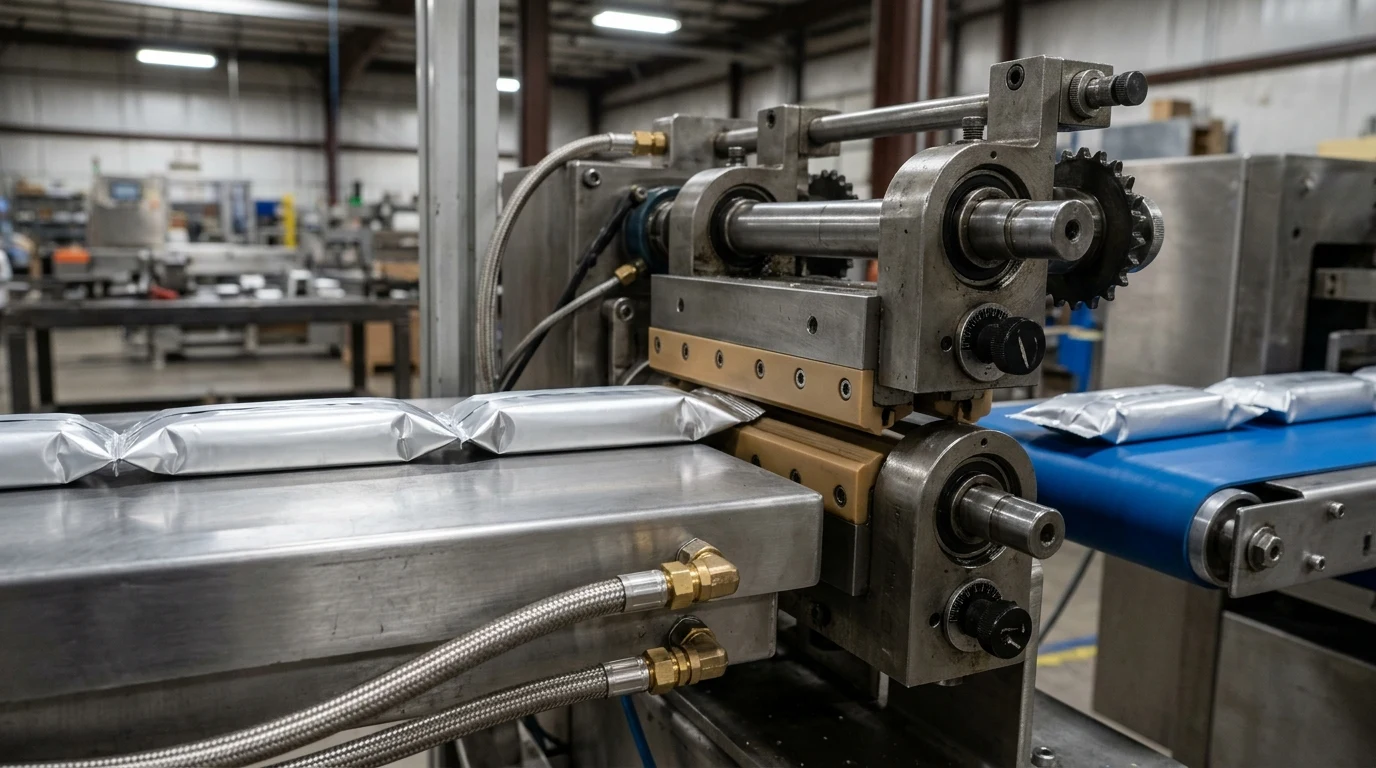
Heat-Seal Protection): When barrier or cost requirements dictate heat-seal film (such as 25 to 35 um metallized BOPP/CPP) on chocolate-bottomed or fat-rich bars, the wrapper integrates a closed-loop10 to 15 °Cglycol/water-cooled stainless-steel carry bedplate above the bottom fin-seal heater assembly. Simultaneously, pneumatic cylinders automatically retract the heated fin wheels15 to 25 mmaway from the film within< 100 mswhenever the wrapper pauses, preventing radiant heat from melting the stationary bar inside the forming tube. - Pattern-Registered Cold-Seal Cohesive Film (
FDA 21 CFR 175.105): For heat-sensitive chocolate-enrobed protein bars or high-speed lines (200 to 600+ bars/min), cold-seal rollstock replaces thermal melting with pressure-activated cohesion. A natural-rubber latex or synthetic acrylic cohesive (compliant with FDA 21 CFR 175.105) is gravure-printed only in the registered fin-seal margins (12 to 15 mmwide) and transverse crimp bands (15 to 22 mmwide) on the inner film surface, while an anti-blocking release lacquer (ASTM D1894outer COFmu_k = 0.20 to 0.26) coats the outer print web so the wound reel can unwind without sticking to itself. Unheated knurled fin rollers and unheated serrated rotary jaws bond the seal zones under1.5 to 3.5 MPaof mechanical nip pressure at ambient20 to 24 °C. FDA 21 CFR 177.1550PTFE Release Surfaces & Slag-Leakage Side Guides: Wherever physical guiding is required, solid side rails are replaced by minimum-contact round stainless-steel rods (6 to 8 mmdiameter) orFDA 21 CFR 177.1550virgin PTFE / UHMW-PE strips mounted above a4 to 6 mmopen slag-leakage drop slot. Crumbled oats, nut fragments, and scraped syrup drop directly into an under-conveyor catch tray instead of packing into rail corners. Rotary crimping jaws are likewise treated withFDA 21 CFR 177.1550PTFE fluoropolymer coatings or PTFE-impregnated fiberglass release tape to prevent sugar or cold-seal adhesive buildup.
| Contact surface or sealing subsystem | Governing standard & physical parameter range | Primary engineering function on sticky bars | Dominant Failure Mode & Mechanical Prevention |
|---|---|---|---|
| Diamond-Embossed Low-COF PU Smart Belt + Knife-Edge Nosebar (R = 3–6 mm) | ASTM D1894 kinetic COF μ_k ≤ 0.20–0.28; Shore 85A–90A PU; tool-less quick-release belt tensioners | Reduces bar-to-belt contact area by 60%–70% and bridges transfer gaps down to 4–8 mm without mechanical pusher lugs | Failure mode: Sticky date/caramel tail wrapping under a large (>18 mm) nose roller -> Prevention: Specify a 3–6 mm radius knife-edge (pullnose) nosebar with an under-belt stainless scraper blade |
| FDA 21 CFR 177.1550 PTFE Deadplate Inserts & Open Slag-Gap Side Guides | FDA 21 CFR 177.1550 perfluorocarbon resin compliance; μ_k = 0.10–0.18; 4–6 mm bottom slag-drop clearance slot | Provides low-shear lateral guiding and lets shed oat/nut crumbs drop into a catch pan instead of jamming the track | Failure mode: Abrasive toasted oat/nut inclusions wearing through thin sprayed PTFE coatings -> Prevention: Use replaceable 3–5 mm sintered virgin PTFE or UHMW-PE wear strips and round rod guides |
| Glycol/Water-Cooled Carry Bedplate + Auto-Open Fin Sealers | 10–15 °C chilled coolant loop (ΔT ≥ 2 °C above ambient dew point); <100 ms pneumatic fin-wheel retraction on line stop | Blocks conductive/radiant heat from 130–165 °C fin rollers so chocolate bottoms (T_soft = 27–29 °C) do not smear | Failure mode: Moisture condensation on chilled bedplate when room RH > 60%, causing wet sugar tack -> Prevention: Regulate chiller supply temperature 2 °C above room dew point via an inline dew-point sensor |
| Pattern-Registered Cold-Seal Rollstock (BOPP / Metallized BOPP + Cohesive) | FDA 21 CFR 175.105 cohesive in 12–15 mm fin & 15–22 mm crimp zones; ASTM F88 peel = 2.5–4.5 N/15 mm at 20–24 °C | Seals strictly via 1.5–3.5 MPa mechanical jaw pressure with zero thermal heat exposure at 150–600+ bars/min | Failure mode: Cold-seal cohesive sticking to crimping jaws or bar touching edge adhesive -> Prevention: Apply PTFE jaw coating, register eye-mark within ±1.0 mm, and maintain a cohesive-free center product lane |
| High-Slip / Release-Modified Inner Polyolefin Film Layer (BOPP/CPP) | FDA 21 CFR 177.1520 olefin polymer compliance; ASTM D1894 inner film COF μ_k ≤ 0.18–0.25; ASTM F1249 WVTR < 1.5–5.0 g/m²·24h | Prevents sticky protein dough or fruit paste from adhering permanently to the inside of the wrapper during storage | Failure mode: Migrating erucamide slip agents blooming into chocolate or failing heat seals -> Prevention: Specify non-migratory silicone-free release-modified or matte-embossed inner CPP/BOPP sealant layers |
Physical-Threshold Engineering Rules for Sticky Bar Flow Wrapping
Apply these four physical-threshold rules during equipment selection and Factory Acceptance Testing (FAT) to prevent sticky-bar transfer jams, melted coatings, and seal contamination:
- Bar Surface Shear Tack, Water Activity (
aw), & DeadplateASTM D1894COF Rule (Bottom-Reel Inverted HFFS vs Top-Reel Flighted Chain): If wrapping an un-enrobed cold-pressed date/fruit paste bar, soft high-humectant whey/collagen protein dough bar, or high-syrup granola bar whose surface water activity isaw = 0.55 to 0.72, compressive yield strength is< 18 to 25 kPa, or dynamic sliding friction against bare stainless steel exceedsASTM D1894 mu_k >= 0.65 to 1.15(with adhesive shear tack tau_tack >= 1.2 kPa) -> prioritize a bottom-reel (inverted) horizontal flow wrapper (such as the ULMA FR 305) fed by a lugless diamond-embossed polyurethane smart-belt phase feeder (mu_k <= 0.20 to 0.28) across a3 to 6 mmradius knife-edge nosebar. Never push un-enrobed high-tack bars across a1.5 to 2.5 mtop-reel lug-chain deadplate because deadplate sliding drag (5 to 9 N) exceeds the bar's compressive buckling limit and coats the metal track with sticky binder within minutes. - Chocolate / Compound Coating Softening Point & Cooling-Tunnel Core Temperature Rule (
Cold-Seal vs Chilled-Bedplate Heat-Seal): If the sticky bar is enrobed or bottom-coated in real tempered cocoa-butter chocolate (softening onset T_soft = 27 to 29 °C,complete melt 31 to 34 °C) or lauric/non-lauric compound coating (T_soft = 32 to 36 °C) -> verify that the upstream cooling tunnel brings internal bar core temperature down to<= 18 to 22 °C(at <= 50% to 55% packing-room RH so moisture does not condense on the cold chocolate and trigger sugar bloom). If line speed exceeds200 to 250 bars/minor the bar cannot tolerate any thermal radiation -> specify pattern-registered cold-seal rollstock (FDA 21 CFR 175.105) with unheated20 to 24 °Cpressure crimpers (Syntegon Pack 403 / 202 Cold-Seal baseline). If running heat-seal rollstock (60 to 200 bars/min), require a10 to 15 °Cglycol/water-cooled carry bedplate, pneumatic< 100 msauto-retracting fin sealers, and a low-SIT (85 to 105 °C) copolymer sealant. - Cold-Seal Pattern Registration & Cohesive-Free Center Product-Lane Rule (
FDA 21 CFR 175.105vs21 CFR 177.1520): If running pressure-activated cold-seal rollstock on an unwrapped sticky protein, caramel, or fruit bar -> require the converter to register theFDA 21 CFR 175.105cold-seal cohesive strictly within the12 to 15 mmlongitudinal fin-seal edges and15 to 22 mmtransverse crimp bands, leaving a 100% cohesive-free center product lane (W_lane = W_web - 2 * F_fin - 6 mm) composed of high-slipFDA 21 CFR 177.1520polyolefin (or release-treated inner BOPP/CPP). If full-coverage cohesive or misregistered pattern adhesive (registration drift > ±2.0 mm) contacts a sticky bar under carton stacking pressure, the wrapper bonds permanently to the bar skin and tears upon consumer opening. - Viscous Tail-Stringing, Slag-Drop Hygiene & End-Seal Jaw Clearance Rule (
C_jaw_side&ASTM F88): If ultrasonic or guillotine slitting leaves exposed viscous caramel, fruit paste, or rice-syrup binder at the cut ends (viscosity 50 to 300 Pa·s at 22 °C) or sheds2 to 6 mmoat/nut inclusions -> specify open slag-leakage side guides (4 to 6 mmbottom drop slot), optical misplaced-product jaw arrest (No-Product-No-Bag / anti-crush), and size the cut-to-cut bag length (L_cut) so single-side end-seal jaw clearance is at leastC_jaw_side >= 0.55 * H_bar + 12 mm(typically 18 to 24 mm per endon heat-seal wrappers, or12 to 16 mmon cold-seal wrappers). This prevents rotary jaws from wiping sticky tail strings into theASTM F88seal zone (maintaining cooled peel strength >= 2.5 to 4.0 N/15 mm). Check dimensional inputs in how to size a flow wrapper and flow wrap film width and bag length.
Quantitative Equations and Worked Arithmetic Examples for Sticky Bar Lines
Use these three explicit engineering formulas to evaluate top-reel deadplate drag versus bottom-reel film-carried transfer, calculate chilled-bedplate thermal extraction and cold-seal versus heat-seal scrap crossover, and size pattern-registered rollstock web width.
1. Top-Reel Deadplate Viscous Drag & Buckling Force vs Bottom-Reel Zero-Sliding Transfer (F_drag_top, Delta_v_slide)
F_drag_top (N) = (mu_k * m_bar * g) + (tau_tack * L_bar * W_bar / 1,000,000)
F_buckle_crit (N) = sigma_yield_comp * (W_bar * H_bar) / 1,000
Delta_v_slide_inverted (m/min) = |v_film_web - v_nosebar_belt|
- Variables:
m_bar= bar mass (kg);g = 9.81 m/s²;mu_k=ASTM D1894kinetic coefficient of friction between bar underside and stationary top-reel deadplate (0.65 to 1.15for sticky date/syrup/protein bars on bare 304 stainless steel);tau_tack= apparent interfacial adhesive shear stress of sticky binder wetting the plate (kPa, typically1.2 to 3.5 kPa);L_bar,W_bar,H_bar= bar length, width, and height (mm);sigma_yield_comp= longitudinal compressive buckling/folding yield stress of a soft un-enrobed bar (kPa, typically7 to 15 kPaat22 °C). - Worked example: Consider an un-enrobed
55 g(0.055 kg) cold-pressed date-and-whey protein bar measuringL_bar = 95 mm,W_bar = 35 mm, andH_bar = 16 mm(bottom contact area = 3,325 mm² = 0.003325 m², cross-sectional areaW_bar * H_bar = 560 mm²) withmu_k = 0.85,tau_tack = 1.8 kPa, and soft compressive yield strengthsigma_yield_comp = 7.5 kPa:- On a Standard Top-Reel Lug-Chain Deadplate: The bar's critical compressive buckling resistance is
F_buckle_crit = 7.5 * 560 / 1000 =4.20 N, whereas sliding it across a bare steel deadplate generatesF_drag_top = (0.85 * 0.055 * 9.81) + (1,800 * 0.003325) = 0.46 N + 5.99 N =6.45 Nof drag resistance. BecauseF_drag_top (6.45 N) > F_buckle_crit (4.20 N), the rear lug crushes and folds the bar into an accordion jam on the deadplate. - On a Bottom-Reel Inverted Flow Wrapper (
ULMA FR 305Baseline): The bar transfers across aR = 4 mmknife-edge nosebar belt (v_nosebar_belt = 27.0 m/min) directly onto the bottom-unwound film web (v_film_web = 27.0 m/min), givingDelta_v_slide_inverted = |27.0 - 27.0| =0.0 m/min(0.0 Ndeadplate sliding drag) and zero compressive buckling.
- On a Standard Top-Reel Lug-Chain Deadplate: The bar's critical compressive buckling resistance is
2. Chilled Bedplate Heat Extraction & Cold-Seal vs Heat-Seal Scrap Crossover (Q_chiller_W, Delta_Cost_net_yr)
Q_chiller_W (W) = U_bed * A_bed * (T_fin_zone - T_coolant)
Delta_Cost_net_yr ($/year) = N_bars_yr * [ (r_scrap_HS - r_scrap_CS) * C_bar_packed - (m_film_pack / 1000) * (P_CS_kg - P_HS_kg) ]
- Variables:
U_bed= overall heat transfer coefficient across the fin-heater radiation shield and chilled stainless bedplate (~45 W/m²·K);A_bed= chilled carry bedplate area (m²);T_fin_zone= radiant air/plate equilibrium temperature above145 °Cheat-seal fin wheels (~55 °C);T_coolant= chilled water/glycol supply temperature (12 °C);N_bars_yr= annual bar volume (bars/year);r_scrap_HSvsr_scrap_CS= combined thermal stop-scorch, melted-coating, and jaw-smear reject rate on heat-seal vs cold-seal lines;C_bar_packed= manufactured cost of one finished protein bar (ingredients + labor + film,$/bar);m_film_pack= film mass per wrapper (g/bar);P_CS_kgvsP_HS_kg= rollstock price per kg for pattern-applied cold-seal laminate ($/kg) vs standard heat-seal BOPP/CPP ($/kg). - Worked example: A nutrition bar plant wraps
N_bars_yr = 18,000,000 bars/year(120 bars/min x 2,500 hours/year) of a60 gchocolate-enrobed caramel protein bar (manufactured cost C_bar_packed = $0.42/bar, usingm_film_pack = 1.90 g/barof metallized film):- Chilled Bedplate Duty (
Heat-Seal Option): Over a1.2 m x 0.18 m(A_bed = 0.216 m²) carry bedplate, maintainingT_coolant = 12 °CagainstT_fin_zone = 55 °Crequires extracting onlyQ_chiller_W = 45 * 0.216 * (55 - 12) =418 W(0.42 kWof recirculating chiller capacity) to hold the bedplate below the chocolate's27 °Csoftening threshold. - Cold-Seal vs Heat-Seal Economic Crossover: Running unchilled/standard heat-seal film (
P_HS_kg = $3.60/kg) suffersr_scrap_HS = 2.8%thermal stop-scorch and tail-smear bar rejects, whereas switching to pattern-registered cold-seal film (P_CS_kg = $5.60/kg, a$2.00/kgor$0.0038/barfilm premium =+$68,400/yearextra film spend) reduces packaging scrap tor_scrap_CS = 0.4%(saving 2.4% = 432,000 bars/year x $0.42/bar =+$181,440/yearin saved protein bars). Net annual savings from cold-seal conversion isDelta_Cost_net_yr = $181,440 - $68,400 =+$113,040/year(plus +18% higher OEE uptime).
- Chilled Bedplate Duty (
3. Sticky-Bar Web Width (W_web), Cold-Seal Cohesive-Free Lane (W_lane), & Cut Pitch (L_cut)
W_web (mm) = 2 * (W_bar + H_bar) + 2 * F_fin + C_forming
W_lane (mm) = W_web - 2 * F_fin - 2 * M_reg
L_cut (mm) = L_bar + k_H * H_bar + 2 * W_crimp + 2 * C_jaw_side
- Variables:
F_fin= longitudinal fin-seal width (12 to 15 mm);C_forming= forming-box clearance (8 to 12 mm);M_reg= lateral web-tracking safety buffer (3 mm per side) separating the bare sticky bar from the registeredFDA 21 CFR 175.105cold-seal cohesive pattern;k_H= end-drape slope factor (0.85 to 1.0);W_crimp= single end-seal crimp width (12 to 18 mm);C_jaw_side= single-side product-to-jaw clearance (12 to 20 mmper end to prevent sticky tail smear). - Worked example: For a sticky caramel-protein bar measuring
L_bar = 95 mm,W_bar = 35 mm, andH_bar = 16 mmwithF_fin = 13 mm,C_forming = 10 mm,M_reg = 3 mm,k_H = 0.90,W_crimp = 14 mm, andC_jaw_side = 15 mm:- Flat rollstock web width is
W_web = 2(35 + 16) + 2(13) + 10 =138 mm; - The center adhesive-free lane on cold-seal film must be
W_lane = 138 - 26 - 6 =106 mmwide (centered to ±1.5 mm); - Cut-to-cut bag pitch is
L_cut = 95 + (0.90 * 16) + 2(14) + 2(15) = 95 + 14.4 + 28 + 30 =167.4 mm(rounded to 168 mmeye-mark repeat).
- Flat rollstock web width is
3-Year Total Cost of Ownership (TCO) Ledger: Sticky Bar Flow Wrapping Architectures
Evaluating a sticky-bar flow wrapper solely on initial machine price overlooks the three dominant 3-year operational cost drivers: protein/fruit bar ingredient scrap ($0.30 to $0.55/bar destroyed during deadplate jams or thermal stop-scorch), shift washdown & jaw-scraping downtime, and cold-seal versus heat-seal rollstock pricing. Compare equipment price drivers in our flow wrapper price guide, review horizontal vs vertical pouching in HFFS machines and HFFS vs VFFS, compare shrink-wrap limits in flow wrap vs shrink wrap, and prepare your RFQ with the flow wrapper requirements checklist.
| TCO cost & operational driver | Unmodified Top-Reel Lug-Chain HFFS (Heat-Seal Baseline) | Bottom-Reel Inverted HFFS + Low-COF Smart Belts (ULMA FR 305 Baseline) | Chilled-Bedplate + Auto-Retract Fin Heat-Seal HFFS | High-Speed Pattern Cold-Seal HFFS (Syntegon Pack 403 / 202 Baseline) |
|---|---|---|---|---|
| Machinery capital & infeed configuration (120 bars/min net output) | Standard top-reel lug chain + fixed metal deadplate (1.0x baseline capex; unsuitable for high-tack or chocolate bars) | Bottom-reel inverted HFFS + 4-stage low-COF PU smart-belt feeder + R=4 mm knife-edge nosebar (1.28x capex) | Top- or bottom-reel HFFS + 12 °C glycol chiller loop + pneumatic auto-open fin wheels + PTFE jaws (1.22x capex) | Servo HFFS + pullnose smart-belt feeder + ambient pressure cold-seal crimpers + auto reel splicer (1.35x capex) |
| Annual rollstock film expenditure (18M bars/yr, 1.90 g/pack = 34,200 kg/yr) | $123,120/yr ($3.60/kg for 30 um heat-seal metallized BOPP/CPP rollstock) | $129,960/yr ($3.80/kg for 30 um heat-seal BOPP/CPP w/ high-slip release-modified inner layer) | $126,540/yr ($3.70/kg for 30 um low-SIT 88 °C copolymer heat-seal metallized BOPP/CPP) | $191,520/yr ($5.60/kg for pattern-registered FDA 21 CFR 175.105 cold-seal metallized BOPP laminate) |
| Annual bar & film scrap from sticking, buckling & stop-scorch ($0.42/bar) | $340,200/yr (4.5% reject rate = 810,000 crushed, smeared, or heat-scorched bars/yr) | $45,360/yr (0.6% reject rate = 108,000 bars/yr; zero deadplate buckling on un-enrobed date/protein bars) | $52,920/yr (0.7% reject rate = 126,000 bars/yr; chilled bedplate prevents bottom chocolate smear) | $30,240/yr (0.4% reject rate = 72,000 bars/yr; zero thermal exposure at 20–24 °C jaw temperature) |
| Belt, deadplate & jaw sanitation / scraping downtime (hrs/yr across 2,500 hrs) | 310 hrs/yr lost (45 min/shift scraping caramelized sugar & chocolate off deadplates, lugs, and 150 °C jaws) | 65 hrs/yr lost (tool-less PU belt release + open slag-drop rails + top fin seal above crumb path) | 80 hrs/yr lost (PTFE jaw release + chilled plate prevents baked-on cocoa butter and syrup carbonization) | 50 hrs/yr lost (no heated jaw bake-on; quick wipe-down of ambient PTFE crimpers and pullnose belts) |
What to Send Us for a Sticky Cereal or Protein Bar Flow-Wrapping Assessment
| Engineering input to provide | Why our engineers need it | Acceptable engineering format |
|---|---|---|
| Bar formulation, binder/coating type & water activity (aw) | Determines bare-steel sliding friction (ASTM D1894 μ_k), adhesive shear tack (τ_tack), and whether bottom-reel inverted carrying is required | Binder/coating details (e.g., cold-pressed date paste aw = 0.64, honey-oat granola, or 30% dark-chocolate-enrobed whey/caramel bar) + photos of top, bottom, and cut ends |
| Infeed bar core & surface temperature (°C) and room RH (%) | Checks against chocolate/compound softening threshold (27–32 °C) and sizes 10–15 °C chilled bedplate vs ambient cold-seal crimpers | Cooling-tunnel exit core temperature (°C), surface temperature (°C), ambient packing-room temperature (°C), and relative humidity (% RH) |
| Three-axis bar dimensions & slitter/enrober tolerances (L_bar x W_bar x H_bar) | Sizes flat web width (W_web), cold-seal cohesive-free center lane (W_lane), cut pitch (L_cut), and R = 3–6 mm knife-edge nosebar gap | Min / nominal / max length, width, and height in mm including chocolate bottom feet or protruding nut inclusions (e.g., 95 ±3 mm x 35 ±1.5 mm x 16 ±2 mm) |
| Upstream cooling-tunnel or guillotine discharge rate & row layout | Sizes multi-belt servo phase feeders, row-distribution belts, or pullnose transfers to prevent bar-to-bar sticking | Continuous bar output (bars/min), arrival pattern (single lane vs 8-to-16 wide cooling-tunnel rows), and short video of current transfer |
| Proposed heat-seal or cold-seal rollstock film specification | Verifies ASTM F88 seal peel strength, FDA 21 CFR 175.105 cold-seal pattern registration, and inner film release COF (ASTM D1894) | Film supplier datasheet showing structure (e.g., 20 um BOPP / 20 um met-BOPP w/ pattern cold seal, or 30 um BOPP/CPP), caliper (um), and cohesive drawing |
Send Your Bar Photos, Dimensions, Packing Temp & Film Spec on WhatsApp for a Sticky-Bar HFFS Engineering Review
Common Questions on Flow Wrapping Sticky Cereal and Protein Bars
When do sticky protein or fruit bars require a bottom-reel (inverted) flow wrapper instead of a top-reel wrapper?
A bottom-reel (inverted) horizontal flow wrapper (such as the ULMA FR 305) is required whenever an un-enrobed cold-pressed date/fruit bar, soft whey/collagen protein dough bar, or high-syrup granola bar has a bare-steel dynamic coefficient of friction (ASTM D1894) of μ_k >= 0.65 to 1.15 or a low compressive yield strength (<18 to 25 kPa). On a standard top-reel wrapper, chain lugs push the bar across a stationary metal deadplate, causing soft sticky bars to buckle into accordion jams and drop sticky crumbs into the bottom fin seal. On an inverted wrapper, the bar transfers from a knife-edge belt directly onto the moving bottom film web (zero sliding drag) and seals the fin seam on top.
Do chocolate-coated protein bars always require cold-seal film, or can they run heat-seal film on a flow wrapper?
Chocolate-coated bars do not always require cold-seal film, provided line speed and thermal isolation are engineered correctly. For speeds of 60 to 200 bars/min, chocolate-coated bars cooled to 18–22 °C can run on low-SIT (85–105 °C) heat-seal BOPP/CPP rollstock if the flow wrapper is equipped with a 10–15 °C glycol/water-cooled carry bedplate, pneumatic fin-seal rollers that retract within <100 ms during line stops, and 14–18 mm of end-seal jaw clearance. For high-speed lines (200 to 600+ bars/min) or zero-heat-exposure requirements, pattern-registered FDA 21 CFR 175.105 cold-seal film sealed at ambient 20–24 °C is the industry standard.
How do you prevent a sticky caramel or fruit bar from sticking to the inside of its flow-wrap film during storage?
First, if using cold-seal film, verify that the FDA 21 CFR 175.105 cohesive adhesive is pattern-registered strictly in the 12–15 mm fin margins and 15–22 mm cross-seal bands, leaving an uncoated center lane (W_lane) wider than the bar perimeter. Second, specify an FDA 21 CFR 177.1520 inner polyolefin layer with a non-migratory silicone-free release modification or micro-embossed matte CPP/BOPP surface (ASTM D1894 kinetic COF μ_k <= 0.18–0.25) so high-tack caramel or fruit paste releases cleanly when peeled open after 30 to 180 days of carton stacking.
Why does moisture condensation form on water-cooled flow wrapper bedplates, and how is it prevented?
Condensation forms when the chilled water or glycol circulating through the carry bedplate is set below the ambient dew point of the packaging room (for example, running 8 °C coolant in a 24 °C room at 60% relative humidity, where the dew point is 15.8 °C). Free moisture on the bedplate dissolves water-soluble sugars on granola or fruit bars, increasing surface tack and microbial risk. Prevent sweating by dehumidifying the bar wrapping room to <= 45%–50% RH (at 18–21 °C) and regulating the chiller supply temperature to stay 2.0 °C above the measured room dew point.
Related guides
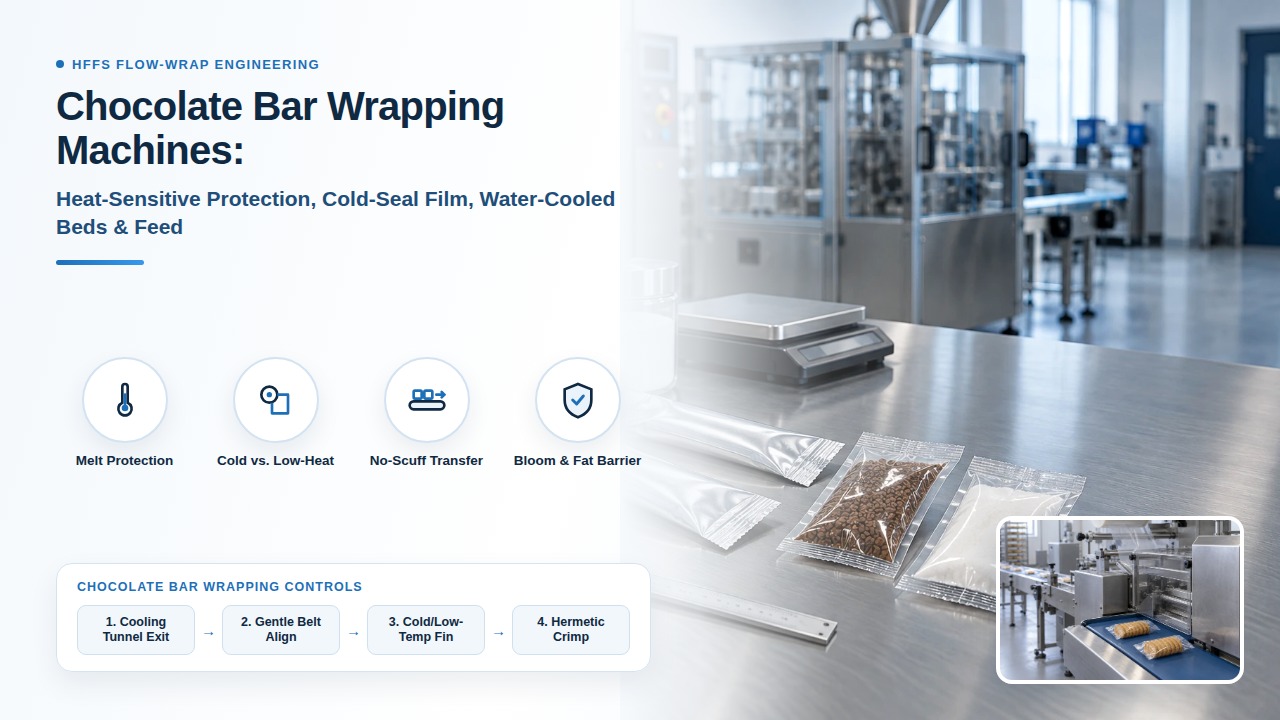
Chocolate Bar Wrapping and Packaging Machines
Choosing a wrapper for chocolate bars? Compare the required finish, foil or film format, product temperature and surface checks for a trial.
Read more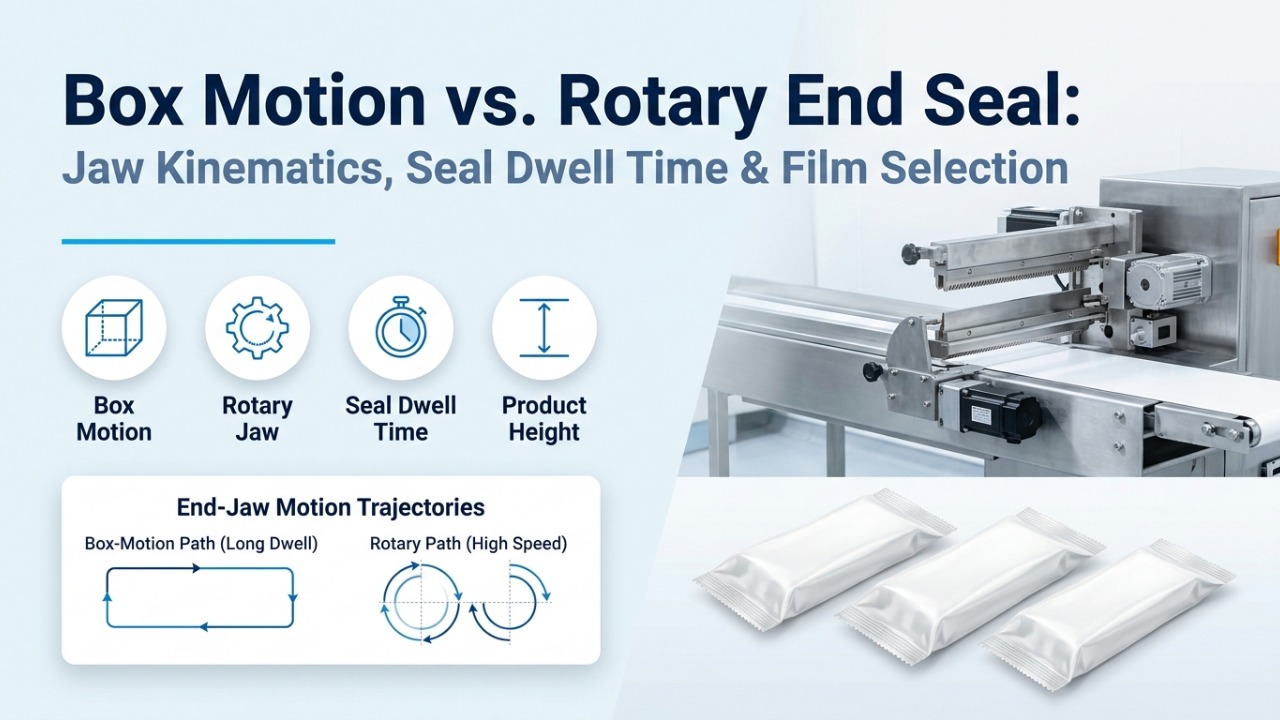
Compare Flow Wrapper Types and Configurations
Rotary or box motion? Top film or bottom film? Compare the feeding, film path and end-seal choices in a flow wrapper proposal.
Read more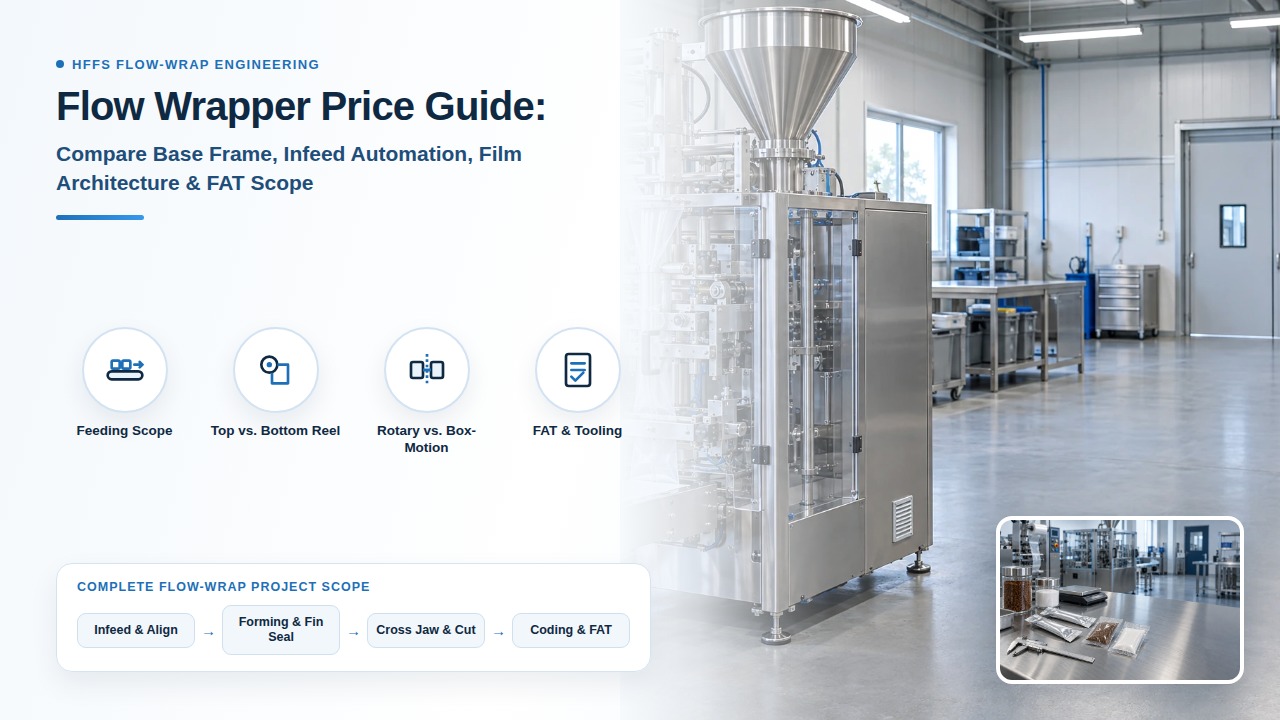
Flow Wrapper Price: What Determines Your Project Cost?
What is included in a flow wrapper quote? Check feeding equipment, options, freight and installation before comparing prices.
Read more