
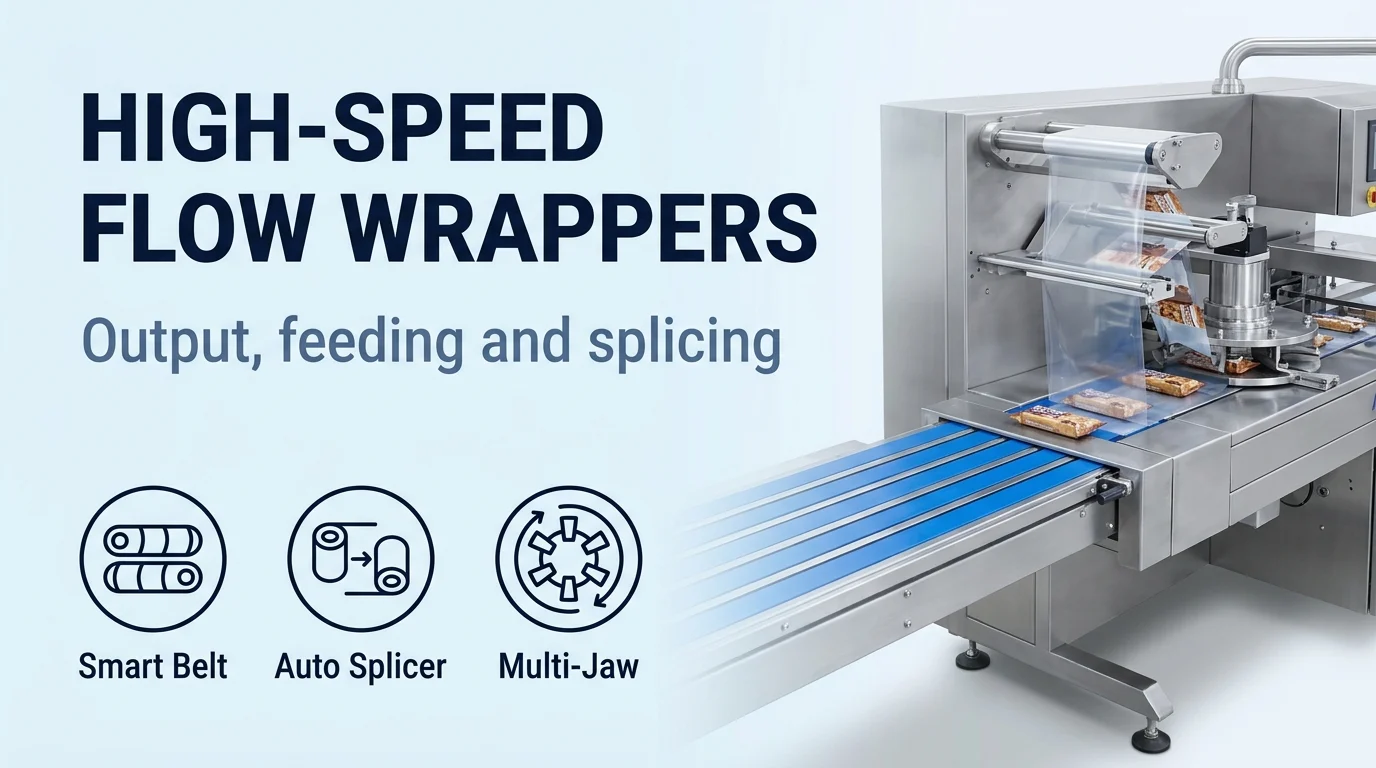
How to check required line output against nameplate cycling speed
When we size a high-speed horizontal flow wrapper for your line, we calculate baseline capacity as Required PPM = Total Units per Shift ÷ Total Operating Minutes per Shift; for example, a target of 80,000 units per 8-hour shift with planned downtime of 30 minutes for breaks and 20 minutes for cleaning leaves 450 operational minutes, or 80,000 ÷ 450 = 178 Effective PPM. In production benchmarking across 10-hour shift runs, pushing a wrapper to maximum mechanical speed with frequent micro-stoppages yielded 117,000 packages (averaging 200 ppm despite a 150,000-pack projection), whereas running the same wrapper at a steadier, synchronized pace produced 129,600 accepted packages at an average of 225 ppm—an increase of 12,600 packs per shift.
While world-class Overall Equipment Effectiveness (OEE) reaches 85% or higher and typical packaging lines average 60% or less—a 25-point gap representing lost shift capacity—most continuous lines achieve maximum net output by running at a sustainable pace 10–15% below peak rated cycling capacity. Across our horizontal flow wrapping portfolio, we engineer standalone high-speed rotary wrappers as well as fully automated, multi-axis integrated bar and confectionery lines with system output capacities reaching up to 1,500 packages per minute.
Compare the mechanical configuration alongside our flow wrapper types overview and review how flow wrapping works before locking your target line rate.
| Sizing input | Engineering brief metric | Wrapper subsystem configured |
|---|---|---|
| Upstream arrival rate | Continuous discharge (pcs/min) from oven/cooler + 10–15% surge margin | 5-belt smart phase feeder, accumulation buffer, pitch servo |
| Shift target & runtime | Accepted packs/shift, net operating minutes (e.g., 450 min/8 hr), reel OD | Dual-reel power unwind, auto butt-splicer (up to 600 FPM), recipe memory |
| Cut repeat & web velocity | Cut-off length (40–565 mm), product height (6–110 mm), web speed (50–80 m/min) | 1-up to 4-up rotary crimper shafts, 3–4 fin-wheel pairs, heated housings |
| Fault & splice rejection | Zero-stop diversion rules for splices, empty wraps, and out-of-pitch items | High-speed pneumatic diverter, 2-way registration eye, no-product-no-bag |
Comparing medium-speed and high-speed flow wrapper machine specifications
In our medium-speed horizontal flow wrapper configuration, the base machine includes a hand-fed infeed conveyor, stainless-steel product-contact surfaces, and dual film reel holders for webs up to 450 mm wide as standard, with an optional 5-belt smart phase feeding module and no-product/no-paper logic to eliminate film waste. Standard equipment on our medium-speed platform includes pneumatic auto-opening hot fin wheels during line stops to prevent melted webs, a rotary crimper head, two-way photo-registration correction for printed films, multi-axis servo motion control, and a 15.6" touchscreen HMI. Rated output on this mid-speed platform is 150 ppm with a 1-up crimper, 250 ppm with a 2-up crimper, and 350 ppm with a 3-up crimper at a maximum film speed of 50 m/min, with working heights of 650 / 850 / 930 mm, machine weight of 550 kg (1,200 lbs), and modular infeed conveyor lengths from 2 m to 10 m.
For 24/7 continuous production of snack bars, bakery items, chocolate tablets, cookies, and crackers, our high-speed rotary flow wrapper platform delivers up to 600 packages per minute depending on product geometry and film structure. The standard high-speed envelope covers product lengths from 40 mm to 565 mm, widths from 12 mm to 120 mm, and heights from 6 mm to 90 mm, accommodating film reels up to 400 mm outer diameter, 35 kg weight, and 265 mm width with fin seal heights of 6 / 9 / 15 mm and cross seal widths of 20 / 25 mm. Rated output scales from 200 ppm with a 1-up crimper to 400 ppm with a 2-up crimper and 600 ppm with a 3-up crimper at 80 m/min maximum web speed, operating on a 440–480 VAC 50/60 Hz supply, 24 VDC control circuit, 80 psi (6 bar) compressed air, and 650 / 850 / 930 mm working height.
Where wet sanitation is required, we build our hygienic washdown high-speed execution with full stainless-steel washdown construction across the infeed, three separately housed fin-wheel assemblies (two heated), electrical enclosure, and discharge. This washdown configuration expands product width capacity to 12–250 mm and product height to 6–110 mm (length 40–565 mm), supporting 300 mm standard film width or an optional 650 mm wide reel at 200 / 400 / 600 ppm (1-up / 2-up / 3-up) and 80 m/min web speed (50 m/min with the 650 mm reel). Across our rotary sealing frames, our dedicated cold-seal bar configuration covers 25–180 mm length, 10–90 mm width, and up to 50 mm height, while our combined cold/hot-seal configuration covers 50–500 mm length, 10–335 mm width, and up to 130 mm height.
Multi-up rotary cutting heads, long-dwell sealing and twin-lane architectures
Our high-speed rotary wrappers come standard with three sets of fin wheels in separate hygienic housings (one set heated for cold-seal or three heated for thermal webs) and 2-up crimper jaws fitted with a straight or bias cutoff knife, while optional upgrades include no-product-no-bag, no-bag-no-seal, a driven overhead discharge hold-down roller, inline date coders, and 3-up or 4-up crimper shafts.
To match seal dwell time to barrier film thickness without sacrificing line throughput, we engineer four distinct cross-sealing kinematics across our horizontal flow wrapper lineup:
- Continuous Rotary End Sealing: Opposed rotary crimp jaws meet briefly on the advancing web without pausing film travel, maximizing cycle rate on thin BOPP and cold-seal structures.
- Amplified Heat Sealing (AHS Hot Rotary): Twin sealing shafts rotate synchronously toward each other while the cross-sealing carriage translates along the film path, multiplying dwell time up to 4× longer than standard rotary sealing at identical web speeds.
- Orbital & Ultrasonic Long-Dwell Sealing: Sealing jaws travel alongside the film tube in hot-bar or ultrasonic executions, extending effective dwell time up to 40× longer than standard rotary heads for hermetic modified-atmosphere packs.
- Twin-Axis Long-Dwell Platform: Provides up to 1 second of constant seal dwell time independent of machine speed, rated up to 150 ppm at 40 m/min film velocity on a 400 VAC 50/60 Hz, 24 VDC, 80 psi (5.5 bar) supply with 40-micron air filtration, manual locking air dump, low-pressure detection, and automatic jaw retraction whenever an out-of-position item is detected between the jaws.
Check both your cut-off repeat and product clearance using our jaw pitch and cutoff length guide and flow wrapper sizing guide.
Automated feeding synchronization: chicanes, smart belts and multi-lane infeeds
To feed high-speed wrapping heads without manual bottlenecks, we integrate robotic pick-and-place loading legs, pullnose and acceleration distribution belts, inline grouping and stacking modules, accumulation buffers, product orientation turners, and roll-fed cardstock U-board or flat-card feeders. For confectionery bars, frozen items, snack bars, and sandwiches arriving in multi-row oven or cooling-tunnel lanes, we deploy a double-bias 45-degree-angled belt chicane system that channels rows into a single stream and meters pieces into a five-belt servo smart feeder. The wrapper drive architecture synchronizes the safety PLC, multi-axis servo amplifiers, color HMI panel, servo film feed roll, automatic splicer, and an independent servo drive on the first fin-wheel pair, paired with no-product–no-package, misplaced-product–no-cut, and optical vision inspection.
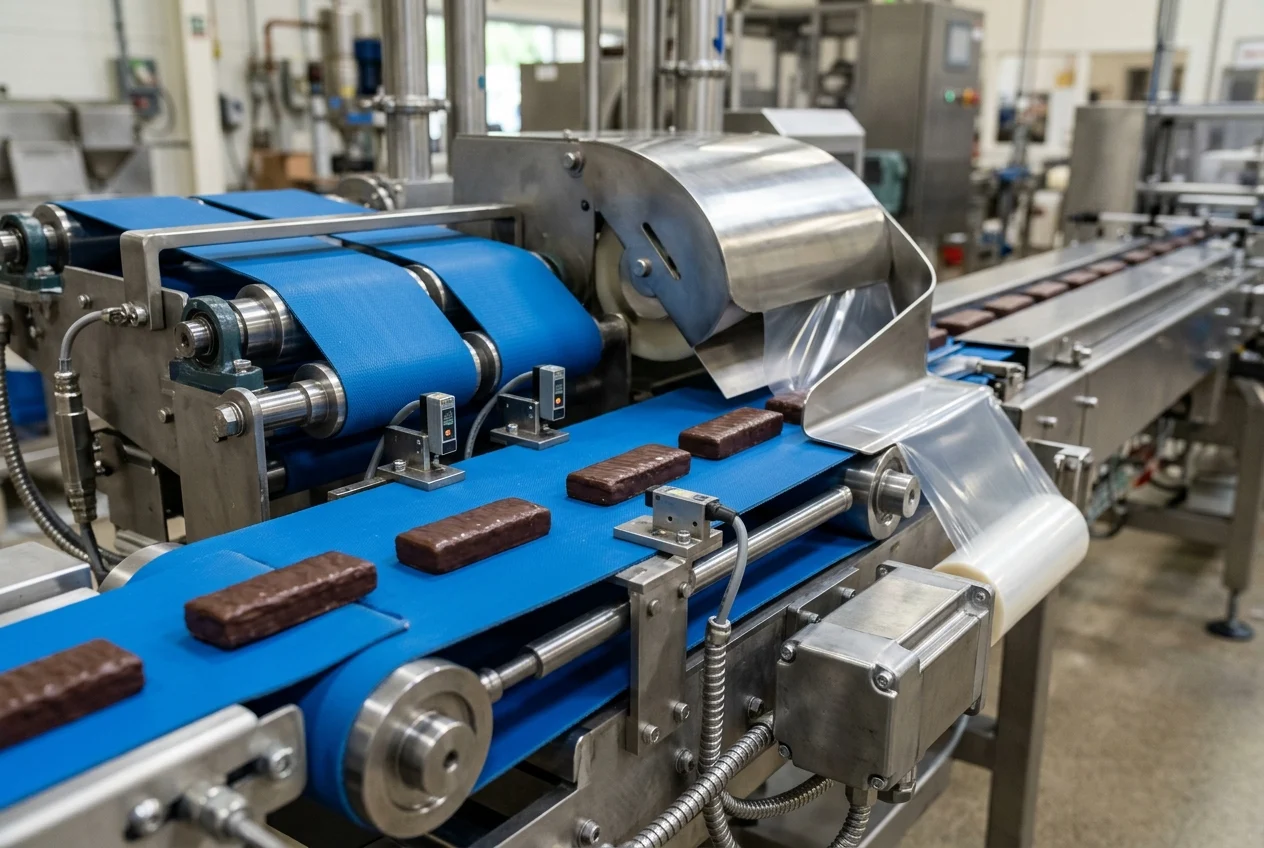
On our high-speed cantilever rotary platforms, a top-mounted reel stand with pneumatic mandrel locking and automatic reel changeover feeds a four-pair longitudinal fin-roller train (with a tiltable first pair for gentle web entry), a 10" graphical touchscreen HMI, and an automated rejector for empty or unsealed packs. Our ultra-high-speed four-servo cantilever configuration reaches up to 1,000 packs/min on three-seal pillow packs, synchronizing independent servomotors on the rotary jaws, four pairs of sealing rollers, infeed conveyor, and motorized reel unwind, with optional water-cooled cold-plate rollers for heat-sensitive bars, vacuum aspiration between roller pairs, and a D-cam jaw profile for heavy laminates.
Where floor space is restricted, our Twin-Lane compact dual-wrapper architecture integrates two independent wrapping lanes inside a single frame occupying up to 50% less floor area, running at up to 2 × 70 m/min web speed and up to 2 × 700 packs/min from a unified HMI panel. When a plant requires four high-speed wrapping lanes, two Twin-Lane units can be installed in a mirrored layout so a single operator supervises all four lanes simultaneously.
Compare upstream transfer layouts in our flow wrapper feeding systems guide before selecting an infeed module.
Dual-reel automatic film splicing and driven unwind tension control
To sustain continuous operation without stopping upstream ovens or cooling tunnels, our high-speed wrappers incorporate dual self-centering film reel mandrels with motorized power unwind and an automatic butt-splicing unit as standard, plus optional low-reel sensors, expiring-web cutoff knives, closed-loop dancer tension control, and automatic web-edge tracking correction.
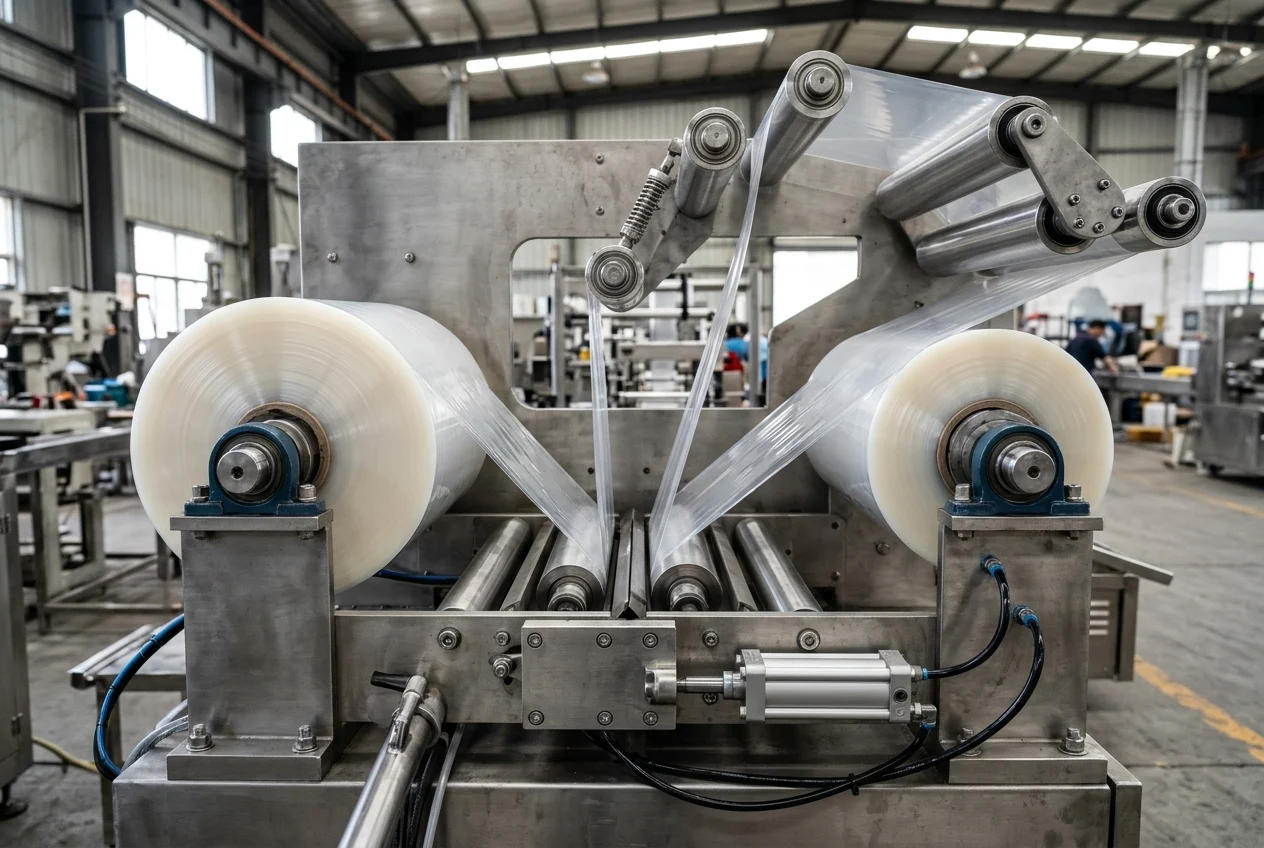
Our high-speed automatic film splicer eliminates roll-change stops by monitoring the expiring reel diameter and executing a registered butt splice onto the standby reel at web speeds up to 600 feet per minute (FPM). Removing manual roll changes and re-threading typically saves 5–10 minutes of downtime per operational hour, which on a 20-hour/day, 6-day/week schedule recovers 20–25 hours of net production time every week. Because the splice head reads printed eye-marks to join the webs in registration, downstream product pitch and date-code placement remain locked while the single spliced pack is automatically diverted at the discharge.
High-speed sealing, automated reject systems and package integrity validation
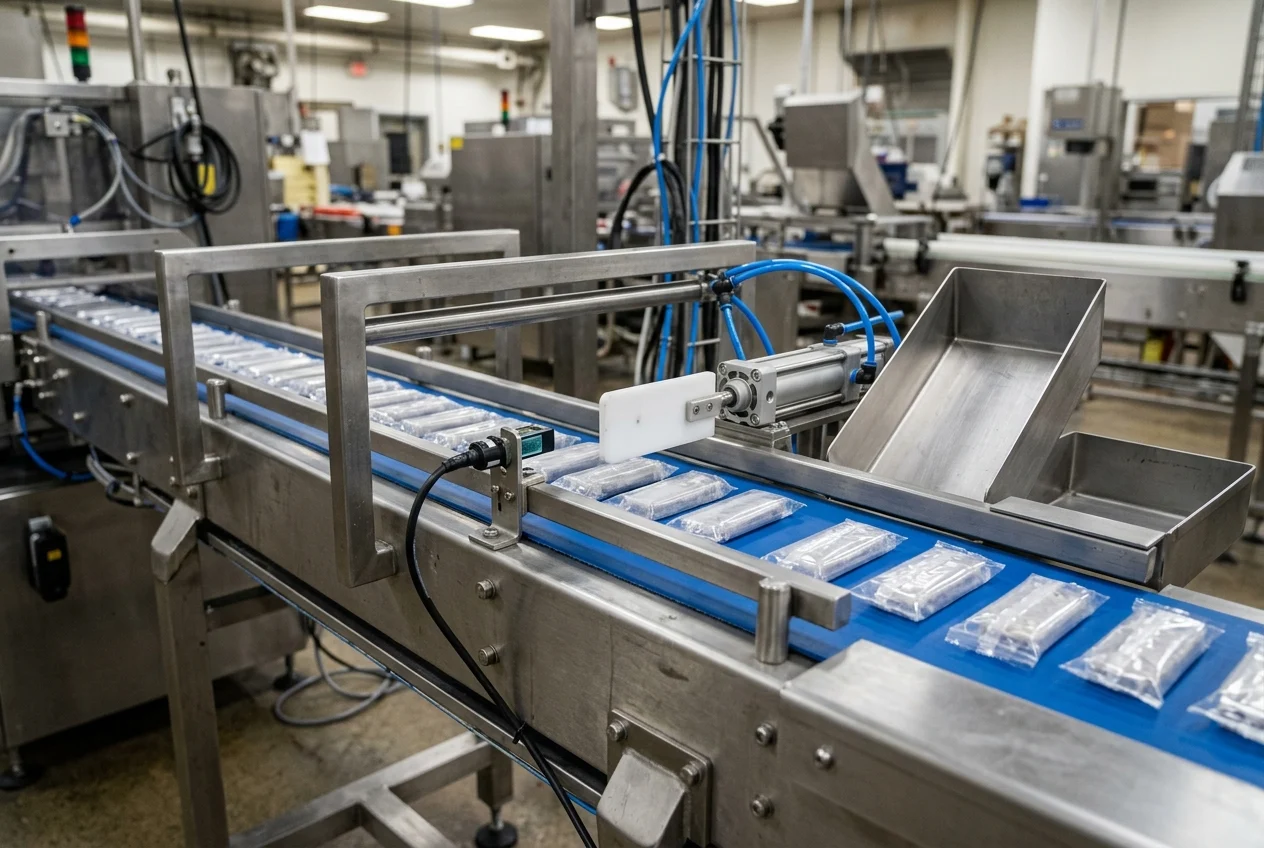
At the wrapper exit, our high-speed configuration uses a 1-meter discharge conveyor with high-speed pneumatic diversion for empty bags, melted-film packs, and splice packs. For medium-to-high-speed lines that step down to a 2-meter standard infeed, we also configure 3-pair and 4-pair longitudinal roller frames with 7" industrial PC or 5" touchscreen controls storing up to 99 product recipes, equipped with no-product-no-bag logic, misplaced-product double-bag protection, dual self-centering reel holders, and D-cam jaw profiles for laminated films.
During high-speed thermal sealing, jaw dwell time (contact duration) and nip pressure (force moving melted sealant into seam overlaps) must stay inside the verified optimum seal window; if combined heat, dwell, and pressure fall short as speed ramps up, channel leaks appear. We validate seal strength across the full speed ramp under ASTM F88/F88M Clauses 1.3, 1.4, and 3.1.3 by measuring the maximum force per unit width required to separate test strips cut from commercial sample packs and recording the failure mode. For thermal safety and line interlocking, hot fin wheels open automatically when the web stops so film never rests on heated jaws, and all upstream feeders and ancillary modules wire into a unified emergency-stop safety circuit compliant with EN 292-2 Annex A §1.2.4 / EN ISO 12100 complex installation requirements.
Review thermal dwell calibration in our crimp dwell and seal strength guide and match cold-seal or heat-seal structures in our flow wrap film guide.
| Subsystem area | Specification to confirm in quotation | Factory acceptance test (FAT) record |
|---|---|---|
| Infeed & phase control | 45° belt chicane, 5-belt smart phase feeder, or robotic pick-and-place | Sustained run at target PPM + 15% surge recovery verification |
| Film unwind & splicing | Dual self-centering power unwind + registered auto butt-splicer (up to 600 FPM) | Live reel-to-reel splice at 50–80 m/min with single-pack reject check |
| Fin wheels & cutting head | 3–4 fin-wheel pairs (auto-open + cold plate) & 1-up to 4-up or AHS/Long-Dwell jaws | ASTM F88/F88M peel-strength curve across min and max operating speed |
| Reject & safety interlocks | 1 m reject conveyor (splice, empty, double-bag) & EN ISO 12100 E-stop loop | Fault-injection test for misplaced item, splice diversion, and jaw auto-open |
Prepare your high-speed flow wrapper requirements brief
Before requesting a machine quotation from our engineering team at LINEVO, assemble your target shift output, upstream discharge rate and lane arrangement, minimum and maximum product dimensions, film structure (heat-seal or cold-seal), reel outer diameter and core size, and required reject logic. Use our flow wrapper requirements checklist to organize your package drawings, film data sheets, and trial acceptance criteria.
Discuss your high-speed flow wrapper requirements on WhatsAppCommon Questions
Does a high maximum cycling speed guarantee my shift output?
No. Nameplate mechanical speed does not account for breaks, sanitation windows, or micro-stoppages. We calculate Required PPM from net operating minutes (e.g., 80,000 packs ÷ 450 min = 178 effective PPM) and size the wrapper to run 10–15% below peak rating so lines sustain 85%+ OEE.
When do I need a dual-reel automatic film splicer?
Specify dual-reel power unwind with automatic butt-splicing whenever upstream ovens, enrobers, or cooling tunnels discharge continuously. Splicing in registration at up to 600 FPM saves 5–10 minutes per operational hour (20–25 hours/week on a 6-day, 20-hour schedule) while diverting only the single spliced pack.
Why do high-speed wrappers use multi-up rotary cutting heads or cold-seal film?
As web velocity reaches 50–80 m/min, single-jaw contact time drops sharply. Fitting 2-up, 3-up, or 4-up rotary crimpers scales output from 200 ppm to 600–1,000 ppm at lower shaft RPM, while pattern-coated cold-seal films bond by nip pressure alone and amplified or orbital long-dwell heads multiply thermal dwell 4× to 40×.
Can a high-speed wrapper run without an automatic infeed?
Above hand-feeding limits (~60–100 ppm), operators cannot load flights consistently without empty bags or jaw jams. We pair high-speed wrappers with 45° belt chicanes, 5-belt servo smart feeders, inline card dispensers, or multi-leg robotic loaders synchronized to the forming box.
Sources
- LINEVO High-Speed Horizontal Flow Wrapper Engineering Specifications — Multi-Up Rotary, Amplified Heat-Seal, Long-Dwell, and Twin-Lane Platforms
- Automatic Butt-Splicing and Continuous Web Tension Control Technical Reports (Up to 600 FPM Registration Splicing)
- ASTM International — ASTM F88/F88M Standard Test Method for Seal Strength of Flexible Barrier Materials
- European Machinery Safety Standards — EN 292-2 Annex A §1.2.4 / EN ISO 12100 Complex Installation Emergency Stop Interlocks
Before you request a quote
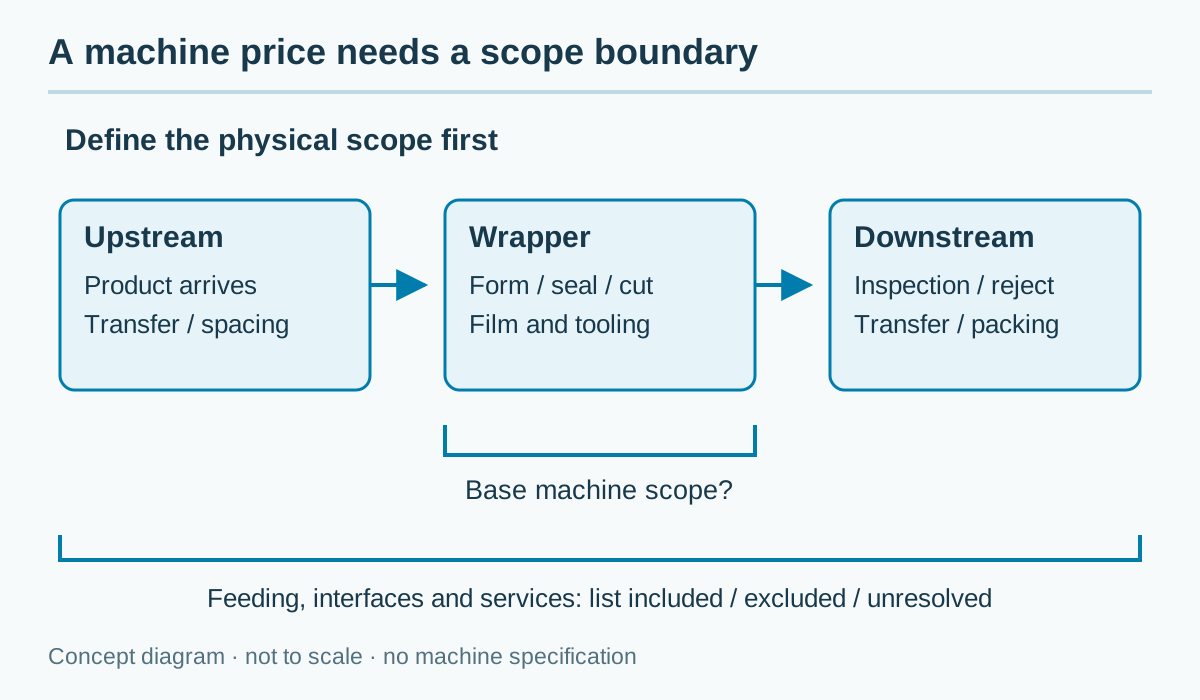
Flow Wrapper Price: What Determines Your Project Cost?
What is included in a flow wrapper quote? Check feeding equipment, options, freight and installation before comparing prices.
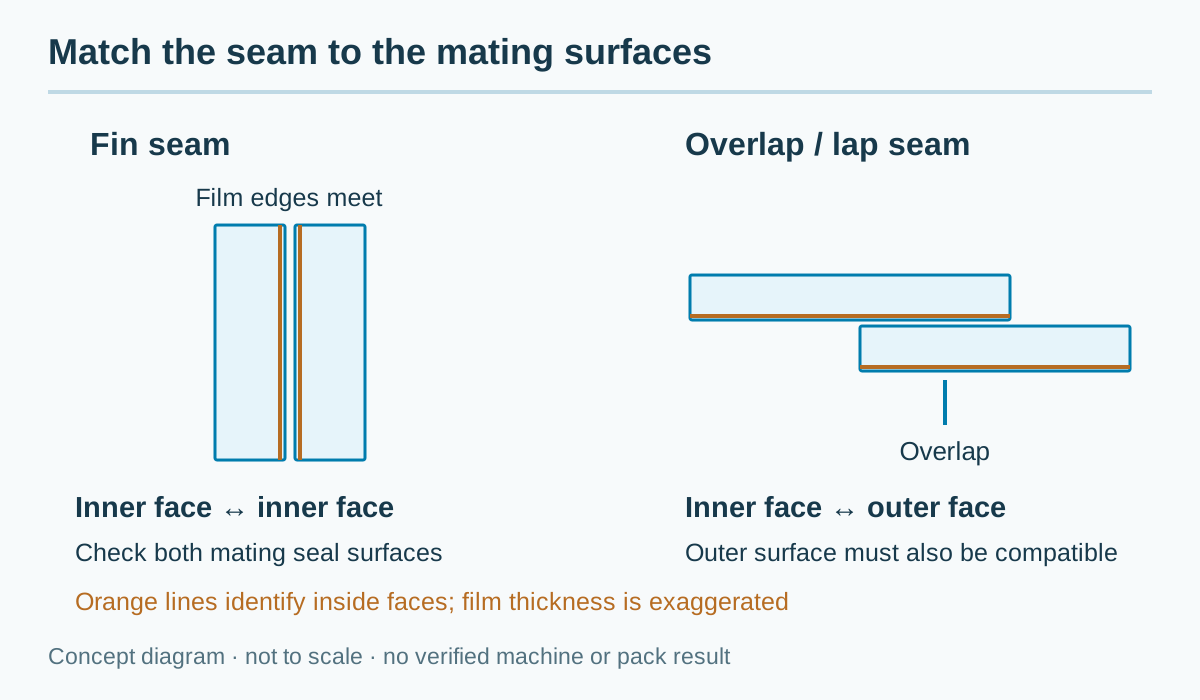
Choosing Flow Wrap Film for Your Product and Machine
Choosing flow wrap film starts with the product and required seal. Gather the film specification, reel dimensions and samples for compatibility testing.
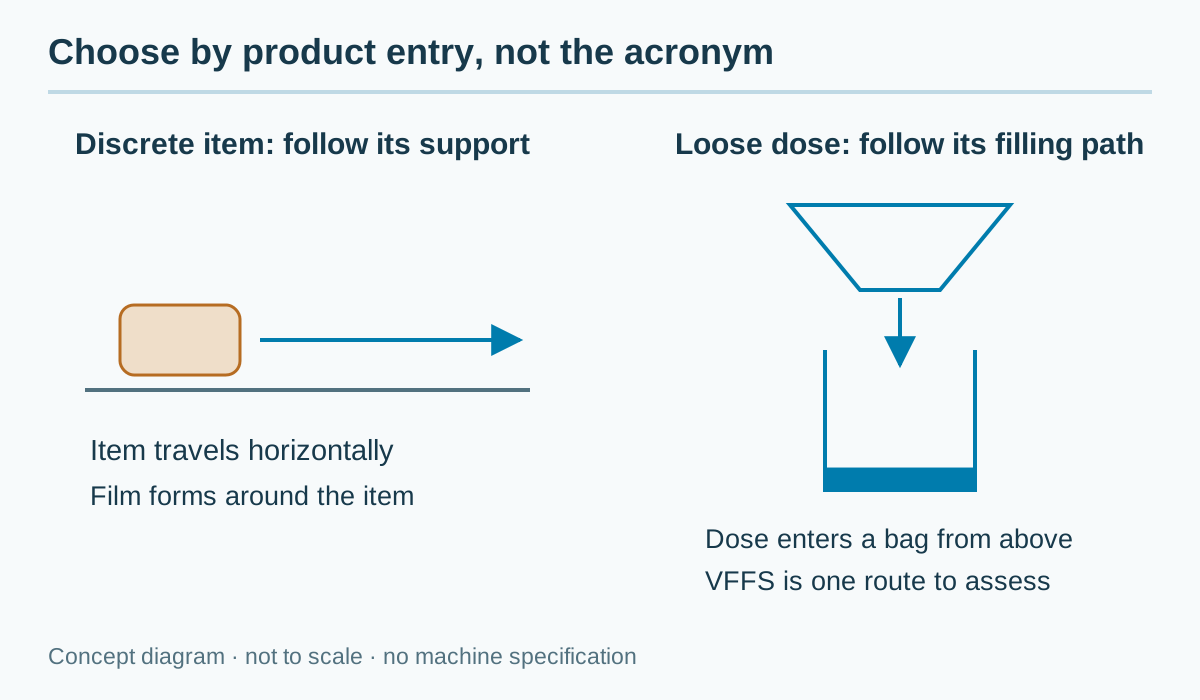
HFFS Machines: Choose the Right Horizontal Packaging Process
HFFS can refer to flow wrappers or horizontal pouch systems. Identify how your product enters the pack before comparing machine proposals.