
Building a flow wrapper maintenance checklist around energy isolation, pre-production operator walkdowns, rotary sealing jaw care, and scheduled technician service prevents unplanned stops across horizontal packaging lines. This guide supports the flow wrap packaging guide and flow wrapper troubleshooting by separating daily operator inspections from password-protected technician procedures.
Energy Isolation, Pneumatic Exhaust and Thermal Safety Before Maintenance
Every servicing, cleaning, or adjustment task on a horizontal flow wrapper starts with isolating electrical, pneumatic, and thermal energy before opening machine guards.
Under OSHA 29 CFR § 1910.147(a)(1)(i), hazardous energy control covers the servicing and maintenance of machines and equipment in which the unexpected energization or start up of the machines or equipment, or release of stored energy could cause injury to employees. Under OSHA 29 CFR § 1910.147(b), servicing and maintenance activities include lubrication, cleaning, or unjamming of machines or equipment and making adjustments or tool changes, where the employee may be exposed to the unexpected energization or startup of the equipment or release of hazardous energy.
Under OSHA 29 CFR § 1910.147(a)(2)(ii)(A), servicing or maintenance which takes place during normal production operations is covered by the lockout/tagout standard when an employee is required to remove or bypass a guard or other safety device. Under OSHA 29 CFR § 1910.147(a)(2)(ii)(B), lockout/tagout applies when an employee is required to place any part of his or her body into a point of operation or where an associated danger zone exists during a machine operating cycle.
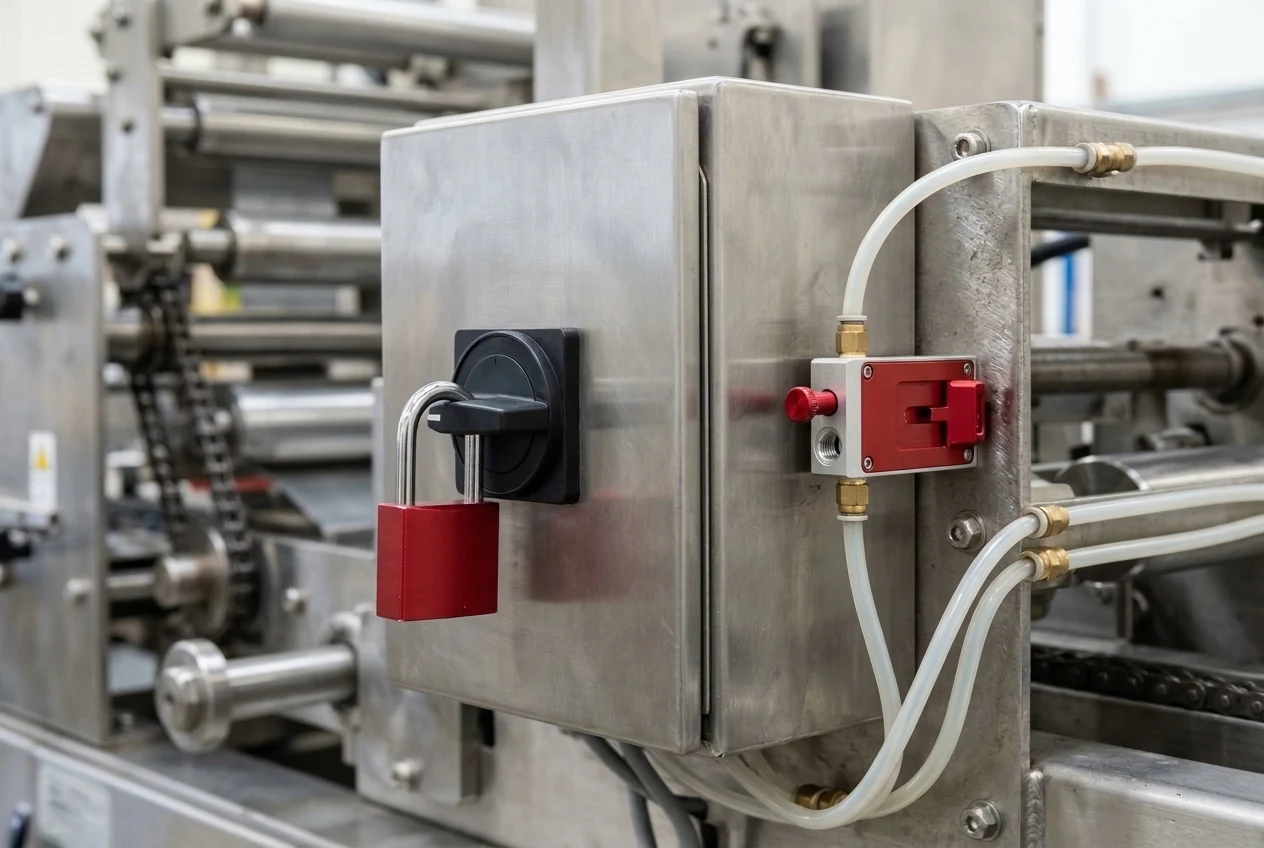
OSHA 29 CFR § 1910.147(b) specifies that push buttons, selector switches, and other control circuit type devices are not energy isolating devices. Section 1.3.3 of the XtraVac-450A operation manual states that before starting normal maintenance and service, adjustment, or repairs, you must make sure the machine is disconnected from the power supply and that the main disconnector is in the OFF position and locked with a paddle lock.
Under OSHA 29 CFR § 1910.147, tagout device attachment means shall be of a non-reusable type, attachable by hand, self-locking, and non-releasable with a minimum unlocking strength of no less than 50 pounds. Under OSHA 29 CFR § 1910.147(c)(6)(i), the employer shall conduct a periodic inspection of the energy control procedure at least annually to ensure that the procedure and the requirements of the standard are being followed.
Syntegon mid-speed horizontal flow wrapper technical specifications specify a 24 VDC control circuit and a minimum pneumatic supply of 80 psi / 6 bar. Under OSHA 29 CFR § 1910.147(d)(5)(i), following the application of lockout or tagout devices to energy isolating devices, all potentially hazardous stored or residual energy shall be relieved, disconnected, restrained, and otherwise rendered safe. Under OSHA 29 CFR § 1910.147(d)(6), prior to starting work on machines or equipment that have been locked out or tagged out, the authorized employee shall verify that isolation and deenergization of the machine or equipment have been accomplished.
Power & Motion Tech notes that Ross Controls modular L-O-X manual lockout air valves are lockable only in the off position, have a full-flow threaded exhaust port, and include a pressure sensing port for installation of a popup indicator for pressure release verification. Power & Motion Tech states that modular pneumatic lockout valves meet OSHA Regulation 29 CFR 1910.147 and the latest ANSI standard requirements found in Z244.1-2003, B11.0-2010, and B155.1-2011.
Under OSHA 29 CFR § 1910.212(a)(1), one or more methods of machine guarding shall be provided to protect the operator and other employees in the machine area from hazards such as those created by point of operation, ingoing nip points, rotating parts, flying chips and sparks. The XtraVac-450A operation manual states that to avoid the risk of fire, you must not allow film to stop on the sealing jaws, and you must never open protective covers or machine doors while the machine is running.
The XtraVac-450A operation manual states that because the machine fin sealing cover surface temperature can be over 65℃, thermo-isolated gloves shall be worn before access. Section 3.2.5 of the XtraVac-450A operation manual states that Machine adj. is the operation mode for cutter adjustment with the cover open, and the adjustment of the end sealing jaws and cutter should be carried out by the training technician using the second level password.
| Hazard or Control Boundary | Mandatory Isolation or Protection Action | Verification or Role Requirement |
|---|---|---|
| Main electrical supply and control switches | Make sure the machine is disconnected from the power supply and the main disconnector is in the OFF position and locked with a paddle lock | Push buttons, selector switches, and other control circuit type devices are not energy isolating devices |
| Compressed air supply and pneumatic actuators | Modular L-O-X manual lockout air valves are lockable only in the off position and have a full-flow threaded exhaust port | Pressure sensing port provides installation of a popup indicator for pressure release verification |
| Heated fin-sealing covers and rotary sealing jaws | To avoid the risk of fire, do not allow film to stop on the sealing jaws | This machine fin sealing cover surface temperature can be over 65℃, so thermo-isolated gloves shall be worn before access |
| Open-cover cutter and end-sealing jaw adjustments | Never open protective covers or machine doors while the machine is running | Machine adj. mode for cutter adjustment with the cover open requires the second level password and should be carried out by the training technician |
Pre-Production Operator Inspection Checklist across Four Machine Zones
Before loading product onto the infeed conveyor, operators should walk the machine path covered in our how flow wrapping works guide.
Greener Corporation recommends investing five or ten minutes before starting production to inspect four flow wrapper areas: 1) Package Formation, 2) Controller, 3) Sealing Jaws, and 4) Cutting & Sealing.
During Package Formation checks, Greener Corporation states that operators verify whether the Deck Plates, Guards, and Rails are properly installed, tightened, and adjusted for the product, and make sure the Forming Box is the correct size or set to the right dimensions and installed and tightened properly. Section 3.4.7 of the XtraVac-450A operation manual states that the front guide position is subject to the product width and has to be adjusted to keep 3-5mm clearance from the entrance of the forming box. Section 3.4.8 of the XtraVac-450A operation manual states that the width of the adjustable forming box is subject to the product width and is adjusted so that the clearance between the product and the forming box is 3-10mm.
During Controller checks, Greener Corporation states that operators confirm that the Recipe for package length, temperature settings, and other variables is set for the current product, and inspect whether the Fin Wheels are worn, damaged, or contaminated with product. In a PacMatix field case study on a PFM Hurricane horizontal flow wrapper producing random unsealed spots in the longitudinal fin seal, debris and residue buildup on the cylinder shaft—a mix of product dust and fragments of packaging film—restricted movement and caused the cylinder to hesitate, resulting in uneven sealing pressure.
During Sealing Jaws checks, Greener Corporation states that operators check that the Sealing Jaws are clean and free of wear and damage, check whether there is excessive backlash, or free play, between the upper and lower shafts, and run a Carbon Impression for each pair of sealing jaws to check clearance and alignment before dating and saving the impressions.
During Cutting & Sealing checks, Greener Corporation states that before running product, operators run film through the cutting and sealing head to verify that Material Registration is correct, the knives are adjusted properly and cutting cleanly without banging, seals are good, and the Product Carriers and Discharge Guides, such as brushes and belts, are properly set so they will not impede packages as they move through and exit the cutting and sealing head. Section 3.3 of the XtraVac-450A operation manual states that on the auto-splicer registration setup, you must make sure to keep the photo registration mark position within the tolerance of ±5mm, noting that the eye mark photo registration mark position is subjected to the bag length.
For flat-web registration sensor setup and coder phasing, see our flow wrapper date-coder placement and seal-jaw clearance guide and film width and bag length calculation guide.
Energy Isolation Before Servicing
- Make sure the machine is disconnected from the power supply and the main disconnector is in the OFF position and locked with a paddle lock. Required
Package Formation Zone
- Verify that Deck Plates, Guards, and Rails are properly installed, tightened, and adjusted for the product, and that the Forming Box is the correct size and tightened properly. Required
- On the XtraVac-450A, adjust the front guide position to keep 3-5mm clearance from the entrance of the forming box. Adjust the width of the adjustable forming box so that the clearance between the product and the forming box is 3-10mm. To confirm
Controller and Fin Wheels Zone
- Confirm that the Recipe for package length, temperature settings, and other variables is set for the current product, and check whether the Fin Wheels are worn, damaged, or contaminated with product. Required
Sealing Jaws Zone
- Check that the Sealing Jaws are clean and free of wear and damage, check for excessive backlash between the upper and lower shafts, and run a dated Carbon Impression for each pair of sealing jaws. Required
Dry Film Cutting and Sealing Check
- Run film through the cutting and sealing head to verify Material Registration, clean knife cutting without banging, good seals, and properly set Product Carriers and Discharge Guides. Required
- On the XtraVac-450A auto-splicer registration setup, keep the photo registration mark position within the tolerance of ±5mm. To confirm
Rotary Sealing Jaw, Knife Slot and Anvil Maintenance
Maintaining uniform serration contact and clean knife slots protects seal integrity across both rotary and box-motion sealing heads compared in our flow wrapper types guide and crimp dwell time, jaw temperature, and seal strength guide.
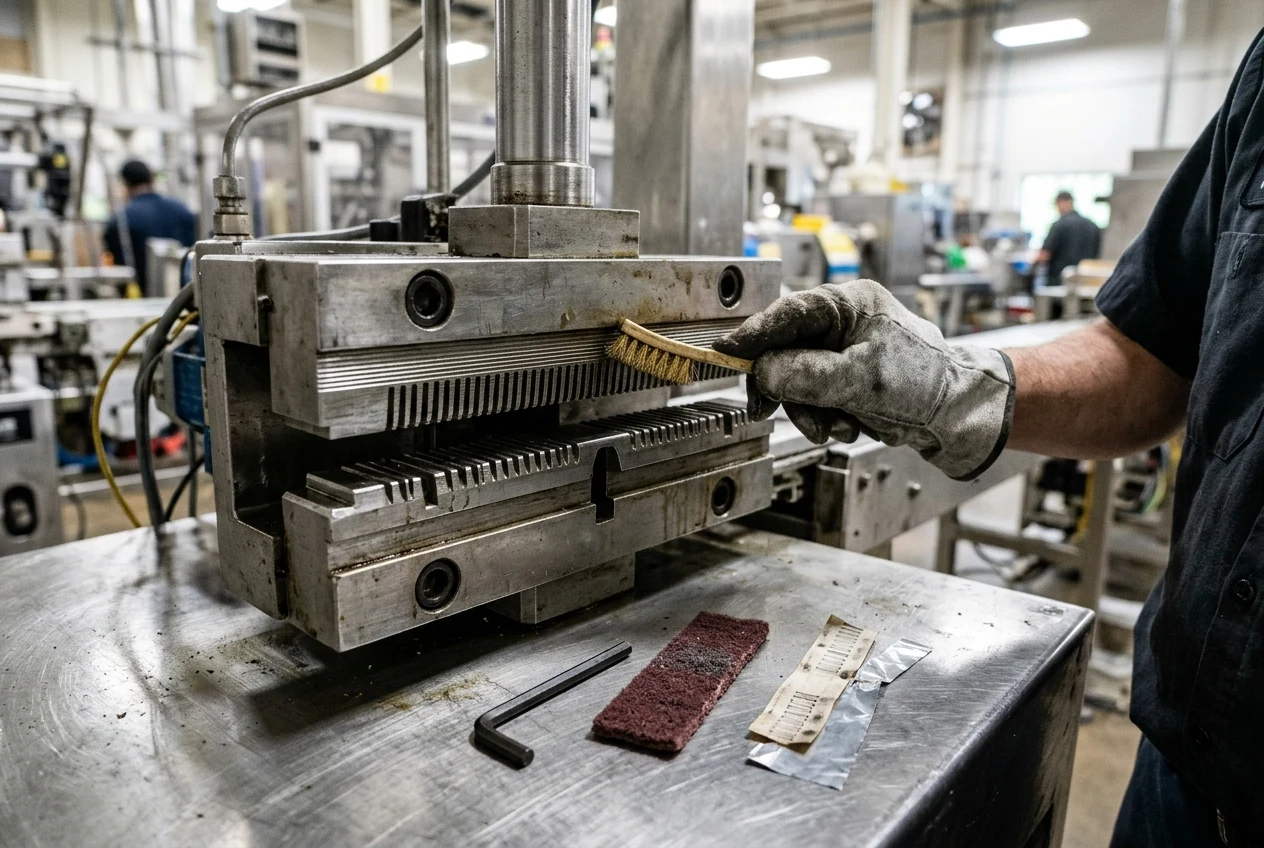
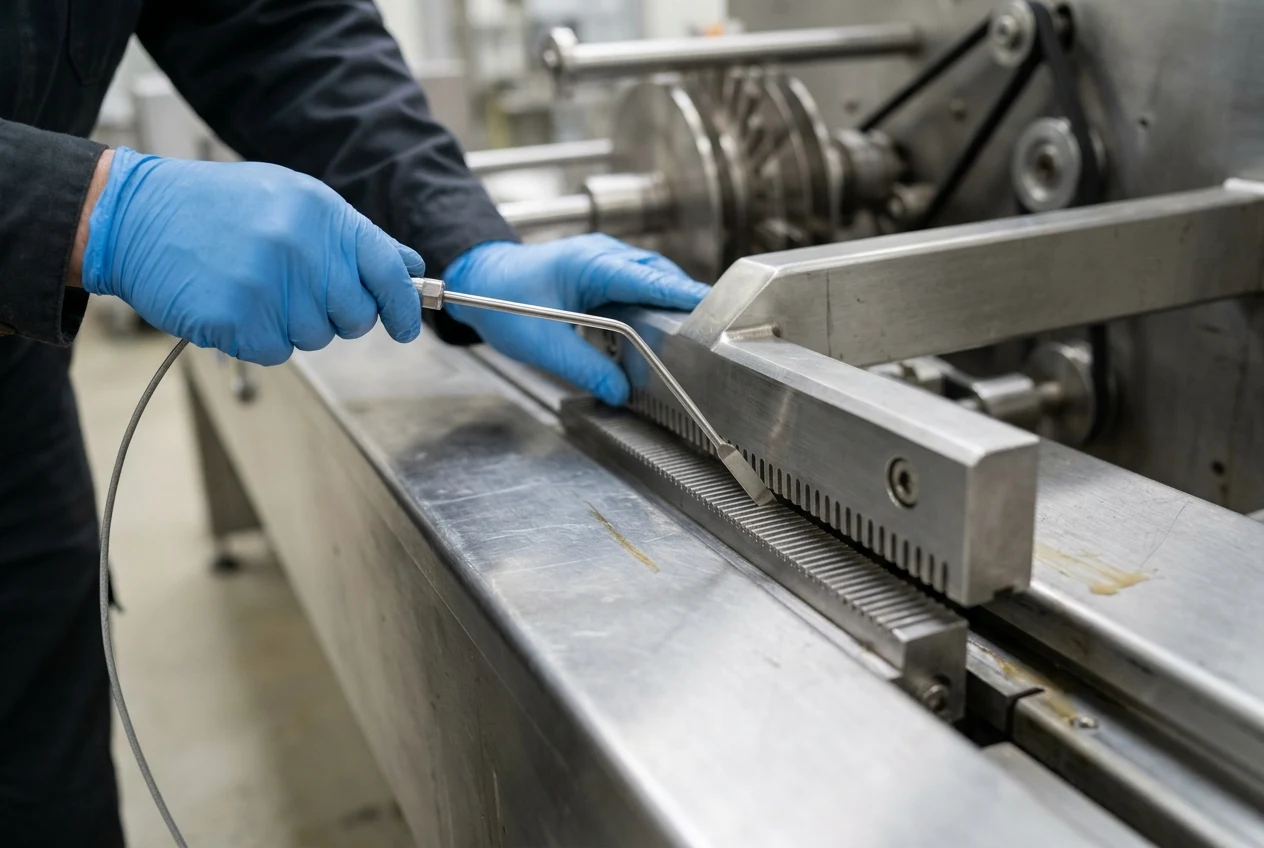
Greener Corporation advises cleaning sealing jaws regularly without using stiff, coarse bristled brushes because they damage the serrations and cause sealing problems; brushes with finer, softer bristles trimmed in length clean more effectively without splaying out, and operators should run a carbon impression after cleaning the jaws to check the current setup. Section 3.4.3 of the XtraVac-450A operation manual states that you must make sure the jaws are near or at operating temperature before the final alignment, clearance, and pressure adjustments are made and the mounting bolts are fully tightened, notes that when shifting from high to lower line speed it may be necessary to reduce temperature settings, and specifies using a brush with either brass or very fine steel bristles to clean jaw sealing faces to avoid damaging the serrations. Former Fab states that its Nickel Teflon Coating (NTC) layer on sealing jaws is resistant to corrosion, flaking, chipping, and peeling, and is self-lubricating yet exceptionally durable.
Greener Corporation states that to clean knife and anvil slots on rotary sealing jaws, you should cut a piece of scouring pad and push it down into the slot with a hex wrench, and not neglect to clean the anvil slot, because product buildup in the slot creates an unstable base that can cause intermittent cutting problems and knife failure. Section 3.4.3 of the XtraVac-450A operation manual states that when adjusting the height of the knife and anvil, you first adjust the upper edge of the anvil at or slightly below the midway point between the crown and root of the jaw's serrations and tighten the lower set screws E, and then adjust the knife out until it cuts properly by the bolts D and C.
Greener Corporation states that to determine if an over adjusted knife is at the root of an end-seal leaker problem, a good first diagnostic step is to remove the knife, run sample packages with product at normal line speeds, and cut these packages apart with scissors to test the end seals. Greener Corporation states that if crimper springs must be compressed excessively—more than half way—in order to achieve a cut, then the springs are worn out and need to be replaced as soon as possible to return to proper operating conditions and prevent damage to critical components of the sealing head.
Greener Corporation states that to ensure accurate setup and prevent jaws from shifting out of alignment, you should use hardened, flat washers to mount jaws on flat surfaces, and spherical washers or, if they are not available, split washers for mounting jaws on round shafts. Greener Corporation states that you should replace all rotary sealing jaws on a machine at the same time and make sure all the jaws come from the same supplier, because inaccurate setup caused by sealing jaws with different wear levels and designs creates sealing problems.
When replacing matched rotary jaw sets on multi-up heads, verify the cutting circle and repeat range in our flow wrapper jaw pitch and cutoff length guide.
Scheduled Preventive Maintenance Intervals: Operator vs. Authorized Technician
Separating routine shift sanitation from electrical and mechanical servicing keeps operators out of energized cabinets and preserves sensor and cutter calibration.
The XtraVac-450A operation manual states that in the cleaning and disinfecting procedure, the operator should clean the processing equipment immediately after manufacture everyday, within 30 minutes before starting production; the operator should disinfect for over 5 minutes, and every week use a suitable way to clean completely and carefully. The XtraVac-450A operation manual states that Step 2 cleaner washing uses at least 5L of cleaner at a temperature between 60-80℃.
Section 1.4.9 of the XtraVac-450A operation manual states that on the XTRAVAC-450A machine measured according to ISO3746, the A-weighted sound pressure level measuring under no load at the operation position is 76.3dB(A), and under load at the operation position is 78.7dB(A). Section 4.1 of the XtraVac-450A operation manual organizes maintenance check items across Daily, Weekly, Monthly, 3months, 6months, and Yearly intervals, assigning electrical box interior cleaning, position sensor screw tightening, electric motor cleaning, motor load voltage and current checks, wire continuity checks, controller box power supply terminal screw tightening, renewal of all limit switches for the safety gates, and replacement of the PLC controller battery to the technician schedule.
| Service Interval | Assigned Role | Scheduled Maintenance or Sanitation Action |
|---|---|---|
| Daily and pre-start sanitation | Operator | Clean the processing equipment immediately after manufacture everyday, within 30 minutes before starting production; disinfect for over 5 minutes |
| Weekly complete washdown | Operator | Clean completely and carefully every week |
| Monthly baseline check | Operator | Check the integrity of noise, temperature, and ventilation of the machine monthly; on the XTRAVAC-450A machine measured according to ISO3746, the A-weighted sound pressure level at the operation position is 76.3dB(A) under no load and 78.7dB(A) under load |
| Scheduled technical service intervals | Trained technician | Follow the Section 4.1 schedule across Daily, Weekly, Monthly, 3months, 6months, and Yearly intervals for electrical box cleaning, sensor screws, motor cleaning, wire continuity, safety-gate limit switches, and the PLC battery |
| Annual energy control audit | Employer / authorized inspector | Conduct a periodic inspection of the energy control procedure at least annually under OSHA 29 CFR § 1910.147(c)(6)(i) to ensure that the procedure and requirements of the standard are being followed |
Hygienic Frame Access, Post-Maintenance Verification and Spare Parts Planning
Machine frame geometry, washdown protection, and structured spare-part kits determine how quickly maintenance teams complete sanitation and verify package seal quality before restarting production.
ULMA Packaging states that its cantilevered horizontal flow wrapper is fully built on a cantilevered stainless steel frame to ensure maximum hygiene and sanitation levels, preventing dirt trap areas, providing easy access to the drive components for maintenance, and pairing with an in-feed conveyor that can be easily removed and disassembled to simplify cleaning and sanitation. The Syntegon mid-speed horizontal flow wrapper brochure specifies three sets of finwheels, one heated, and auto-open hot finwheels during stoppages to minimize melted film and reduce film waste. The Syntegon hygienic high-speed horizontal flow wrapper brochure specifies three (3) sets of finwheels built in separate hygienic housings with two (2) sets heated, 2-up crimper jaws with straight/bias knife, and a hand-wheel for manual rotating of sealing jaws for cleaning.
Greener Corporation states that a typical vertical bagger or long dwell flow wrapper might run at 60-80 packages per minute, whereas a typical rotary flow wrapper runs faster, around 200-250 packages per minute, with shorter dwell times that make optimizing pressure and heat levels more crucial. Greener Corporation states that because sealing jaws are often hotter in the middle than at the ends where heat dissipates more quickly, and the controller usually only indicates the temperature at one point within the jaw, a pyrometer should be used regularly to check multiple points across the functional length of the sealing face. Greener Corporation states that to determine the minimum temperature setting at production speed, you drop the temperature by increments of 5° F, or 3° C, until seal integrity is unacceptable, and then add back 5° F (or 3° C) to this number.
Under ASTM F88/F88M-15 Section 6.2, seal-strength test specimens are cut in accordance with Test Methods D882 to a width of 0.984 in. [25 mm], 0.591 in. [15 mm], or 1.00 in. [25.4 mm]. Under ASTM F88/F88M-15 Section 6.1, during tensile seal-strength testing, the rate of separation of the jaws shall be uniform and capable of adjustment from approximately 8 to 12 in. [200 to 300 mm]/min. Under ASTM F2096-11 Section 1.1, the internal pressurization bubble test method covers the detection of gross leaks in packaging with method sensitivity down to 250 μm (0.010 in.) with an 81 % probability; the method may be used for tray and pouch packages.
Syntegon states that pre-assembled, easy-to-handle parts in its Preventive Maintenance kits facilitate the maintenance process, reducing time spent per maintenance event by 20% on average and helping reduce unexpected downtime resulting from worn critical components. Syntegon states that its Recommended Parts Inventory (RPI) helps manufacturers prioritize parts that should always be available on site, standard spare parts that can be sourced quickly when needed, and customer-specific components with longer lead times.
Prepare Your Flow Wrapper Maintenance and Spare-Parts Brief
When you are planning a new horizontal flow wrapper project or structuring an on-site wear-part inventory with LINEVO, gather the following operational details before messaging our engineering team:
- Product and sanitation environment: dry ambient wiping versus washdown cleaning requirements, shift schedule, and any allergen or particulate clearance steps between runs.
- Film structure and sealing configuration: converter film specification from our flow wrap film guide, fin-seal wheel setup, and rotary versus box-motion end-seal head configuration.
- Wear-part and tooling baseline: current crimper serration pattern, cutoff knife and anvil style, heater and thermocouple ratings, and target maintenance intervals.
- Acceptance and verification method: carbon impression records, contact pyrometer logs, and package peel or leak test requirements from our flow wrapper requirements checklist.
Frequently Asked Questions
Can an operator rely on the emergency stop or HMI switch instead of locking out the main electrical disconnector before maintenance?
OSHA 29 CFR § 1910.147(b) specifies that push buttons, selector switches, and other control circuit type devices are not energy isolating devices. Section 1.3.3 of the XtraVac-450A operation manual states that before starting normal maintenance and service, adjustment, or repairs, you must make sure the machine is disconnected from the power supply and that the main disconnector is in the OFF position and locked with a paddle lock.
What type of brush should be used to clean horizontal flow wrapper sealing jaw serrations?
Greener Corporation advises cleaning sealing jaws regularly without using stiff, coarse bristled brushes because they damage the serrations and cause sealing problems; brushes with finer, softer bristles trimmed in length clean more effectively without splaying out, and operators should run a carbon impression after cleaning the jaws to check the current setup. Section 3.4.3 of the XtraVac-450A operation manual specifies using a brush with either brass or very fine steel bristles to clean jaw sealing faces to avoid damaging the serrations.
How do you test whether an over-adjusted cutoff knife is causing end-seal leakers?
Greener Corporation states that to determine if an over adjusted knife is at the root of an end-seal leaker problem, a good first diagnostic step is to remove the knife, run sample packages with product at normal line speeds, and cut these packages apart with scissors to test the end seals. Greener Corporation states that if crimper springs must be compressed excessively—more than half way—in order to achieve a cut, then the springs are worn out and need to be replaced as soon as possible to return to proper operating conditions and prevent damage to critical components of the sealing head.
Which scheduled maintenance intervals belong to a trained technician rather than the machine operator?
Section 4.1 of the XtraVac-450A operation manual organizes maintenance check items across Daily, Weekly, Monthly, 3months, 6months, and Yearly intervals, assigning electrical box interior cleaning, position sensor screw tightening, electric motor cleaning, motor load voltage and current checks, wire continuity checks, controller box power supply terminal screw tightening, renewal of all limit switches for the safety gates, and replacement of the PLC controller battery to the technician schedule.
How are seal strength and gross leak integrity verified after rotary jaw or knife maintenance?
Under ASTM F88/F88M-15 Section 6.2, seal-strength test specimens are cut in accordance with Test Methods D882 to a width of 0.984 in. [25 mm], 0.591 in. [15 mm], or 1.00 in. [25.4 mm]. Under ASTM F2096-11 Section 1.1, the internal pressurization bubble test method covers the detection of gross leaks in packaging with method sensitivity down to 250 μm (0.010 in.) with an 81 % probability; the method may be used for tray and pouch packages.
Sources
- Occupational Safety and Health Administration — The Control of Hazardous Energy (Lockout/Tagout) Standard
- Occupational Safety and Health Administration — General Requirements for All Machines Standard
- Power & Motion Tech — Ross Controls Modular Manual Lockout Air Valves Technical Reference
- XtraVac Packaging Machines — Horizontal Pillow Type Packing Machine Operation Manual
- Greener Corporation — Preventative Maintenance Checklist for Flow Wrappers
- Greener Corporation — Preventative Maintenance Quick Tips for Flow Wrappers and Vertical Form-Fill-Seal Baggers
- Greener Corporation — When Cutting Issues Cause End Seal Leakers on Flow Wrappers
- Greener Corporation — Optimizing Pressure, Heat, and Time on Flow Wrappers and Vertical Baggers
- PacMatix — Horizontal Flow Wrapper Fin Seal Cleaning Field Case Study
- Former Fab — Sealing Jaws and Nickel Teflon Coating Technical Specification
- ULMA Packaging — Cantilevered Horizontal Flow Pack Wrapper Technical Specification
- Syntegon Technology — Mid-Speed and Hygienic High-Speed Horizontal Flow Wrapper Application Information Brochures
- Syntegon Technology — Preventive Maintenance Kits and Recommended Parts Inventory Technical Guides
- ASTM International — Standard Test Method for Seal Strength of Flexible Barrier Materials
- ASTM International — Standard Test Method for Detecting Gross Leaks in Packaging by Internal Pressurization (Bubble Test)
Related guides
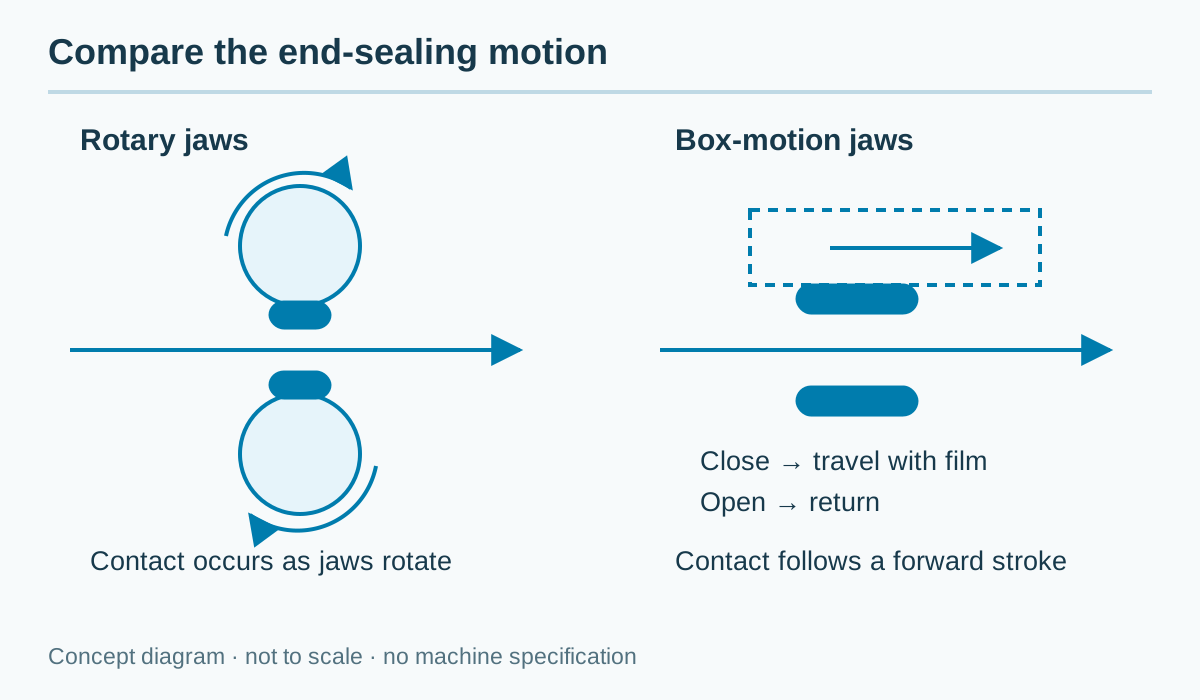
Compare Flow Wrapper Types and Configurations
Rotary or box motion? Top film or bottom film? Compare the feeding, film path and end-seal choices in a flow wrapper proposal.
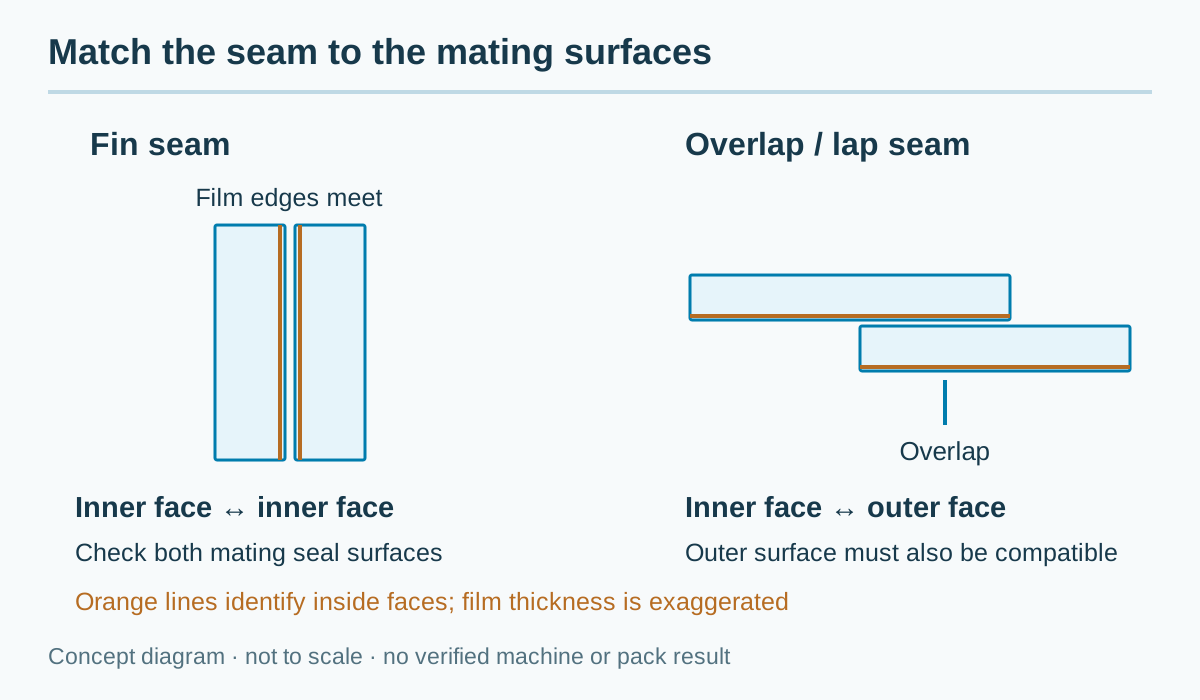
Choosing Flow Wrap Film for Your Product and Machine
Choosing flow wrap film starts with the product and required seal. Gather the film specification, reel dimensions and samples for compatibility testing.
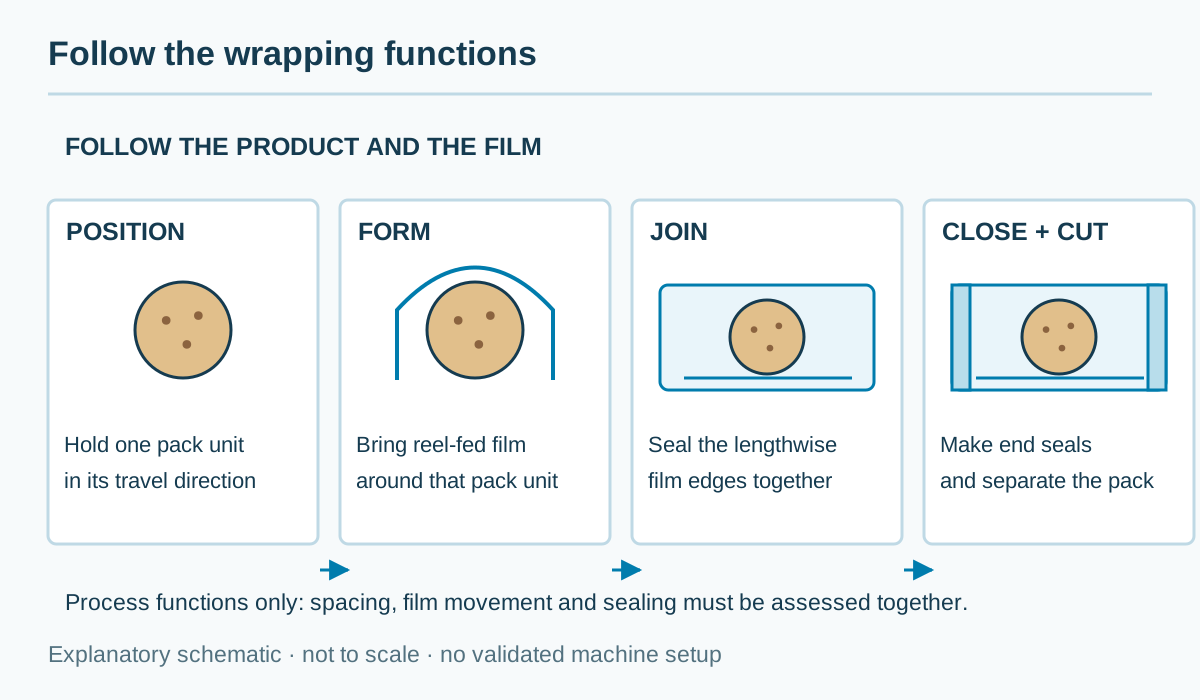
How Does a Flow Wrapper Work? Step-by-Step Process
Follow the horizontal flow wrapping process from feeding and film forming to longitudinal sealing, end sealing, cutting and finished-pack checks.