

How Box-Motion Jaw Travel Differs from Rotary and Orbital Long-Dwell Heads
Every horizontal flow pack starts from a single reel of film that wraps around the product and is closed with three seals—one longitudinal seal along the back and two transverse seals at the ends. Those end seals determine pack tightness, speed, and usable films. When comparing flow wrapper types across our flow wrapper types overview, evaluate three separate choices—how the product is fed, where the film enters, and how the end-sealing jaws move—noting that a long-dwell description addresses contact time rather than one universal jaw mechanism.
In our horizontal flow-wrap engineering classification, end-sealing systems fall into three families—rotary, orbital/revolving Long Dwell, and reciprocating Box Motion—selected by three practical criteria: required line speed, film structure, and product geometry. On our rotary and orbital horizontal wrappers, each sealing shaft can be configured with 1 to 4 jaws to match the sealing pitch to pack length, target speed, and multi-format changeover requirements.
In horizontal rotary end sealing, rotary crimp jaws meet on the advancing film without ever stopping it, providing brief contact that is sufficient when running standard heat-sealable films and regular, uniform products. For rotary heads discussed in our jaw pitch and cutoff length guide, nominal jaw pitch is P = πD / n and kinematic cut rate follows cuts/min = 1,000 × web speed (m/min) / cutoff (mm).
By contrast, high-barrier films, multilayer laminates, recyclable mono-materials, and paper-based films need additional time to absorb heat and deliver a reliable seal. In our orbital Long Dwell system, the jaws travel with the film and extend the contact time while the line maintains continuous web speed, producing the hermetic seal required for Modified Atmosphere Packaging (MAP).
Horizontal Box Motion further extends the effective sealing time compared to rotary or orbital heads because the jaws trace a box-shaped path, closing on the film and moving forward linearly with the product for the entire sealing cycle before opening and returning. Following the product along that path allows our box-motion flow wrappers to pack bulkier, irregular, or height-variable products while maintaining prolonged, even pressure, reducing mechanical stress on the pack, and forming strong hermetic seals on barrier films and MAP formats. Our extended-contact sealing heads are also engineered for recyclable mono-materials (PE/PP) and paper-based films, which require longer thermal transfer windows than conventional laminates to seal reliably.
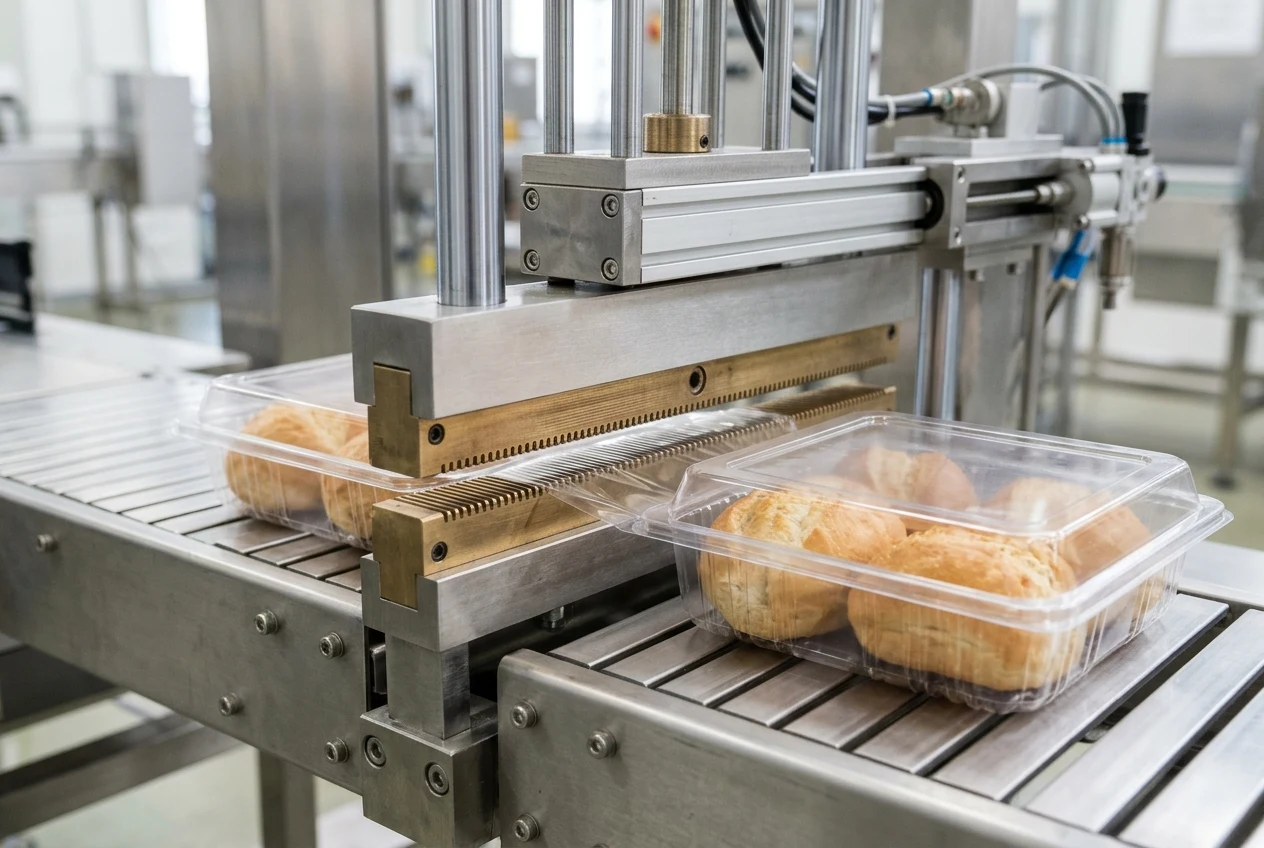
Across typical production lines, a standard long-dwell or reciprocating box-motion flow wrapper operates at 60–80 packages per minute on heavy barrier laminates, whereas a continuous rotary flow wrapper runs at 200–250 packages per minute with shorter dwell times. In like-for-like configurations, a box-motion flow wrapper carries a higher capital cost than a rotary flow wrapper because the reciprocating carriage requires a heavier end-seal structure, multi-axis servo motion control, and higher mechanical complexity.
| Sealing head family | Jaw motion profile | Primary film and pack fit | Typical speed & trade-off |
|---|---|---|---|
| Rotary end seal | 1–4 opposed crimpers per shaft rotating continuously across the web | Standard BOPP and thin heat-sealable webs on uniform products | 200–250+ PPM typical; brief dwell limits thick barrier laminates |
| Orbital / revolving Long Dwell | Orbital, oval, or twin-axis path synchronized with web travel | Barrier laminates, delicate mono-webs, and high-speed MAP packs | Up to 150–250 PPM (up to 1 s dwell on twin-axis); moderate clearance |
| Reciprocating Box Motion | Linear clamp-travel-open-return rectangle following the pack | Heavy OPA/PE laminates, paper/PE/PP mono-films, tall trays, MAP | 20–100 PPM typical; maximum hermetic dwell and vertical clearance |
Film Structure, Heat Transfer, and the Manufacturing Seal Window
During package sealing, heat acts to melt the sealant layer, time (often referred to as dwell) is the duration that the sealing jaws remain in contact with the packaging film, and pressure moves the melted sealant layer into any open channels. If total heat, time, and pressure falls short of the optimal seal window, a quality seal cannot be achieved and significant leaks will be present, whereas seal integrity and package appearance are degraded by excess heat, time, and pressure.
Our horizontal flow-wrapper sealing jaws maintain reliable sealing performance through independent PID temperature control, uniform pressure distribution, precise jaw alignment, and a defined dwell time. Upstream of the cross jaws, our fin-wheel assemblies provide synchronized film guidance and stable web transport to prevent slippage and wrinkles, forming airtight longitudinal fin seals in stainless-steel or thermal-alloy executions.
Unlike the Laboratory Seal Range, the Manufacturing Seal Range does not remain constant and narrows as machine speed increases and sealing time, or dwell, is reduced. Because temperatures dissipate as heat travels through the core layers to the sealant, thicker packaging materials require higher sealing jaw temperatures and/or more dwell time to activate the sealant layer. Wider packages or wider seal widths spread force over a larger area and dilute sealing pressure, while varying thicknesses at the fin or lap seal, gussets, and wrinkles (the Triangle of Death) create gaps that are difficult to seal without distorting or damaging the pack.
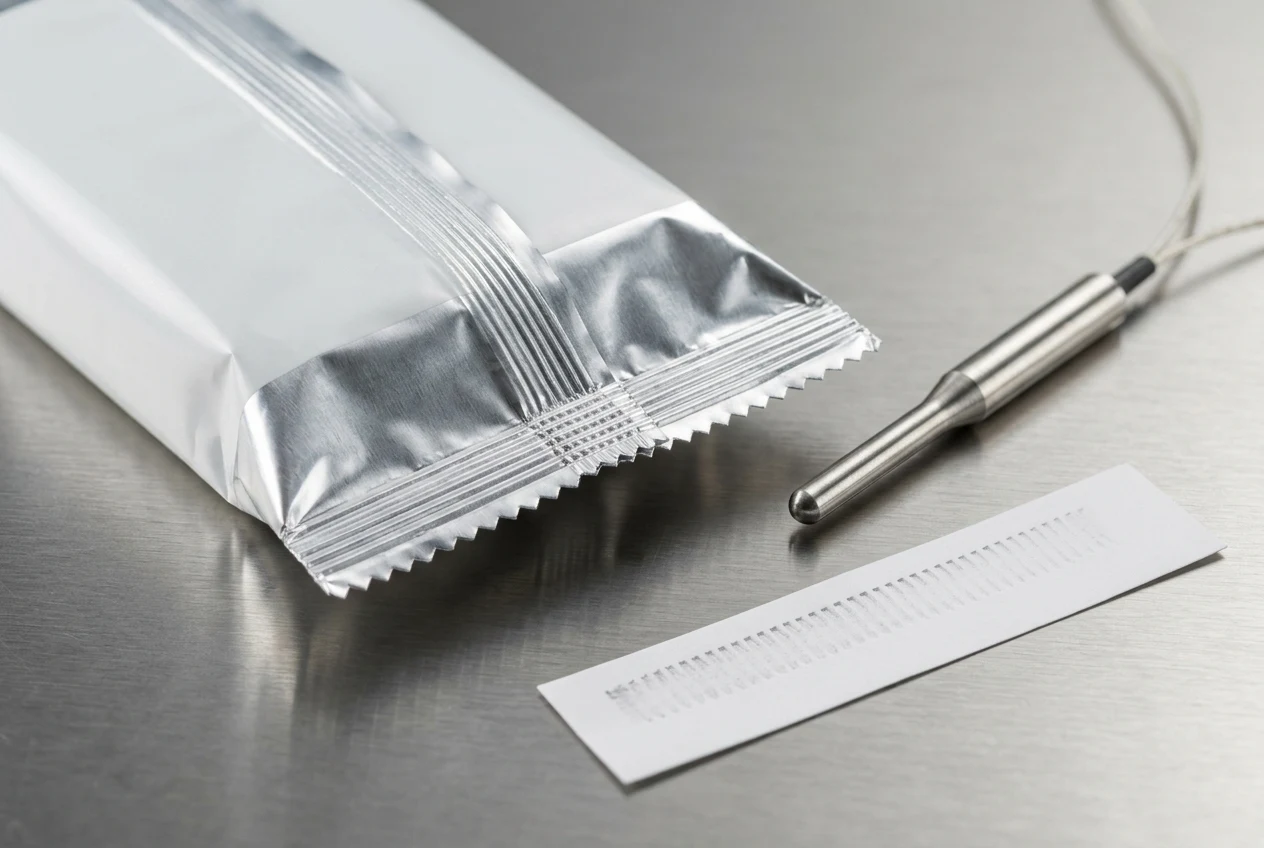
Converter data sheets reviewed in our crimp dwell and seal strength guide show that Torayfan PMX2 metallized BOPP has a typical Seal Initiation Temp (>200g/25mm) of 91 °C and a typical Heat Seal Strength @ 121°C of 430 g/25mm on a Sentinel Sealer model 12 ASL at 0.5 sec and 20 psi, with a typical Hot Tack @ 250 °F of 210 g/25mm. By comparison, FLEXOPP B-THL standard transparent heat-sealable BOPP film specifies a minimum Heat Seal Strength of 300 gm/25mm at 15 micron thickness, 375 gm/25mm at 25 micron, and 450 gm/25mm at 40, 48, and 50 micron. Printpack Preserve Compostable Heat Sealable Flow Wrap (2.1 mils gauge) specifies a typical Heat Seal Strength of 2800 g/in when sealed at 260F, 60 psi, and .25 sec.
Because a film supplier's temperature window is typically determined on a lab sealer with flat, non-serrated jaws, we calibrate the production seal window on the machine by dropping jaw temperature in increments of 5 °F (3 °C) until seal integrity becomes unacceptable and raising it until package distortion appears. Pair your material specification from our flow wrap film and sealing guide with an on-machine window check at target line speed. As detailed in our residual oxygen and gas flush guide, our MAP flow-pack configurations replace air inside the film tube by continuous gas flushing before sealing, achieving residual oxygen levels below 1% on carbon-dioxide and nitrogen-flushed packs.
Our Box-Motion and Long-Dwell HFFS Platform Configurations
In our horizontal flow wrapper lineup, we engineer reciprocating box-motion and orbital/revolving long-dwell configurations around pack dimensions, film barrier structure, and sanitation requirements:
- Standard MAP Box-Motion Platform: Produces a totally hermetic three-seal pillow pack for fresh food in modified atmosphere (MAP) using a reciprocating Box Motion sealing head driven by two independent servo motors. The recipe control system stores product height to automatically position the longitudinal sealing roller height and the cross-sealing jaw center, while top and bottom jaw temperatures are regulated on independent PID loops. "No product – no bag" and misplaced-product protection are standard, while film-specific sealing versions (BOPP, shrink film, or barrier laminates such as OPA/PE) and inline gas analyzers are configured to match the line brief.
- Compact Over-Pressure Box-Motion Platform: Incorporates a 2-meter infeed conveyor, motorized height adjustment of the longitudinal sealing assembly, and a box-motion cross-sealing station fitted with a pneumatic over-pressure nip system. Configurable options include an OPA/PE barrier laminate version, a BDF shrink barrier film version, print registration photocell tracking, and inline residual gas analysis. For wide or irregular products, our wide-frame box-motion execution fits 400 mm wide cross jaws driven by an independent servo motor, with a heavy-duty wide version supporting 550 mm wide jaws.
- Inverted Bottom-Reel & Top-Seal Vacuum Box-Motion Platforms: For soft, trayless, or difficult-to-push items, our bottom-sealing inverted box-motion configuration unwinds film from below with "no product, no bag" logic, independent upper/lower jaw heater control, and adjustable longitudinal weld height. For top-seal shrink and vacuum packs, our top-seal box-motion configuration pairs reciprocating end crimp and crimp slow-down control with vacuum evacuation, automatic film tension regulation, and film suction support.
- Mid-Web (470 mm) and Wide-Web (610 mm) Servo Reciprocating Series: Our 470 mm web box-motion configuration runs at 30–100 PPM across bag lengths of 150–400 mm, max film width 470 mm, max product width 190 mm, and max product height 70 / 100 mm (with 120 / 160 mm jaw clearance trajectory) on a 4.2 kW, AC 220 / 380 / 450 V 3-phase supply, complete with PLC control, PID temperature loops, a 7" color touchscreen with 50 recipe memories, and jaw overload protection. Our wider 610 mm web box-motion configuration runs at 20–70 PPM across bag lengths of 170–500 mm, max film width 610 mm, and max product width 250 mm, with optional end-seal gusseting attachments, gas-flushing lances, and full stainless-steel frames.
- High-Speed Orbital, Revolving, and Twin-Axis Long-Dwell Platforms: Where washdown sanitation and higher continuous speeds are required, our orbital Long-Dwell washdown platform runs up to 150 packs/min in top-reel, bottom-reel, or side-seal versions, while our open-frame revolving Long-Dwell platform reaches up to 250 products/min with a 10" HMI touchscreen. We also configure an oval-profile Long-Dwell head with optional inline residual oxygen analysis and automatic gas-flow regulation, as well as a twin-axis Long-Dwell configuration that applies heat gradually for up to 1 second of dwell time independent of machine speed—supporting pillow and gusseted formats with straight-cut seals and horizontal or vertical serrations validated through factory film and product trials.
| Subsystem | Specification to request in writing | Verification artifact before sign-off |
|---|---|---|
| Cross-sealing kinematics | Reciprocating box-motion vs orbital/twin-axis profile; 400/550 mm jaw width; 70–100 mm height clearance | Stroke clearance diagram and tallest-pack pass test |
| Thermal & pressure control | Independent top/bottom jaw PID loops, fin-wheel heaters, and over-pressure nip mechanism | Multi-point contact-pyrometer log and carbonless crimp impression |
| Film path & orientation | Top-reel vs bottom-reel inverted path, 470/610 mm max web width, and OPA/PE or BDF film kit | Production-speed trial on actual converter reel with fin-fold inspection |
| MAP gas flush & gusseting | Gas lance, inline O2 analyzer loop (<1% target), and end-seal gusset tucking attachment | Headspace O2 log, ASTM F88 peel strips, and ASTM F2096 bubble test |
Verifying Seal Strength and Hermeticity: ASTM F88/F88M and ASTM F2096
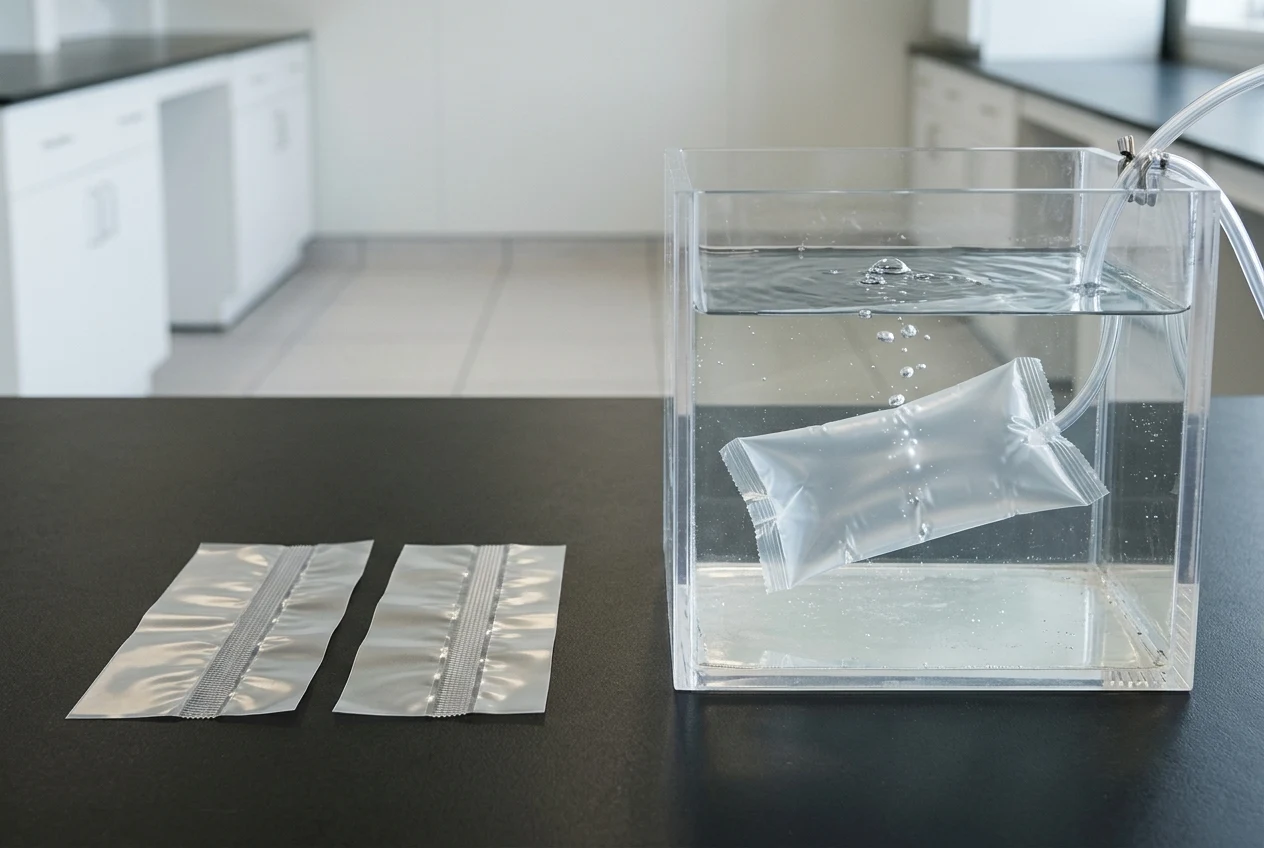
For destructive seal verification, the F88/F88M Standard Test Method for Seal Strength of Flexible Barrier Materials measures the force required to separate a test strip of material containing the seal and identifies the mode of specimen failure. Under F88/F88M, consistent use of one technique (Technique A unsupported, Technique B: Supported 90° By Hand, or Technique C folded 180° over the seal) is recommended across a test series.
To verify gross package integrity, F2096 internal pressurization bubble testing is used to detect substrate holes and channels in tray and pouch packages with a method sensitivity down to 250 μm (0.010 in.) with an 81 % probability.
Prepare Your Box-Motion Flow Wrapper Trial and Quotation Brief
We engineer and supply horizontal flow wrapping systems through LINEVO, the international project and systems engineering division of the Dession manufacturing group. In every quotation, we mark each proposed subsystem as standard, optional, not offered, or to be trial-verified. When requesting a quotation or sample trial, prepare your product dimensions (length, width, height, and tray profile), your converter film data sheet, your target accepted output, and your seal verification criteria using our flow wrapper requirements checklist.
Discuss your box-motion flow wrapper project on WhatsAppCommon Questions
Is a box-motion flow wrapper the same as a long-dwell flow wrapper?
Long dwell refers to extended jaw-to-film contact time, whereas box motion is a specific reciprocating rectangular jaw mechanism that clamps the web, travels linearly with the pack, opens, and returns. We also build orbital, oval, and twin-axis long-dwell heads that extend dwell up to 1 second at higher continuous speeds.
When should we choose a box-motion sealing head over a rotary sealing head?
Select a reciprocating box-motion head when running thick OPA/PE barrier laminates, paper-based webs, or recyclable PE/PP mono-films that need prolonged thermal transfer and over-pressure nip force, or when tall trays and 70–100 mm product heights require wider vertical jaw clearance at 20–100 PPM.
Why are gas flushing, gusseting, and barrier film versions listed separately on quotations?
Base machine frames include core protection logic such as no-product-no-bag and misplaced-product detection, whereas OPA/PE or BDF barrier sealing kits, end-seal gusseting attachments, gas-flushing lances, and inline residual oxygen analyzers depend on your exact film structure and headspace target. We itemize each module in writing as standard, optional, or trial-verified.
How should we validate hermetic end seals during a factory acceptance trial?
Verify jaw setup first with a multi-point contact pyrometer (calibrating in 3 °C / 5 °F steps) and carbonless impression strips, then test finished sample packs using ASTM F88/F88M peel-strength strips and ASTM F2096 submerged bubble leak testing down to 250 μm sensitivity.
Sources
- LINEVO Horizontal Flow Wrapping Engineering Standards — Rotary, Orbital Long-Dwell, and Reciprocating Box-Motion Sealing Systems
- Toray Plastics (America) — Torayfan PMX2 Metallized BOPP Film Technical Data Sheet
- Flex Films — FLEXOPP B-THL Transparent Heat-Sealable BOPP Film Technical Data Sheet
- Printpack — Preserve Compostable Heat-Sealable Flow Wrap Technical Data Sheet
- Linde Gas — Modified Atmosphere Packaging (MAP) Residual Oxygen Guidelines
- ASTM International — ASTM F88/F88M Standard Test Method for Seal Strength of Flexible Barrier Materials; ASTM F2096 Standard Test Method for Detecting Gross Leaks in Packaging by Internal Pressurization (Bubble Test)
Before you request a quote
Choosing Flow Wrap Film for Your Product and Machine
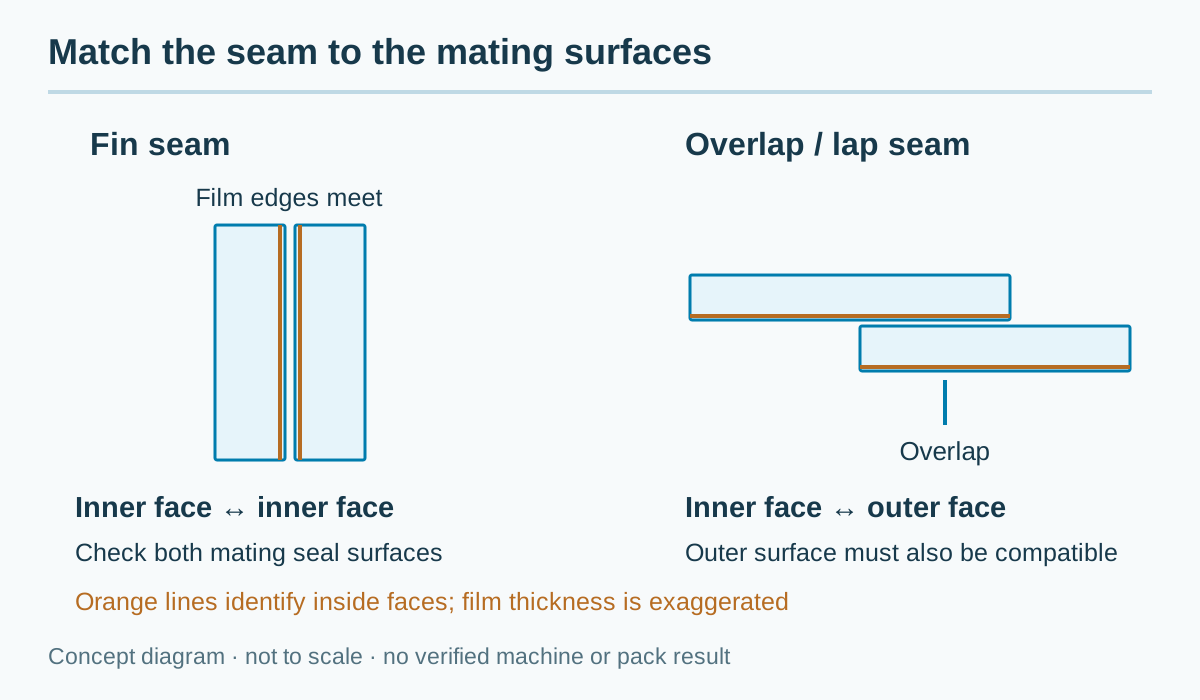
Choosing flow wrap film starts with the product and required seal. Gather the film specification, reel dimensions and samples for compatibility testing.
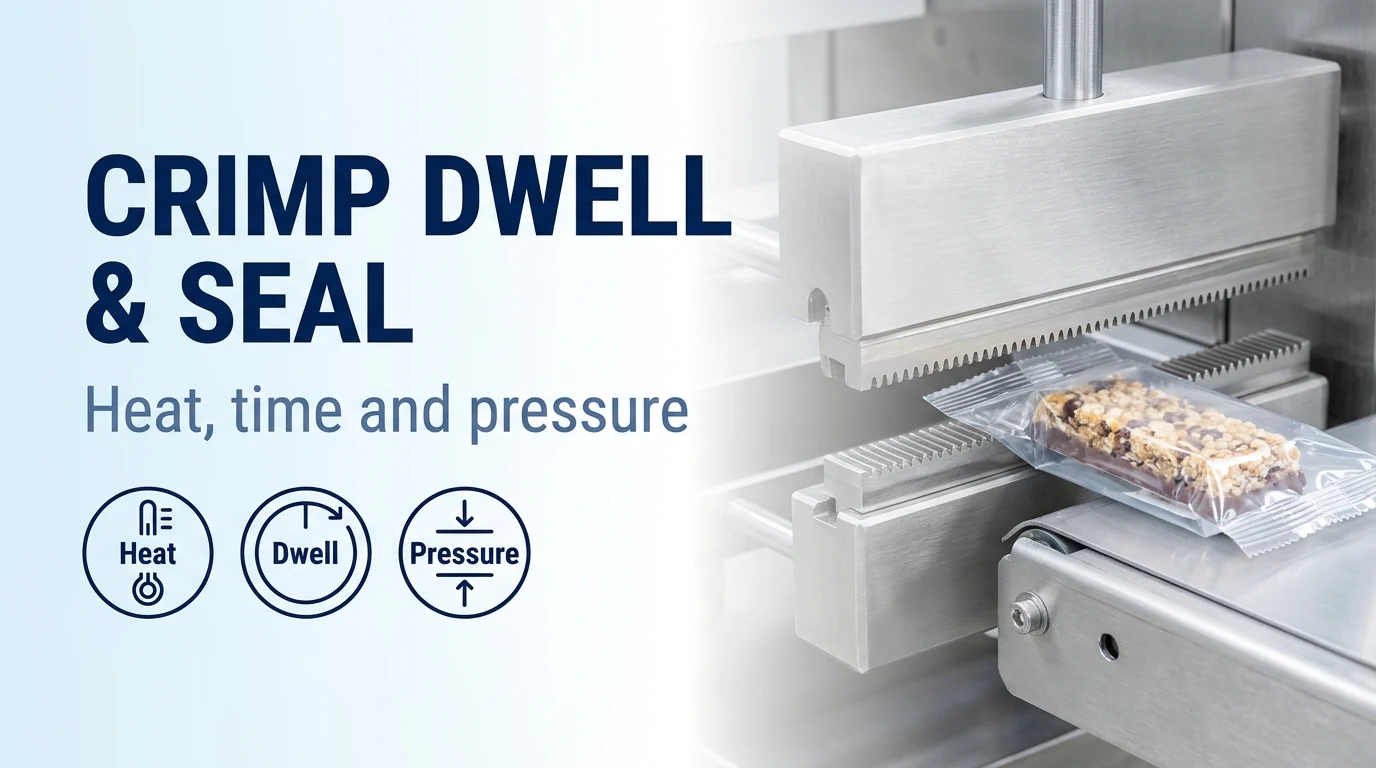
Flow Wrap Crimp Dwell Time, Jaw Temperature and Serration Pressure: Balancing Seal Integrity as Line Speed Increases
Balance flow wrap seal dwell, jaw temperature and serration pressure as line speed changes. Prepare film, crimper, pyrometer and seal-test records.
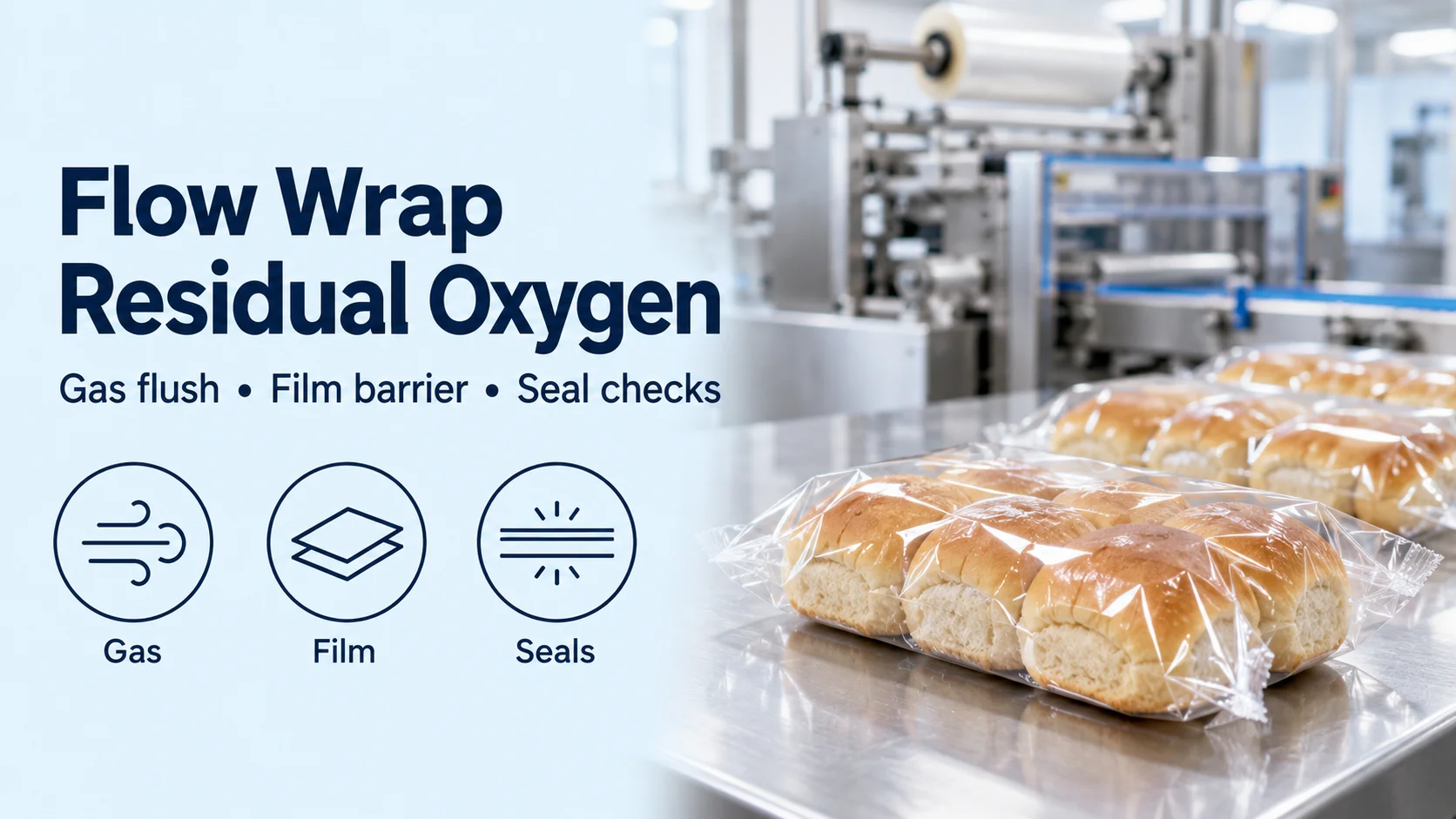
Flow Wrapper Gas Flushing and Residual Oxygen Control: Lance Geometry, Film Barrier and Cross-Seal Leak Prevention
Plan your flow wrap residual oxygen assessment: review the gas lance, bakery product, film barrier, cross-seals and finished-package testing.