
Cake, Muffin and Pastry Formats: Pillow Packs vs Vertical Bagging
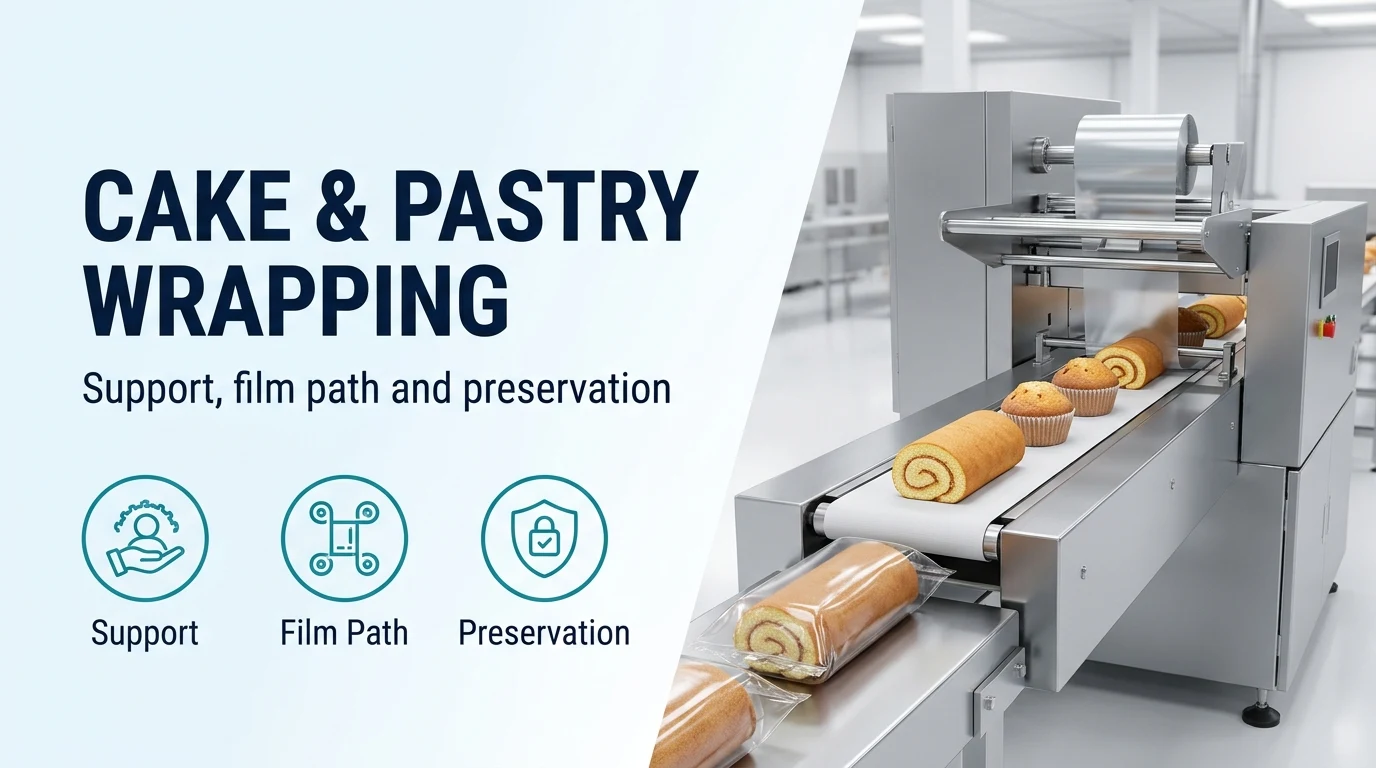
Choosing a horizontal flow wrapper for cakes, muffins, or pastries requires matching the product support and film path to the baked item so fragile surfaces avoid mechanical damage during transfer and sealing.
Soft sponge cakes and filled pastries can be squashed or dented when pushed by mechanical lugs too aggressively. Defining whether the baked item enters the line as an individual portion, a grouped multipack, a paper-cup muffin, or a trayed assortment determines the film path, lug pitch, and sealing head kinematics required to prevent product damage and seal contamination.
In our bakery horizontal flow wrapping (HFFS) portfolio, we configure pillow-pack lines for individual and multipack croissants, napolitanas, sponge cake rolls, snack cakes, cookies or waffles in tray overwrap, single cupcakes or grouped muffin packs, reclosable sliced cake assortments, and Modified Atmosphere Packaging (MAP) sandwich bread and pastries. Where prepacked mini-muffins are dosed as loose bulk counts into a steady flat-bottom bag with a clip closure, we route that format to a vertical form-fill-seal (VFFS) bagger rather than a horizontal flow wrapper.
For upstream bakery line preparation, review our bakery packaging machine guide and compare format boundaries on our cookie and biscuit packaging machine page and bread packaging machine page.
| Bakery product format | Handling & shelf-life risk | Infeed & film-entry path | Sealing & preservation setup |
|---|---|---|---|
| Sponge cakes, Swiss rolls & cream pastries | Compression or icing smear against metal beds | Inverted bottom-film carrier web (lug-less transfer) | Rotary D-cam or long-dwell jaws + sachet dispenser |
| Domed muffins & paper-cup cupcakes | Crown crushing or cup tipping at transfer | Single/grouped flighted HFFS infeed (or VFFS clip bag) | Box-motion or oval long-dwell jaws + MAP gas flush |
| Croissants, Danish & iced viennoiserie | Flake breakage; excess CO2 dissolving into fat/icing | Top-reel or bottom-reel HFFS with U-board or flat card | Hermetic long-dwell seal + balanced CO2/N2 MAP (<1% O2) |
| Sliced cake assortments & snack multipacks | Slice separation and rapid ambient mold growth | Flighted, belt, trough, or robotic pick-and-place loader | Reclosable barrier film + ATEX ethanol spray or absorber |
Top-Film vs Bottom-Film Conveying for Soft and Unstable Cakes
Bottom-Film Rotary and Inverted Long-Dwell Wrappers
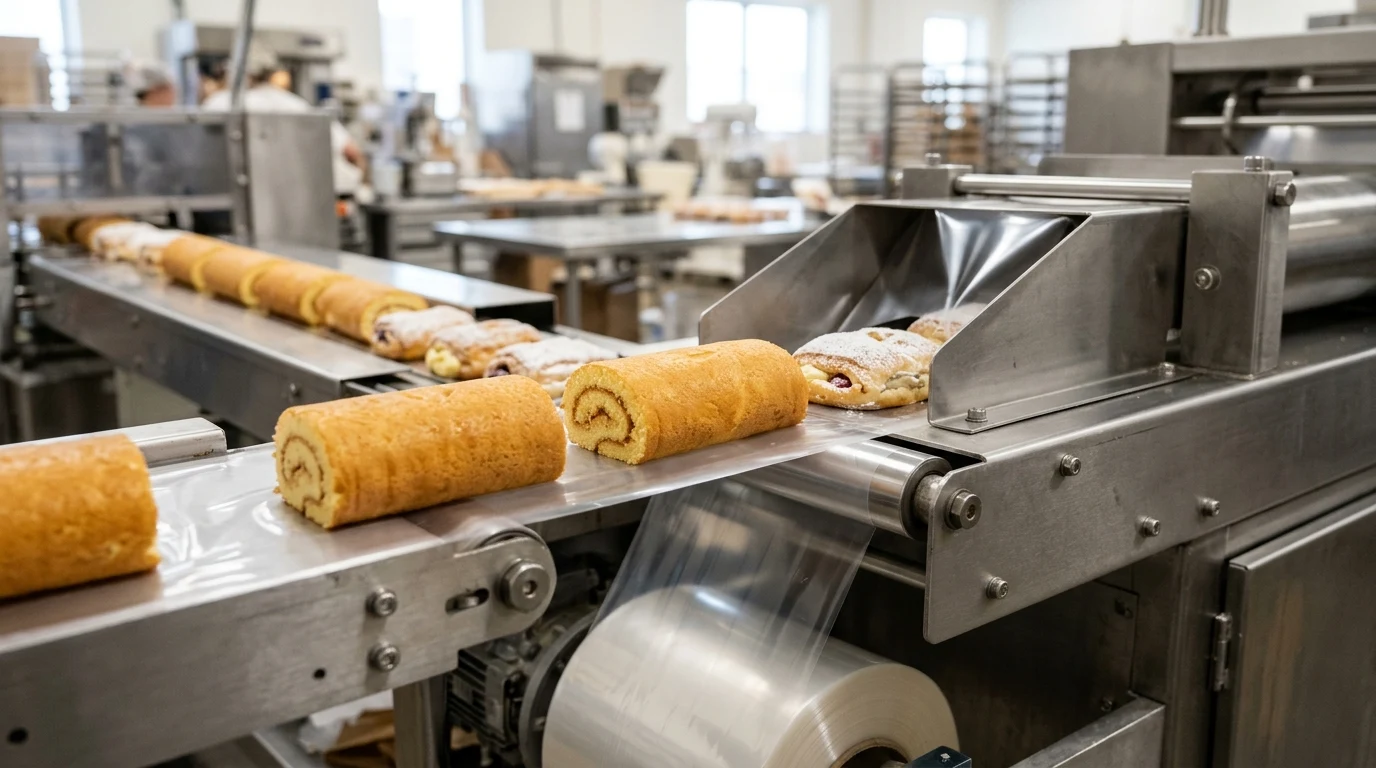
Conventional horizontal flow wrappers unwind film from above and push products across a metal infeed bed into the forming box with flighted chain lugs. When wrapping sponge cakes, soft or filled pastries, or sticky products, mechanical lug pushing can squash or dent soft products and sticky residue can build up on the metal infeed bed. Inverted bottom-film wrappers unwind the web beneath the product stream so the film itself carries the product toward the sealing area.
In our bakery equipment lineup, our Inverted Bottom-Film Rotary Platform forms a three-seal pillow pack specifically engineered for delicate bakery, cookie, chocolate, and confectionery products that are irregular or difficult to push across deadplates. Standard configuration includes a 2-meter left-to-right infeed conveyor, touchscreen parameter and fault diagnostics, and recipe memory for up to 99 machine setups.
For delicate, soft, or unstable bakery items requiring extended hermetic dwell, our Inverted Long-Dwell (ID) Platform combines bottom-film web transport beneath the product with a long-dwell cross-sealing head for Modified Atmosphere Packaging, integrating with flighted, lug-less, trough-style, and smart-belt feeders or robotic pick-and-place loading.
Top-Film Rotary Wrappers for Rigid or Trayed Bakery Items
When cakes, muffins, or pastries sit inside rigid trays or on stiff backing cards, our Top-Film Rotary Bakery Wrapper provides stable, high-speed feeding across a 2-meter infeed conveyor, pairing rotary cross-sealing jaws with an electronic overload safety switch, 99-recipe memory storage, and an optional D-cam jaw profile for thicker laminated barrier films.
Compare machine architectures in our flow wrapper types overview, measure the complete product assembly using our flow wrapper sizing guide, and evaluate loading interfaces in manual feeding vs automatic feeding.
Active Shelf-Life Subsystems: Oxygen Absorber Dispensers and In-Line Alcohol Spray
Spooled and Connected-Bag Oxygen Absorber Dispensers
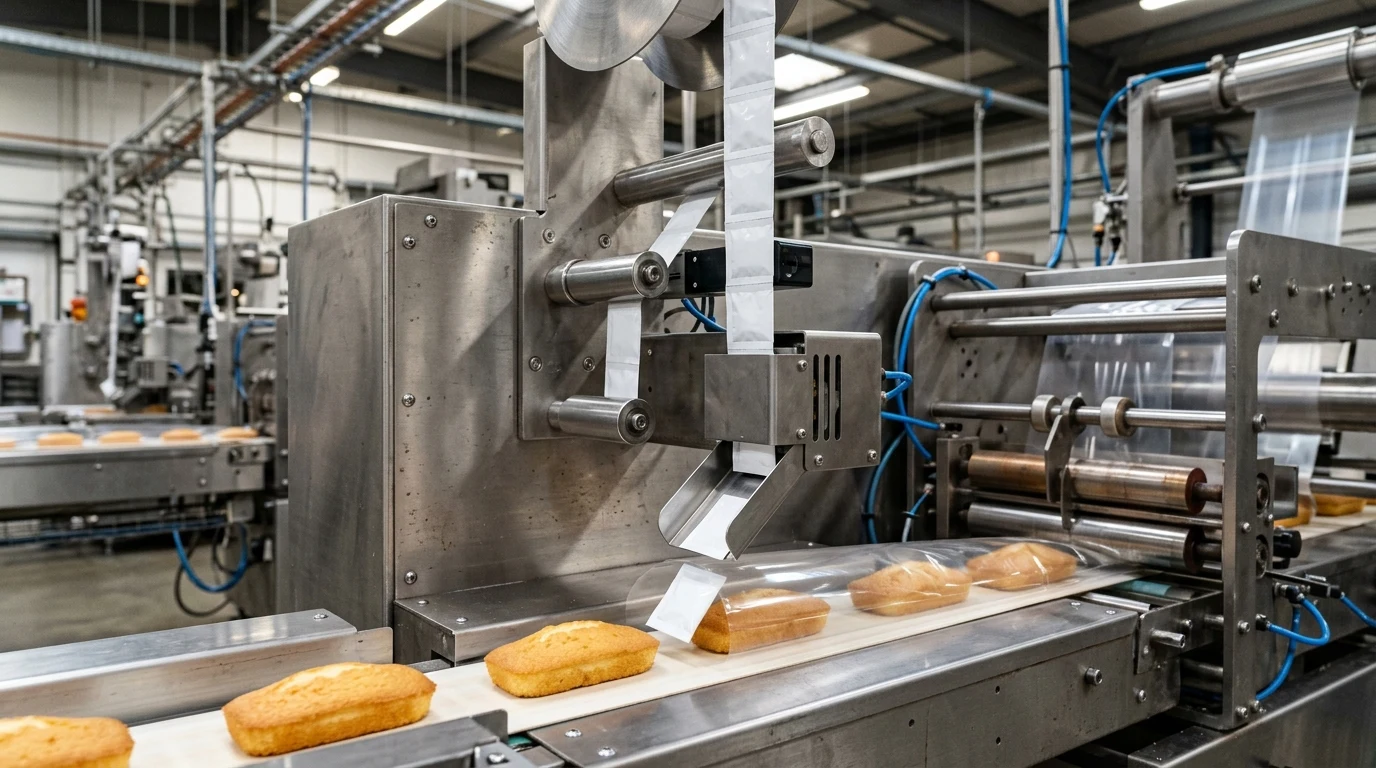
High-moisture cakes and filled pastries support rapid aerobic mold growth if residual oxygen remains trapped inside the sealed pillow pack. Bakeries targeting ambient distribution integrate automatic sorbent packet dispensers over the infeed conveyor or forming tube so each package receives an oxygen scavenger sachet before the transverse jaws close. Selecting a dispenser model requires matching the continuous packet feed rate, optical registration tracking, and knife cut timing to the wrapper cycle speed.
Our MAP bakery flow-wrapping lines integrate automatic oxygen-absorber sachet feeders as well as pre-evacuation gas-flushing modules that evacuate air before back-flushing protective gas. Depending on line speed and footprint, our engineering team interfaces with connected-bag or spooled sorbent dispensers:
- Connected-Bag Sachet Feeder Module: Uses photoelectric color-mark tracking and ultrasonic transverse seal detection with a positioning accuracy of ≤±1 mm, pairing stepper-driven web advance and electromagnetic cutting at speeds up to 200 packets/min.
- Spooled Active-Pak Automation (APA) Dispensers: CE-compliant spooled packet dispensers for HFFS flow-wrap integration include the Multisorb APA 700 (up to 80 ppm), compact APA 3400 (up to 100 ppm), low-speed APA 1000 (up to 135 ppm), mid-speed APA 1500 (up to 185 ppm), high-speed APA 2000 (up to 300 ppm), and food-grade APA 3800, as well as the ABOX Automation PD2XLE high-speed dispenser rated at 200 CPM with an optional nitrogen-purgeable unwind cabinet and humidity/oxygen monitors.
In-Line Alcohol (Ethanol) Spray Dosing Systems
Where visible sachets are undesirable inside retail cake packs, in-line food-grade ethanol dosing sprays a calibrated mist of alcohol onto a specific strip of the cake or inside the film tube immediately before sealing to create an antimicrobial vapor atmosphere.
Because atomized ethanol on an industrial bakery line (running up to 90 bags/min) creates an ignition hazard, our integrated dosing stations utilize ATEX-certified Spraying Systems PulsaJet nozzles (such as the AAB10000AUH-104208 cycling up to 25,000 times/min with Precision Spray Control and an AutoJet E2008+ controller) or Sealpump line-synchronized ethanol dosing units that lock directly into the wrapper's speed encoder and start/stop interlocks with recipe-specific dosing menus.
End-Seal Kinematics and Modified Atmosphere Packaging for Iced Pastries
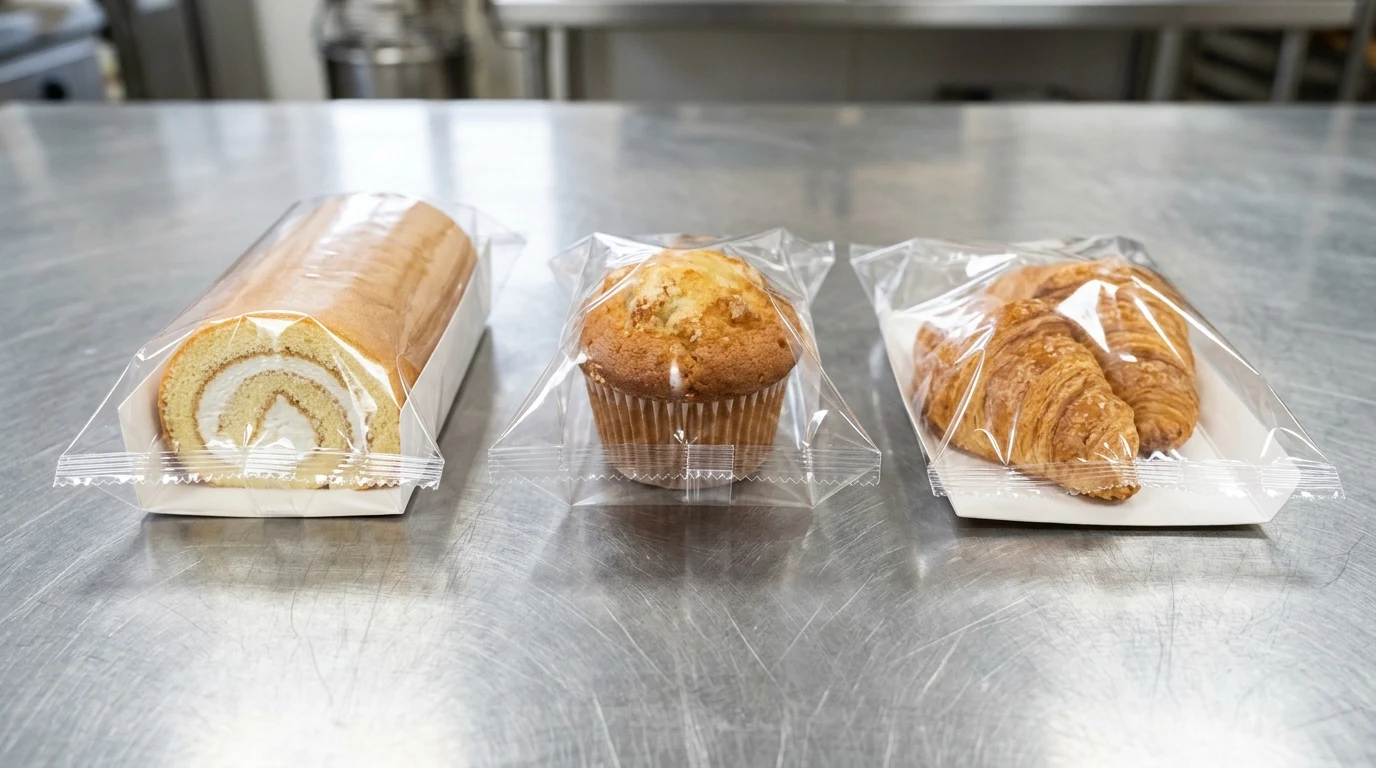
Achieving a hermetic bakery package depends on pairing the longitudinal fin wheels and transverse cross-sealing jaws with the thickness and sealant layer of the barrier web:
- Rotary D-Cam Sealing Configuration: Uses rotary cross-sealing jaws with an electronic overload safety switch and an optional D-cam motion profile to extend contact dwell on laminated barrier films.
- Twin-Motor Box-Motion MAP Platform: Produces a totally hermetic three-seal pillow pack for fresh bakery MAP applications using a reciprocating Box Motion sealing head driven by two independent servo motors. Recipe memory stores the product height for each SKU and automatically positions the longitudinal sealing roller height and cross-sealing jaw center, while independent PID temperature loops regulate each roller pair and the top and bottom jaws across BOPP, shrink film, and OPA/PE barrier laminates.
- Oval Long-Dwell MAP Platform: Features a Long Dwell cross-sealing station with an oval jaw trajectory in top-reel or bottom-reel executions, complete with gas-flushing lances and an optional inline residual oxygen analyzer with automatic gas-flow regulation.
Across all three platforms, synchronized fin wheels maintain wrinkle-free web guidance and airtight back seams while the cross jaws control temperature, pressure, and dwell time. Using Linde MAPAX carbon-dioxide and nitrogen gas mixtures, our MAP bakery configurations hold residual oxygen below 1% to inhibit aerobic mold growth.
For gas-flushing verification and film web geometry, see our residual oxygen and gas flush guide, flow wrap film guide, and film width and bag length calculation guide.
Food-Contact Film Layers, Machine Guarding and Trial Brief Preparation
Specifying a bakery flow wrapper for commercial production also requires verifying food-contact polymer sealant layers, antimicrobial dosing limits, and physical point-of-operation guarding around rotary knives, nip rollers, and heated jaws. Documenting the complete product envelope, carrier support, target line speed, and preservation method before factory acceptance trials prevents misalignment between upstream cooling conveyors and the wrapping station.
Under U.S. FDA 21 CFR regarding ethyl alcohol (ethanol), the ingredient is used as an antimicrobial agent on pizza crusts prior to final baking at levels not to exceed 2.0 percent by product weight. Under U.S. FDA 21 CFR on olefin polymers, ethylene-maleic anhydride copolymers containing no more than 2 percent by weight of copolymer units derived from maleic anhydride are permitted as the adhesive component in multilaminate structures or as the sealant layer in flexible packaging in contact with food at temperatures not exceeding 49 °C (120 °F). Under U.S. OSHA machine guarding requirements (29 CFR 1910.212), point-of-operation guarding protects operators around ingoing nip points, rotating parts, forming rolls, and guillotine/rotary cutoff knives.
As outlined in our bakery packaging machine hub, when preparing a trial brief for cakes, pastries, or wafers, photograph the product with any tray, paper cup, or U-board support in place, mark decorations, coatings, and edges that must stay intact, and confirm which feeding and support arrangements fit your line. Before shipping bakery samples for a wrapper trial, organize your pack dimensions, film structure, and line layout using our flow wrapper requirements checklist.
Discuss Your Cake or Pastry Flow-Wrapping Requirements
Share photographs of your cake, muffin, or pastry together with any paper cup, U-board, or tray, target pack arrangement, and shelf-life goal so our engineering team at LINEVO can configure the right feeding, film path, and sealing setup.
Message LINEVO on WhatsApp to review your cake packaging setup
When should a bakery choose an inverted bottom-film flow wrapper instead of a top-film wrapper for cakes?
Select our inverted bottom-film configuration when wrapping trayless sponge cakes, Swiss rolls, or cream-filled pastries that deform or smear against metal deadplates. Unwinding the web beneath the product carries the cake directly on the moving film into the forming shoulder without lug-chain compression.
How is an oxygen absorber sachet synchronized with a horizontal flow wrapper?
We mount a servo or stepper-driven sachet dispenser above the infeed or forming tube that tracks packet registration marks via photoelectric and ultrasonic sensors (≤±1 mm accuracy) and cuts one absorber per cycle at 80–300 ppm before the cross jaws close.
Why must carbon dioxide be balanced with nitrogen when gas-flushing iced pastries?
High CO2 concentrations inhibit mold at <1% residual O2, but excess CO2 dissolves into bakery fats and moisture, causing sugar glazes and fondant icings on Danish pastries to dissolve and weeping packs to collapse. Blending nitrogen as a balance gas preserves both icing appearance and pillow-pack cushion.
Sources
- LINEVO Bakery Horizontal Flow Wrapper Engineering Specifications — Top-Reel Rotary, Inverted Bottom-Film, and Twin-Motor Box-Motion MAP Systems
- Spraying Systems Co. — AutoJet and ATEX PulsaJet Precision Ethanol Spray Dosing for Bakery Lines
- Sealpump Engineering Ltd — Line-Synchronized Alcohol Dosing Systems for Bakery Packaging
- Multisorb Technologies & ABOX Automation Corp. — Active-Pak Automation (APA) and PD2XLE Oxygen Absorber Dispenser Specifications
- Linde Gas — MAPAX Modified Atmosphere Packaging for Baked Goods
- U.S. Food and Drug Administration (21 CFR) & U.S. OSHA (29 CFR 1910.212) — Food-Contact Polymer Sealants, Ethanol Antimicrobial Limits, and Machine Guarding Standards
Before you request a quote
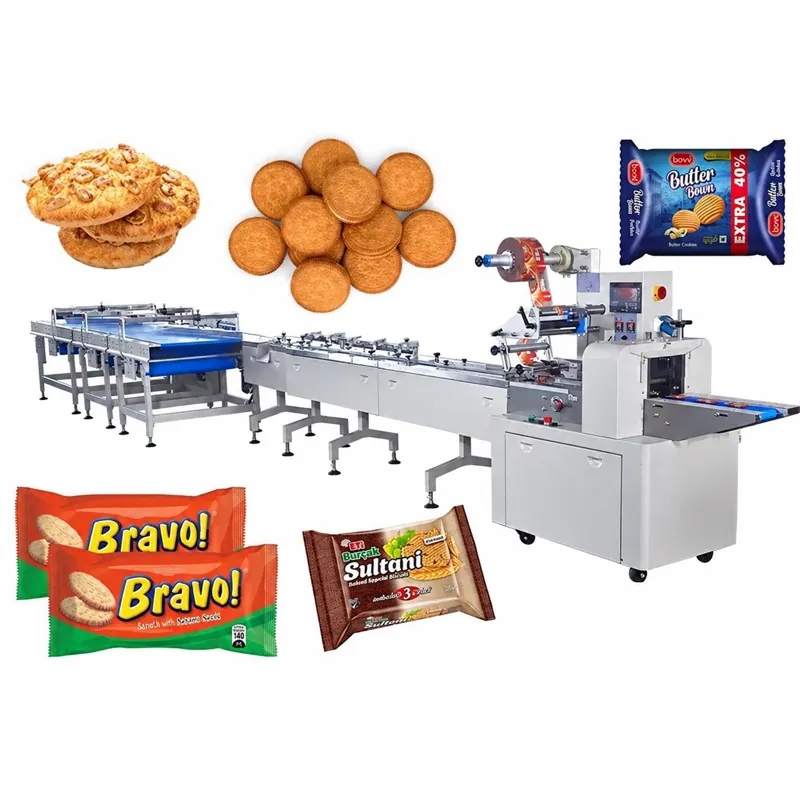
Cookie and Biscuit Packaging Machines
Cookie and biscuit flow wrappers from LINEVO. Configure feeding for single pieces, stacks or loaded trays, with product handling and seal checks.
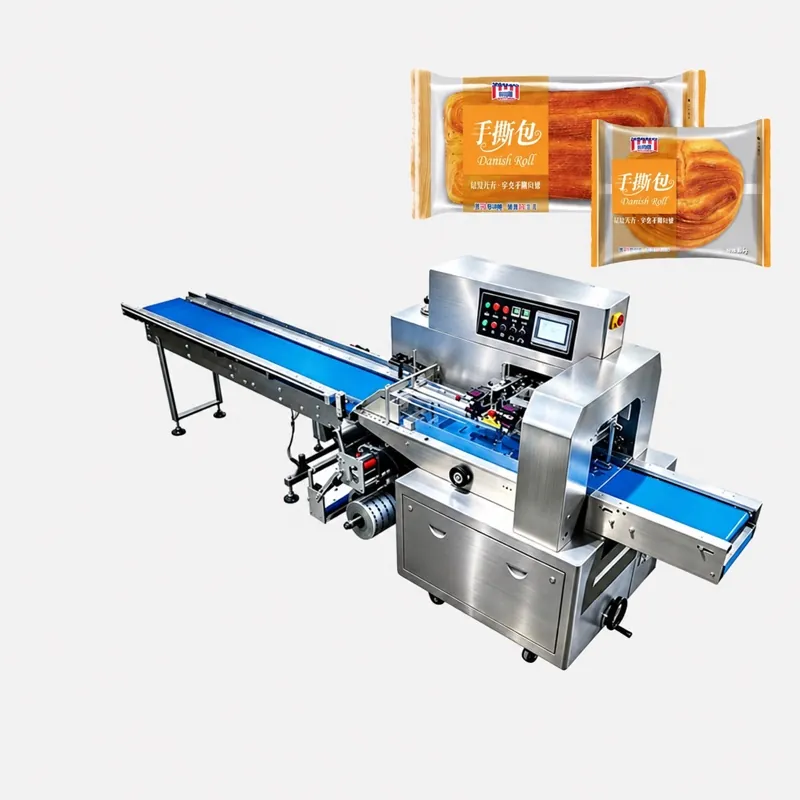
Bread Packaging Machines for Flow-Wrap Applications
Bread flow wrapping machines from LINEVO for loaves, rolls and prepared groups. Review support, film, product temperature and the required closure.
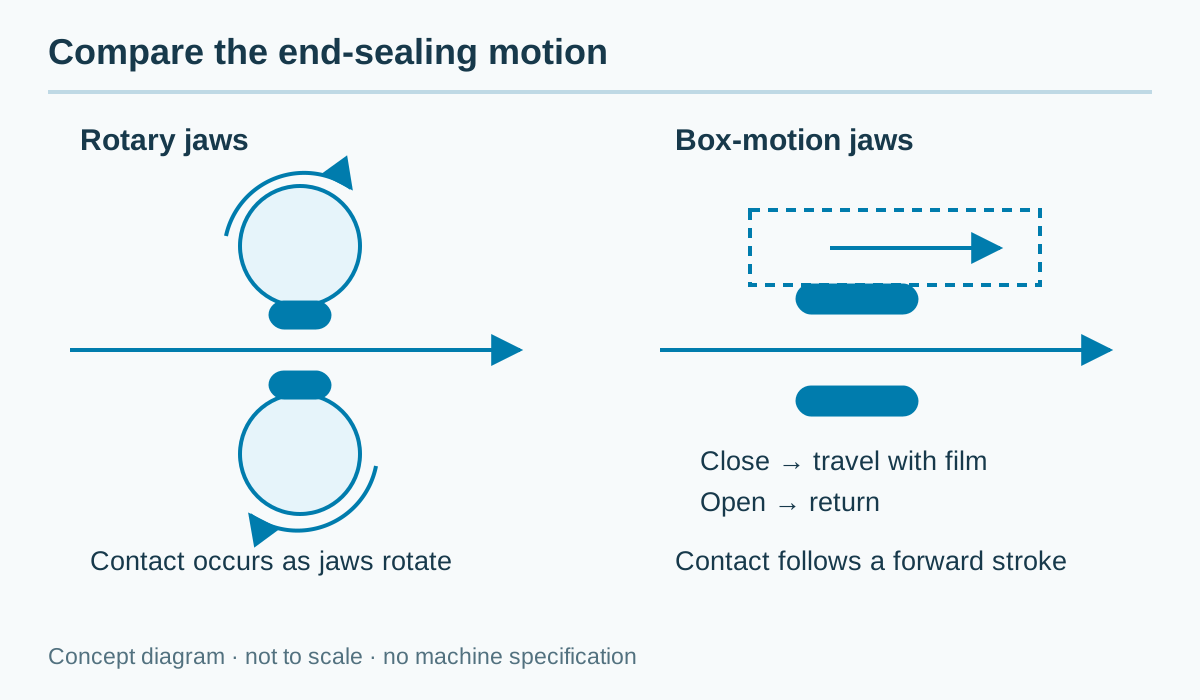
Compare Flow Wrapper Types and Configurations
Rotary or box motion? Top film or bottom film? Compare the feeding, film path and end-seal choices in a flow wrapper proposal.